
By John Kelly
The earliest known programme used at a GAA match, or tournament in this case, was produced for the First Grand Intercounty Contest played at the home of Charles Stewart Parnell in Avondale on 31 October 1886. The GAA was still in its infancy, and the All-Ireland football and hurling championships as a concept weren’t introduced until the following year, but tournaments between clubs from different counties were becoming popular and also became a kind of blueprint for the All-Ireland championships of 1887. The programme, as is common practice nowadays, listed the players and clubs from Wexford and Wicklow that played in that tournament. The cover of the programme names the officials for the event—general managers, umpires and timekeepers. A schedule of the matches and times of trains for supporters was also provided. The 1886 programme became the template for other match programmes, but no further programmes emerged until the provincial championships of 1913.
That year is significant because the GAA, realising the need to have its own grounds and headquarters, entered into negotiations with the then owner of the Jones’s Road site and former GAA president Frank Dinneen. The 1913 All-Ireland finals were played in November and December, but the sale of the grounds was only completed in late December 1913, after the championships had finished. The GAA produced programmes for both finals. The cover of the hurling programme states that the final was played at Jones’s Road on 2 November; the football final on 14 December was played at the same venue but by then it had been renamed Croke Memorial Park by the GAA in honour of the archbishop of Cashel, Thomas Croke, a first patron of the fledgling association. Further programmes were produced for the All-Ireland finals of 1914 and 1915 and followed a similar format.
Events overtook the GAA in 1916, however, as the country entered a period of revolution and political upheaval. Although the association continued to organise its competitions, match programmes—and sometimes the matches themselves—were less important, given the political climate of the time. For the next ten years programmes for GAA matches all but disappeared, and there were likely several reasons for this. Firstly, there was often an overlap between those who were active in the armed struggle of the War of Independence and the Civil War and those who were heavily involved in the GAA—a case in point being the infamous Bloody Sunday match played in Croke Park between Dublin and Tipperary on 21 November 1920, which had active Volunteers on both teams. Such players were surely reluctant to be named in a programme that would make them easily identifiable to the authorities. Another reason was that the volatile situation in the country meant that the GAA regularly failed to complete its championships on time during this period. The difficulties in scheduling matches had a knock-on effect on the production of programmes. A third probable reason was the breaking of printing presses, which was carried out during the War of Independence and the Civil War in an effort to prevent the spread of propaganda. Between 1916 and 1926, as the country lurched from revolution to civil war to state-building, sport and sports literature were hardly a priority, although within that period the GAA did manage to produce programmes for the All-Ireland football finals of 1920 and 1924.
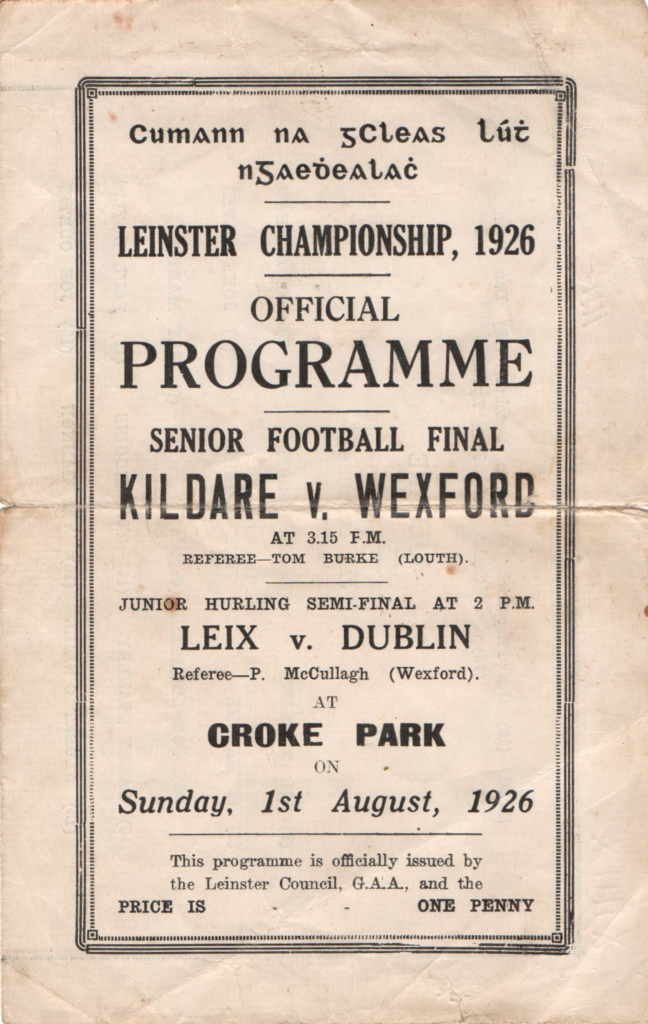
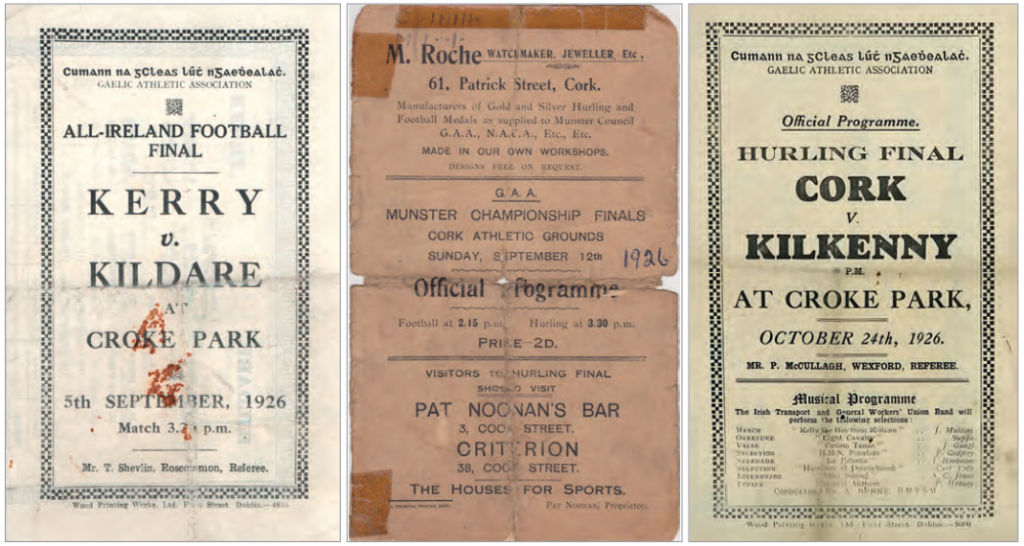
It was 1926 before the GAA got their All-Ireland championships back on track (the 1925 All-Ireland football championship was never completed) and it was also in this year that match programmes underwent something of a revival. The Leinster football final between Kildare and Meath played on 1 September was the first of these. The Munster hurling final between Cork and Tipperary was an epic saga, which took three matches to decide. Programmes for all three matches survive. The prolonged Munster final pushed the All-Ireland hurling final back to 24 October in 1926, and the football championship finished only a week earlier after the final between Kildare and Kerry required a replay before Kerry emerged victorious.
A full set of All-Ireland final programmes from 1926 until the present day exists, with only one exception. In July 1929 the GAA secretary, Luke O’Toole, died suddenly, but his successor was not appointed until the week of the All-Ireland hurling final, much too late to produce a programme. Pádraig Ó Caoimh, the new secretary, after whom the GAA grounds in Cork are named, compiled the programme for the All-Ireland football final three weeks later. His name, and later his signature, was printed on the cover of the programme, thereby marking it as the official programme for the matches.
John Kelly has an MA in Irish Regional History from St Patrick’s, Carlow College.