
A plaque commemorating the founding of the United Irishmen was unveiled in Belfast’s Clifton Street cemetery on Saturday 7 October by Douglas Gageby, former editor of the Irish Times and Patron of History Ireland, who said that the United Irishmen ‘were above all good people, brave people, people with aspirations for harmony among the people of this island’.
The veil over the plaque was a flag made for the 1898 centenary celebrations, which were an important part of the upsurge in nationalist awareness that led to the 1916 Rising. The plaque was erected by the Glenravel Local History Project, based in the neighbouring New Lodge area, whose members have been campaigning for years for the City Council to restore the cemetery and give it the status it deserves.
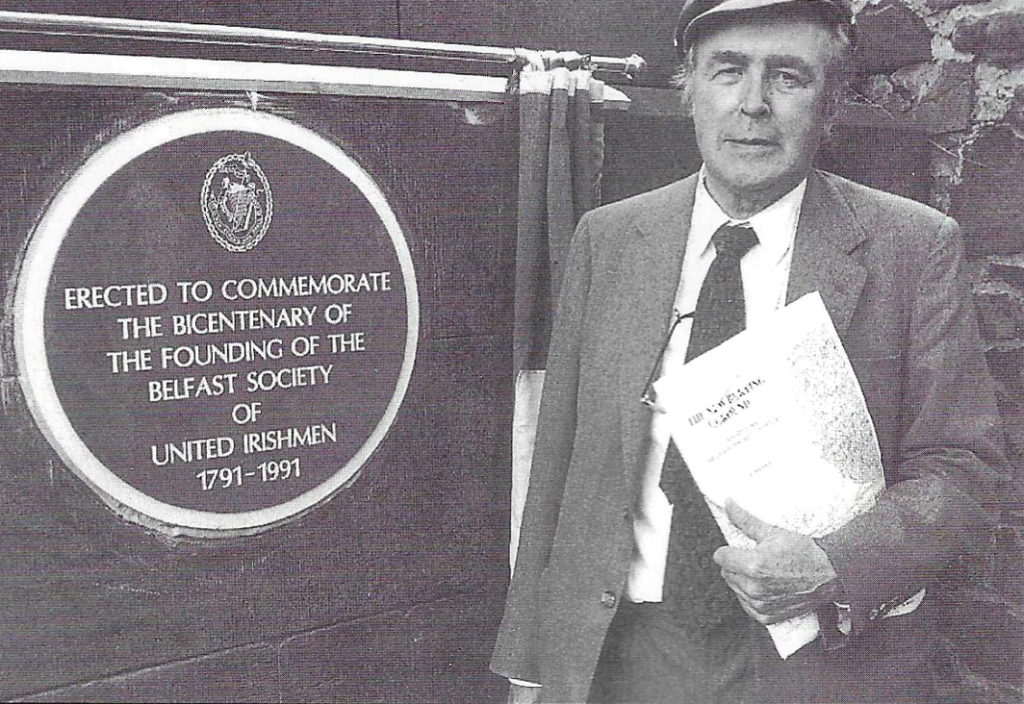
The cemetery contains several graves of leading United Irishmen, and the plaque has been erected on the most famous one, that of MaryAnn McCracken and her brother Henry Joy. Mary Ann was a sworn member of the movement, and went on to become famous for her unstinting work for Belfast’s poor. As Douglas Gageby said, ‘At the age of eighty she was handing out pamphlets in the Belfast docks against slavery’.
Even better known is Mary Ann’s brother, Henry Joy, who was born and brought up in Belfast’s High Street, fought at the battle of Antrim, and was executed in High Street after his capture in July 1798.He was originally buried in High Street, but what are believed to be his bones were removed in 1902 and later reburied in the grave of his sister.
The cemetery is at Carlisle Circus a few minutes walk from Belfast city centre, and is well worth a visit. Originally owned by the Poor House, it is non-sectarian and encapsulates the history of the city. Here lie rich and poor, the famous and obscure. There are the vaults of prosperous business families, such as the Dunvilles, and unmarked expanses of grass which cover the remains of some 11,000 poor people, many the victims of the Great Hunger of the 1840s. Other United Irishmen buried here are William Drennan, William Steele Dickson and Robert and William Simms. From the cemetery there is a clear view of Cavehill, where the Simms brothers and Henry Joy McCracken were present at McArt’s Fort along with Wolfe Tone and Thomas Russell when the famous pledge to struggle for Ireland’s independence was taken.
The Glenravel History Project organises tours of the cemetery for schools and other groups, and can be contacted at the Ashton Centre, Belfast, tel: (01232) 742255.