
MIKE HENNESSY
Thirsty Books
£25
ISBN 9781739318185
Reviewed by
Niall Whelehan
Niall Whelehan is a historian and part of the Modern Irish History group at the University of Strathclyde, Glasgow.
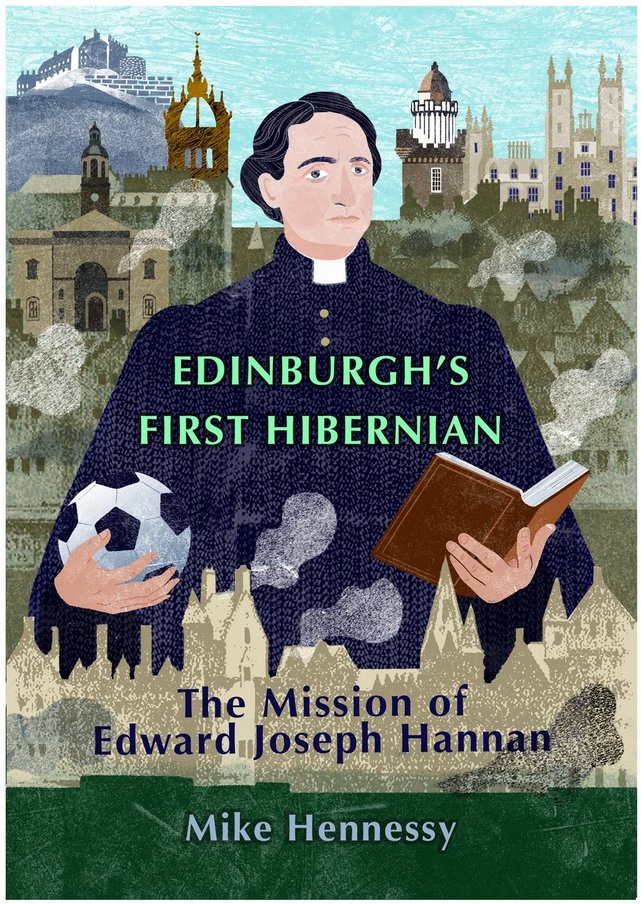
When football and the history of Irish migration to Scotland are mentioned, most minds would turn to Celtic FC, the Glasgow club with the global following. Yet the original Irish team in Scotland were Hibernian FC, founded in the Cowgate, or Edinburgh’s ‘Little Ireland’, in 1875. As Mike Hennessy states in this new study, ‘Hibs were the first visibly Irish football club in Scotland’ and ‘support was drawn from the Irish working classes throughout Scotland’. Hibs were co-founded by two immigrants, the missionary priest Edward Hannan and first club captain Michael Whelahan. The former is the focus of this interesting biography. Hannan’s story, and the story of Hibs, presents a fascinating window into the history of the Irish diaspora in Scotland.
Hannan, a missionary priest produced by All Hallows College, Dublin, arrived in Edinburgh in 1861. Born in Ballingarry, Co. Limerick, in 1836, he was the second son of dairy farmers who prospered after the Great Famine. Despite the family’s comfortable status, several Hannan siblings emigrated, mostly to Australia, with another brother also becoming a priest in Scotland. Hennessy suggests that Hannan’s memories of the Famine and the influence of his local parish priest, Michael Fitzgerald—an advocate for the poor and a disciple of O’Connell—shaped both his pastoral and his political outlook.
On arrival in Edinburgh’s Cowgate, then a predominantly, but not exclusively, Irish neighbourhood, Hannan confronted grinding poverty, overcrowded tenements and disease. At least three fellow priests died from fever, while Hannan survived a bout of typhus. The industrious Hannan soon set about expanding the Church’s educational and institutional presence in the city through fund-raising, often from wealthy Scottish Catholics, including the aristocrat and industrial magnate John Crichton-Stuart. In Hannan’s 30 years in Edinburgh his projects were often successful, albeit he had a ‘cavalier attitude to spending money’ and the parish finances were in bad shape when he died in 1891.
Hibernian FC was co-founded by Hannan in the Catholic Institute in the Cowgate on the centenary of Daniel O’Connell’s birth in 1875. From the outset it was tied to Hannan’s Catholic Young Men’s Society (CYMS). The first team was an even mix of Irish- and Scottish-born players, and all were required to be practising Catholics. Initially this worked against their recognition by the Scottish footballing authorities owing to anti-Irish Catholic prejudice, but they were accepted by 1876. The first reported Hibs match was played against local rivals Hearts of Midlothian on Christmas Day 1875 in a public park. Most early matches were charitable fund-raisers, with the proceeds directed to poverty within the parish. Some matches had a physical edge. Hearts complained of Hibs’ ‘brutal play’ and ‘rough usage’ in 1878. One Hibs fan was ‘Burly’ Dan Fyfe: ‘Everywhere Dan went, he always had a shovel over his shoulder and sometimes it came in handy as a weapon’. An 1884 match report noted that ‘The Bo’ness club is composed of Orangemen … Nine of the eleven Hibernians returned home severely beaten’. For Hannan, match day violence was unwelcome. He viewed Hibs, like the CYMS, as a vehicle to advance respectability. Within a few years the club became one of Scotland’s top teams, winning the Scottish Cup in 1887.
Within this male Irish diaspora community, the extent of overlap is striking between Hibernian FC and other societies. The ubiquitous Hannan connected various groups, but so did many others, such as Michael Flannigan. He served as president of the CYMS, an Irish National League branch and Hibernian FC. His roles also extended to the Liberal Party, and he became Edinburgh’s first Catholic city councillor. Not only did different Irish groups contain the same faces but also most meetings were held in the Catholic Institute, which gave Hannan oversight of developments.
Despite this consistency of people, tensions did occur around the separation of politics from Catholic-affiliated societies. William Smith, the archbishop of St Andrews and Edinburgh, called for the condemnation of the Plan of Campaign in the 1880s, and removed Flannigan from the CYMS when he voiced support. Bitter recriminations from both sides followed. Hannan’s own nationalist views are elusive: he was not vocally nationalist but made occasional public comments about his hopes to ‘see Irish people making their own laws, ruling a country which Irish people know better than anyone else’.
The best-known son of ‘Little Ireland’ is James Connolly, and a welcome aspect of this book is the more sober assessment of his links with Hibs than in some previous studies. Club folklore might claim that he was a ballboy or present at meetings in Hibs’ first years, but Hennessy highlights how little evidence there is for this. It was unlikely that the adult Connolly viewed Hannan or the CYMS positively, as the latter was a vehicle for the working classes to become respectable within the system rather than rebelling against it. Yet from surviving letters we know that Connolly was an avid Hibbee and undoubtedly attended matches.
Any biography of Hannan presents challenges because he left few writings behind, but Hennessy diligently reconstructs his life using an array of sources. There is inevitably informed speculation about his life, which the book does well, though generally in a sympathetic light. Overall, this is a well-researched study of Hannan that fills a gap in our knowledge of Edinburgh’s ‘Little Ireland’. It is essential reading for all involved in Hibernian FC, a club that, in recent times, has not always engaged with its Irish roots.