
A new acquisition by the National Library of Ireland sheds light on the final months of Lord Edward FitzGerald’s widow.
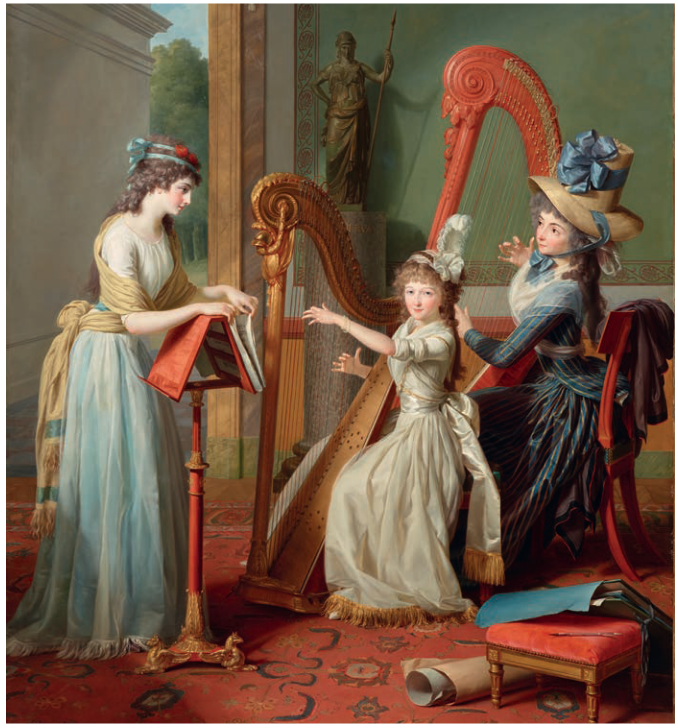
By Marie Stamp
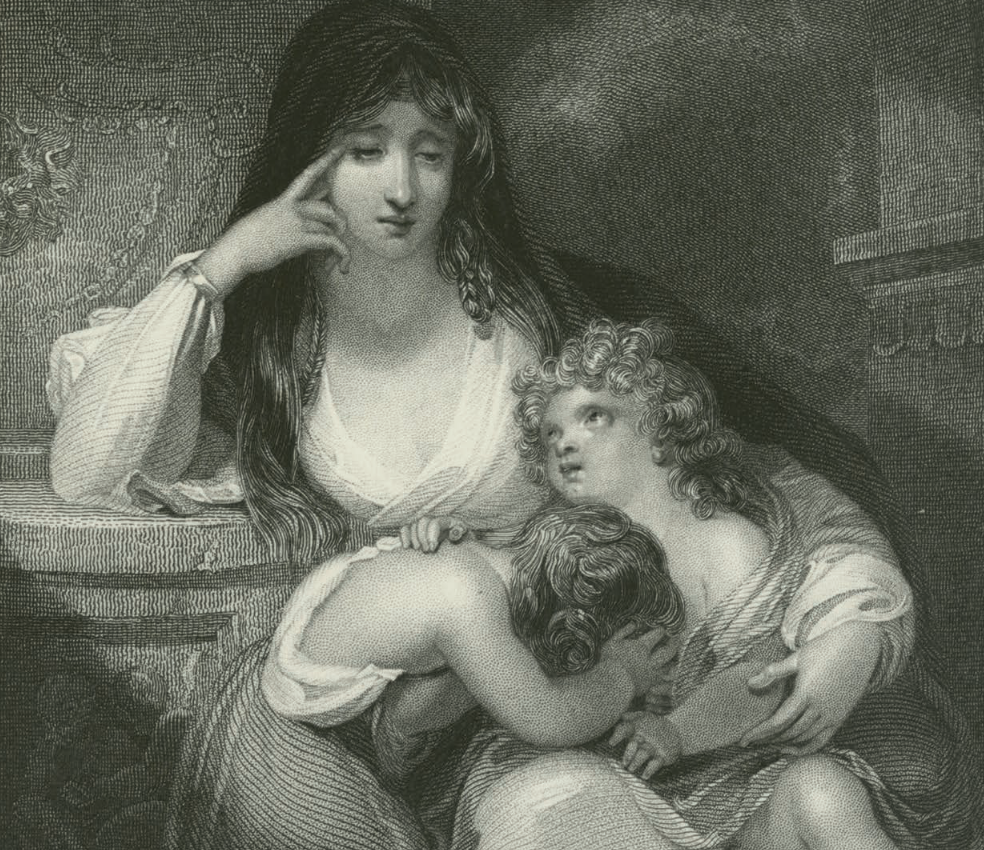
In August 1798 Lord Edward FitzGerald’s widow, Pamela, left the protection of his uncle, the Duke of Richmond, for refuge in Hamburg. ‘Lovely in her appearance, great in her character, persecuted, ruined and banished—her name so well-known as to be brought into the history of the country’, Pamela’s place in Irish history ended in 1798, but her bereavement remained a powerful symbol for Irish nationalists for generations. An imagined portrait of her and her grieving children became a popular print and fixed her public image at that point. In 1848 the United Irishman lamented that Pamela FitzGerald had died ‘starving in an alley’ of the French capital where once she had ruled like ‘a Republican queen’—but all this was far from the truth, as new evidence can attest.
NEWLY DISCOVERED EVIDENCE
A letter discovered by Dublin antiquarian Éamonn de Búrca and acquired in 2024 by the National Library of Ireland (https://catalogue.nli.ie/Record/vtls000926274) provides important insight into Pamela’s life and social circle in post-Restoration France. Written by her from Montauban at the end of May 1831, five months before her death in a hotel in Paris, it provides closure to the story of Pamela FitzGerald’s fascinating life and exile. Her circuitous path from Dublin to Montauban began 33 years earlier with an order to leave Ireland after Lord Edward’s arrest. She hurried to London with her children before rebellion broke out on 23 May 1798, but England would not offer asylum. Richmond defied government orders by offering his protection at Goodwood, but Pamela’s position was about to become even more precarious.
Lord Edward died in prison on 4 June before being tried for any crime, yet the Irish government was sufficiently persuaded of his guilt to pass an act of attainder against him that summer, posthumously seizing all his property and possessions. Attainder and execution were corollary punishments for treason, and this act had the effect of a judicial conviction. Pamela not only was dispossessed but could also potentially face charges for abetting a ‘convicted’ traitor and a hanging sentence.
BACK STORY
Her guilt was broadly assumed, except by those who knew her intimately, because of her extraordinary back story. Pamela was an English girl who had grown up in France from the age of six, when Madame de Genlis (the acclaimed author, educator and governess to the daughters of the Duc d’Orléans) raised her with the duke’s children to help them learn English. Owing to Orléans’s notorious reputation, it was widely believed that Pamela was his illegitimate daughter by Madame de Genlis, and when he voted for Louis XVI’s execution in 1793 Pamela was assumed to be as regicidal as he. This did not mean that France offered Pamela any refuge in 1798. Orléans had been guillotined in 1793; his offspring, Madame de Genlis and her relations were all living in exile. Pamela preferred to join them, and it was her decision to leave ‘little Eddy’ (b. 1794) and ‘baby Lucy’ (b. 1798) in the care of their English relatives and to depart with ‘little Pam’ (b. 1796) for Hamburg with a small sum from the FitzGeralds.
She was welcomed in Hamburg by Henriette Mathieson, niece of Madame de Genlis and Pamela’s childhood friend. The Mathiesons’ wedding in 1796 had been the alibi for Lord Edward’s journey to Hamburg that year; Pamela had stayed with Henriette while he travelled to the French border with Arthur O’Connor for secret negotiations to bring French troops to Ireland.
In 1800 Pamela married Joseph Pitcairn, the United States’ Scottish-born representative to the free city of Hamburg. They had a son whose short life was over before 1805, and a daughter named Helen, born in 1803, when the first hints of Pitcairn’s cruelty and Pamela’s misery appeared in a letter to her children’s aunt, Lady Sophia FitzGerald. Asking for money for ‘little Pam’, she begged: ‘Send me that sum of money, otherwise very disagreeable things will happen to me’.
An end to the blockade between Britain and the Continent in 1806 finally provided Pamela with an opportunity to escape. As Mrs Pitcairn, she travelled unnoticed to England with ‘little Pam’ to be reunited with her children and Sophia in Worthing. In no hurry to return to Hamburg, she headed back to France. Madame de Genlis and other former exiles had returned to Paris, and Pamela hoped for their support and the reinstatement of her small ‘pension’ for her service to the Orléans family. Her return to France using someone else’s passport scandalised Madame de Genlis, but Pamela refused to return to her husband. Pitcairn sent their daughter to his aunt in Scotland and told the girl that her mother was dead. They never saw each other again.
‘LADY EDWARD FITZGERALD’
Apart from a short stay in Vienna, Pamela remained in France for the rest of her life, resuming the identity of ‘Lady Edward FitzGerald’. She encouraged the belief that she was the illegitimate daughter of the wealthy Orléans, persuading several merchants to offer her credit. In the crisis that followed her non-payment, she hid in a secluded cottage outside Paris and was broken-hearted when ‘little Pam’ had to be sent back to England. Her reckless behaviour led to a profound rift with Princess Adélaïde of Orléans, who discovered Pamela’s debts when the Orléans property was restored in 1815. The rift also caused an estrangement with Lord Edward’s niece Isabella, who had married the Vicomte de Chabot and was lady-in-waiting to the princess.
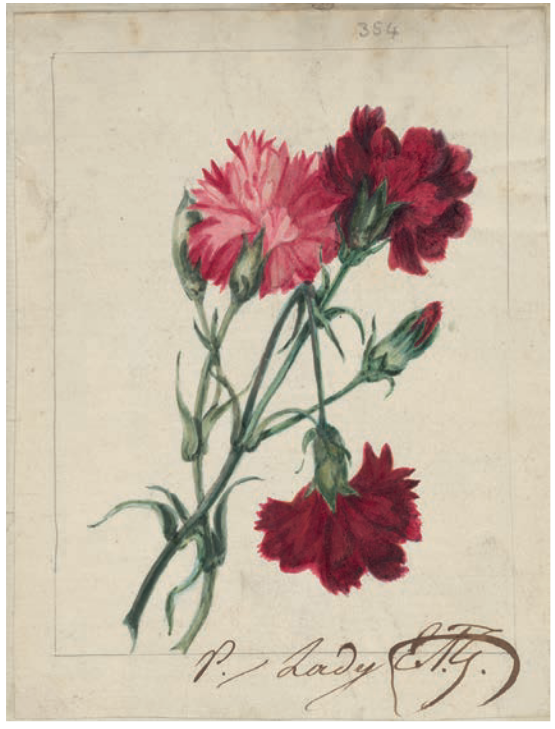
Madame de Genlis stepped in, and a lawyer was retained to manage Pamela’s small pension income and keep up her payments. Living alone in her cottage, Pamela sold her watercolours and small crafts to any friends who would buy them, until she was gradually able to resume a social life in Paris as a long-term lodger with the nuns at the Abbaye-aux-bois. The convent was also open to temporary guests, including noblewomen of the ancien régime who became Pamela’s friends; one of these women introduced Pamela to Louis-Joseph Nompar de Caumont, Duc de La Force. Charmed by her often-remarked plumpness and good looks, he was the affectionate friend who remained devoted to her until the end of her life, and it was from his home that she wrote the letter now in the National Library.
NOT A ‘REPUBLICAN QUEEN’
Pamela’s enduring relationship with La Force puts paid to any lingering doubts about her presumed republicanism. La Force was from a family of staunch monarchists; one of his sisters had had sitting privileges in the court of Marie-Antoinette, escaped to London during the revolution and had a child with the Prince of Wales. La Force had served as an officer under Bonaparte, but from 1815 he remained a monarchist—even during the Hundred Days of the emperor’s return.
Around 1820 La Force persuaded Pamela to move to Montauban, where he possessed a house and gardens and a secondary property named ‘Chambord’, where he installed Pamela in her own apartment. Living separately, they avoided any display of impropriety, although La Force’s estranged wife might have had other opinions. Almost nothing is known about Pamela’s time in Montauban, and there has never been an explanation for why she was in a hotel in Paris when her life ended on 7 November 1831. This newly discovered letter finally brings that last chapter of her life into clearer focus.
THE LETTER
Addressed to an unnamed ‘prince’, the letter is undoubtedly intended for Pamela’s childhood companion and classmate Louis-Philippe d’Orléans, brother of Princess Adélaïde and king of France since July 1830. It responds to a verbal message delivered to her from him through an intermediary, a Mr Daure. Hector Daure was a senior army veteran who had been recalled by Louis-Philippe’s minister of war to serve in his new government. A purge of top military command was a significant feature of the new regime in 1830, and official army business at the king’s bidding could have been the reason that Daure visited Montauban to meet with La Force. The two were old comrades, having both served in Napoleon’s campaign in Russia in 1812.
Pamela had been heartened by the king’s message and by the opening of direct communication with a powerful man who might grant her an important favour. She wrote a request to the British prime minister, Lord Gray, and included it with her letter to the king, asking him to support it. The enclosed request is now missing, but she mentions her ‘merits’, hinting at a desire to clear her name of criminal charges in England, where her children and grandchildren lived. She also mentions her persistent creditors, which suggests that she could not have afforded a return to Paris without the continued support of her friends.
Daure’s visit provides a clue that La Force might have had career-related reasons to sell his property in Montauban shortly after this letter was written, and to return to Paris with Pamela that summer. In the capital, they stayed in separate apartments at La Force’s preferred Hôtel du Danube near the church of the Madeleine and near his sister, the Comtesse de Balbi. Pamela attended the comtesse’s salon just days before showing signs of a serious unexplained illness. She did not want La Force to see her in such a condition and begged only for a priest and for a visit from Lord Edward’s niece, Isabella.
Madame de Genlis had died in 1830, but her niece, a poor musician named Georgette Ducrest, attended Pamela in her final days. For years Pamela had been sending a charitable gift of 300 livres per year to Georgette, who was shocked to find only a small sum of cash in a drawer upon Pamela’s death. Georgette wrote to Princess Adélaïde, who immediately agreed to pay the funeral expenses, and to Pitcairn, who also sent money. Louis La Force was said to be unable to compose himself sufficiently to attend the funeral service, but he paid for the marble headstone that sat atop her grave in Montmartre and that followed her when her grandchildren repatriated her remains to a quiet cemetery with other family in Thames-Ditton, Surrey, in 1880. It reads:
‘Pamela Ladye Edward Fitzgerald, par son ami le plus dévoué, L.L.’
Marie Stamp is pursuing a Ph.D in history at Trinity College, Dublin, on the life and afterlife of Lord Edward FitzGerald.
Further reading
G. Fitzgerald Campbell, Edward and Pamela Fitzgerald; being some account of their lives, comp. from the letters of those who knew them (London, 1904).
L. Ellis & J. Turquan, La belle Pamela (London, 1924).
Vicomte de Reiset, Les reines de l’émigration: Anne de Caumont La Force, comtesse de Balbi (Paris, 1908).