
BY AODHÁN CREALEY
MAY
07/1915
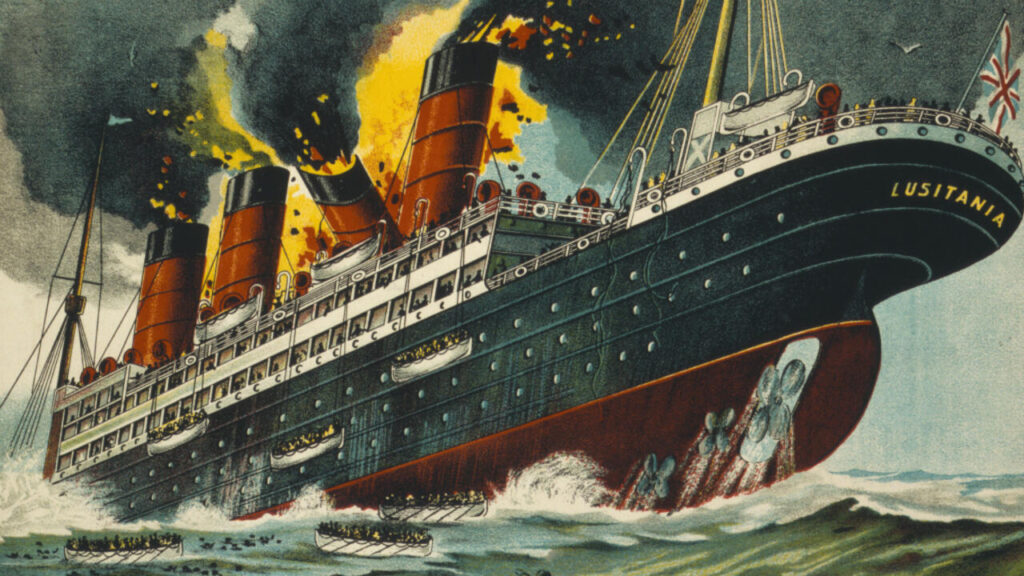
The luxury liner SS Lusitania, en route from New York to Liverpool with 1,962 passengers and crew on board, was struck by a U-boat torpedo some 18km off the Old Head of Kinsale. Minutes later, her secret cargo of 173 tons of rifle ammunition and shells exploded, sinking her in a mere eighteen minutes with the loss of 1,191 lives, including over 100 Irish citizens and 128 Americans. There were 771 survivors. One of them, a car salesman from Detroit who dived into the water, described looking back at the crowds on deck frozen in terror, and then, with ‘a thunderous roar’, the ship disappeared, ‘dragging with her hundreds of fellow creatures into the vortex’. He described how the sea became black with the figures of struggling men, women and children (only six of her several dozen lifeboats had been successfully lowered), including the traumatic sight of a woman giving birth in the water. The possibility of a German submarine pack being in the area delayed the arrival of Admiralty rescue vessels from Cobh and Kinsale. Instead, it was local fishermen who picked up most of the 761 survivors—and 160 bodies. Most of the dead were buried in the Old Church cemetery in Queenstown (Cobh). The German government, in notices published a week earlier in 50 US newspapers, had warned intending passengers that the Lusitania was headed for a declared maritime warzone. It hailed the tragedy as a great success which had saved many thousands of German lives. The German press were triumphant. One paper dismissed ‘the general howls of anger and screams of indignation emanating from around the world’, declaring that the German people were in a fight to the finish against ‘this nation of vulgar shopkeepers’.
01/1976
Seamus Ludlow (47), a forestry worker, was found dead near Dundalk. He had been shot dead in controversial circumstances, apparently by a three-member loyalist gang, which included two UDR members, from whom he had hitched a lift.
05/1976
Gardaí arrested eight members of the SAS, heavily armed and in civilian clothes, in three separate cars near Omeath, Co. Louth. They claimed to have strayed across the border by mistake.
06/1966
A strike by junior officials closed all Irish banks—until 21 June in Northern Ireland and 5 August south of the border.
12/1926
The general strike by c. 1.7 million workers in Britain ended in defeat for the TUC after nine days.
13/1986
Peadar O’Donnell (93), socialist, republican, writer and untiring champion of social reforms and unpopular causes, died.
16/1926
The inaugural meeting of the Fianna Fáil party, subtitled the ‘Republican Party’ on the suggestion of Seán Lemass, took place at the Scala Theatre, Dublin.
19/1936
The final sitting, before it was abolished, of the first Seanad Éireann, created by the constitution of the Irish Free State (1922).
21/1986
Eighteen artworks, including a Vermeer and a Goya, valued at £10m were stolen from Sir Alfred Beit’s collection at Russborough House, Co. Wicklow.
22/1986
James Christopher ‘Lugs’ Branigan (76), boxer, boxing referee and garda, well known for dispensing rough justice on the streets of Dublin, died.
27/1936
The first Aer Lingus flight took place when the five-seater de Haviland Dragan Iolar departed from Baldonnell military airport, landing in Bristol 90 minutes later.
30/1986
Connaught Regional [Knock] Airport was officially opened by Fianna Fáil leader Charles J. Haughey.
JUNE
20/1756
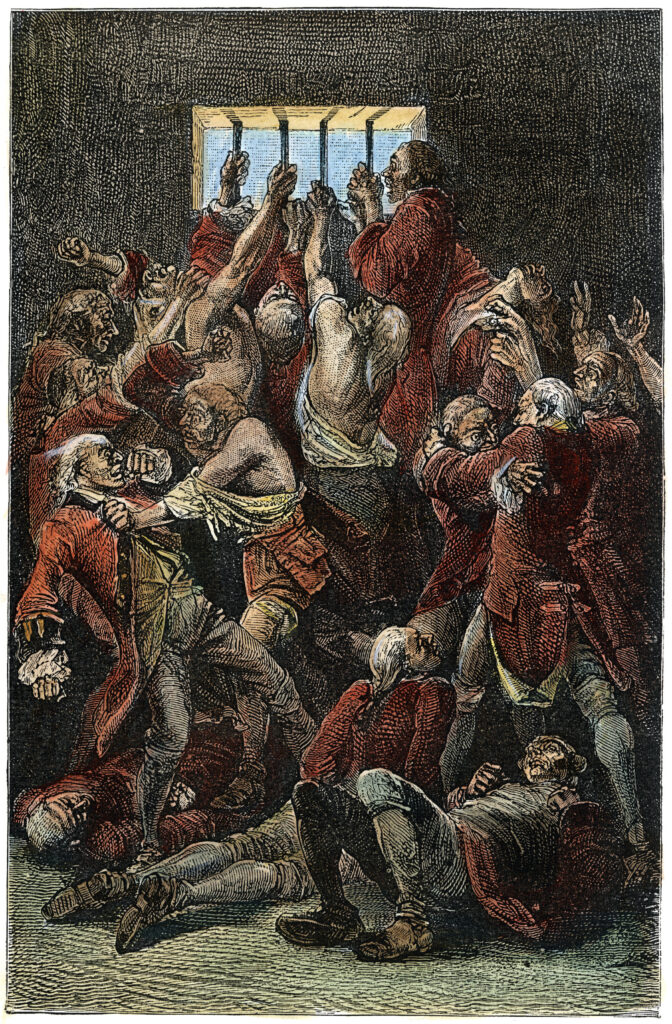
The garrison of the East India Company (EIC) at Fort William, Calcutta, led by Dublin-born John Zephaniah Holwell, surrendered to the forces of Siraj-ud-Daulah, nawab of Bengal, and were incarcerated in what became known as the ‘Black Hole of Calcutta’. According to Holwell, in his A genuine narrative of the deplorable deaths of the English gentlemen and others who were suffocated in the Black Hole (1758), he and some 145 others—though modern historians put the figure at 64—were forced that evening into the fort’s 14ft by 18ft punishment cell, with the only ventilation coming from two small windows high up in the walls. The following morning, through heat exhaustion, dehydration and suffocation caused by panic-driven trampling as men tried to reach the windows, only 21 were still alive. Apart from that notorious episode, which provoked calls for greater British colonial expansion, Holwell had a very successful 30-year career with the EIC. Signing up at the age of 21, he travelled extensively as a ship’s surgeon, studying Indian and Arab culture and teaching himself Hindu, Moorish and Arabic. He also studied connections between Christianity and Hinduism. He retired from the company with a considerable fortune. During his time as temporary governor of Bengal he threw his weight behind the bid by the outsider Mir Kasim to become the new nawab of Bengal. Duly appointed, Kasim rewarded Holwell with ‘two lakhs of rupees’ worth around £20,000. He returned to England with a personal fortune of over £96,000. During a lengthy retirement—he lived into his late 80s—he wrote extensively on the history of India and on medical and legal subjects.
01/1966
Éamon de Valera (83) was re-elected president of Ireland, narrowly defeating the Fine Gael nominee Tom O’Higgins (49) by a mere 10,617 votes—a margin of less than 1%.
06/1966
Revd Ian Paisley led several hundred supporters in a march to Belfast city centre in protest against the Presbyterian Church’s ‘Romanizing tendencies’. Following disturbances, he was arrested and jailed for three months.
14/1946
Donald Trump, 47th president of the United States, born in New York city, the fourth child of Fred Trump, a real-estate developer and businessman, and Mary Anne née MacLeod, a native Gaelic-speaker from the Outer Hebrides.
15/1996
The IRA detonated a 1,500kg lorry bomb in the centre of Manchester, causing an estimated £700 million in damage. Over 200 were injured.
18/1936
The Fianna Fáil government declared the IRA an illegal organisation. Soon after, its chief of staff, Maurice Twomey, was sentenced by a military tribunal to three years’ hard labour.
23/2016
In a referendum on the UK’s membership of the European Union, 51.9% voted ‘Leave’ whilst 48.1% voted ‘Remain’. In Northern Ireland 44.2% voted to leave whilst 55.8% voted to remain.
25/1876
The Battle of the Little Bighorn in south-eastern Montana, in which General George Armstrong Custer’s 600-strong 7th Cavalry, which included over 100 Irishmen, were wiped out by the Lakota Sioux and Northern Cheyenne.
26/1966
Three Catholics were shot in Malvern Street off Belfast’s Shankill Road, one of whom, Peter Ward (18), later died of his wounds. Three members of the UVF, including Augustus ‘Gusty’ Spence, were later convicted of his murder.
30/1876
‘I do not believe, and never shall believe, that any murder was committed in Manchester’—Charles Stewart Parnell MP in a debate in the House of Commons in reference to the shooting dead of a policeman in Manchester ten years earlier for which three Fenians were executed.