
By Damian Murphy
The Tower of Lloyd, standing on the crest of the Hill of Lloyd, 440ft above sea level on the outskirts of Kells, Co. Meath, can make a legitimate claim to the title of highest-placed lighthouse in Ireland but also enjoys the dubious title of the lowest-ranked for usefulness to mariners, given its setting 26 miles as the crow flies inland from the nearest coastline.
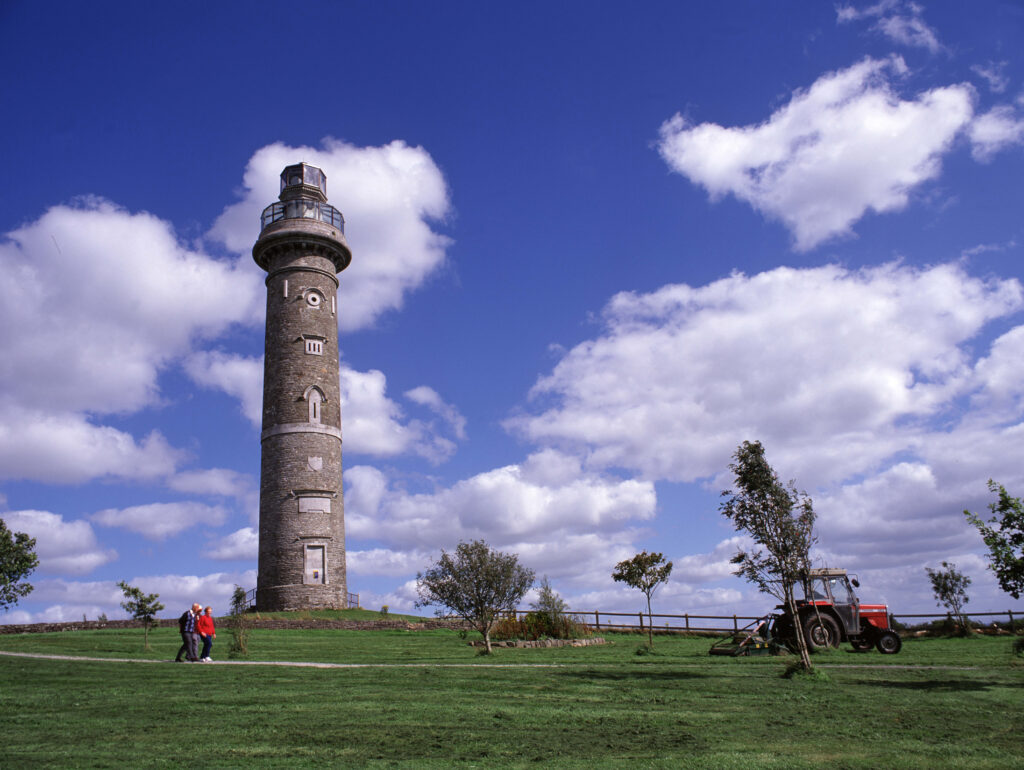
The eye-catching tower was built in 1791 by Thomas Taylor (1724–95), 1st Earl of Bective, not only as a memorial to his father, Sir Thomas Taylor (1685–1757), but also as the ultimate viewing point from which he could enjoy panoramic vistas over the town of Kells, his demesne at Headfort and a rich landscape extending from the margins of Donegal in the north-west to the outskirts of Dublin in the south-east, the whole enclosed by an undulating horizon of far-distant hills and mountain ranges.
The tower is a perfectly proportioned Doric column in profile; its capital, a corbelled viewing platform, circles a dome-topped hexagonal lantern, but pure Classicism is diluted by Georgian Gothic detailing, including hooded lancets and loops overhead. The silver-grey dressings also include the coroneted arms of the Earl of Bective and two inscribed panels, the first naming Taylors senior and junior, the second naming those who helped bring the tower, styled a ‘pillar’, to fruition. These individuals include Henry Aaron Baker (1753–1836) as architect, Joseph Beck as stonecutter, Owen McCabe as head mason and Bartle Reilly as ‘overseer’. The names of casual labourers have been lost in the mists of time, although Leigh’s New Pocket Road-Book of Ireland (1827) mentions the involvement of local tenantry ‘as a means of employing the poor during a year of scarcity’.
The motives behind the inclusion of a lantern are unclear and there is nothing on record to say that it was ceremonially lit to mark any particular anniversary or occasion. Local tradition has it that the lantern guided the Taylors safely back to Kells following the hunting season in Virginia, Co. Cavan, while a more recent theory has it that the tower somehow predicted the Napoleonic emergency and, when lit, ‘provided a convenient signalling station which could communicate at once with the whole of the Irish midlands’!
The Tower of Lloyd was originally surrounded by a circular grove of trees but, given the exposed nature of the site, little of the planting had survived when, in a curious juxtaposition of wealth and poverty, a pauper graveyard was opened in its shadow at the height of the Great Hunger (1845–9). Now the centrepiece of a public park, the slopes dotted with maturing trees, the tower is accessible to those prepared to climb the spiral staircase of 164 steps lit at intervals by deeply splayed loops. The viewing platform, originally open to the elements and railed, was wholly enclosed in metal-framed glass in 1997. That the resulting effect resembles a BT tower-made-Classical is appropriate as, once broadcasting the status and wealth of a titled landlord to all passers-by, the Tower of Lloyd is now studded with antennae broadcasting digital signals to mobile phones.
Damian Murphy is Architectural Heritage Officer, NIAH. Series based on the NIAH’s ‘building of the month’, www.buildingsofireland.ie.