
By Fiona Fitzsimons
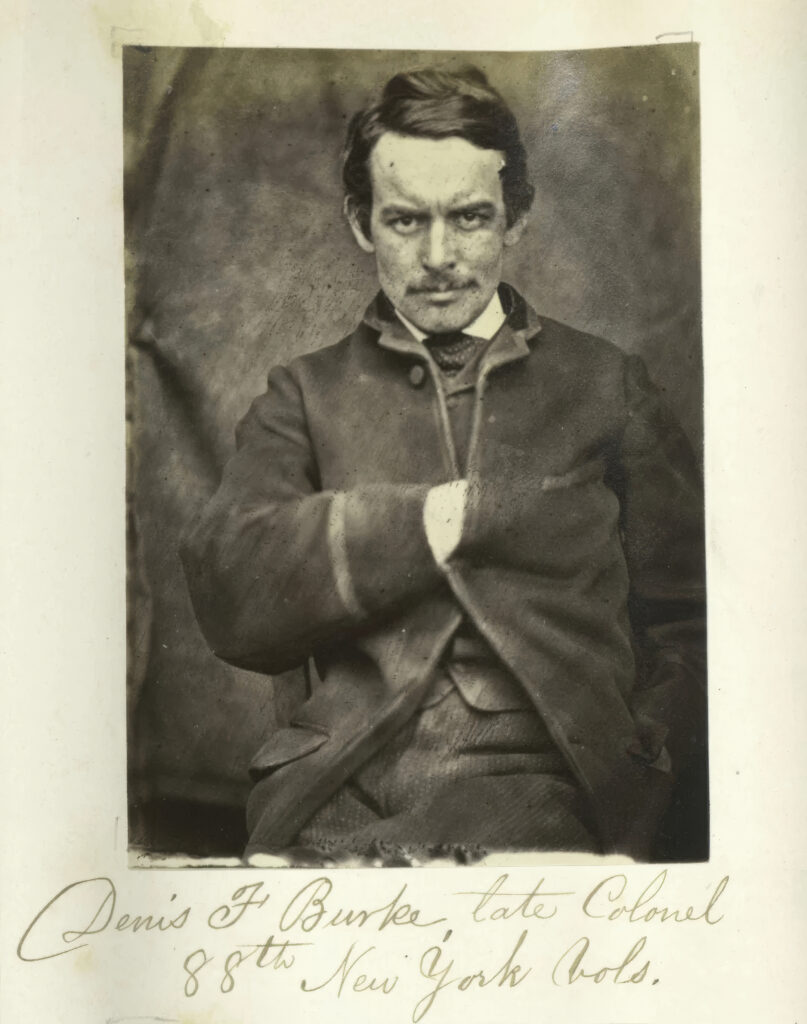
On 17 March 1858 the Fenian Brotherhood was founded to overthrow British rule in Ireland by armed insurrection and establish a republic. The Fenians were a secret society operating in plain sight. They held public meetings and published a newspaper, the Irish People. Fenian networks extended beyond Ireland to wherever the Irish had settled—in Britain, Canada and the United States.
The international dimension of the Fenian movement became even more pronounced during the American Civil War. We see entire regiments within the Union Army—the 63rd New York Infantry, the 69th New York Infantry and the 88th New York Infantry—closely aligned with the Fenians. At the end of the Civil War, tens of thousands of Irish-American soldiers were demobilised, raising fears that they would return to Ireland and start a rebellion. The UK government acted decisively, pushing the Habeas Corpus Suspension Act through both Houses of Parliament in one day. The Act allowed for the arrest and detention of suspects without trial and remained in force for three years. During that time, thousands of men were detained in Ireland.
The Fenian Papers, compiled from the Chief Secretary’s Office Registered Papers, were the result. Our focus here is on two subsets: the Abstracts of Cases (1866–8) and the Fenian Photographs (1866–87). The Abstracts were designed to make it easier to retrieve prisoner files. There are three volumes of abstracts, ICR 10–12, and an index volume, ICR 13. At the top of each abstract are details for each prisoner, including his name, age, employment, a physical description (the colour of hair, eyes and complexion, e.g. ‘fresh’ etc.) and any distinguishing marks on his face or body. Then come relevant details about the grounds for suspicion, the arrest, and any memorials made by the prisoner himself, his family or friends during his detention. Grounds for arrest could be vague. James Bibles, a draper’s son in Lismore, ‘gave a confused and unsatisfactory account of himself and … no good reason for being in Tipperary’.
Abstracts survive for every county in Ireland. The men in these records came from every walk of life: cottiers and farmers, shoemakers and bricklayers, curates and national school teachers, land-surveyors and bailiffs, bartenders, publicans and vintners, medical doctors, engine-drivers from Inchicore and hundreds of demobilised soldiers ‘lately returned from America’. They didn’t always give their real names when they were first detained, and often only revealed their identity under questioning. John Barry, a stonecutter from Harold’s Cross, proved to be John O’Gorman. Frederick Fitzgibbon, a watchmaker from Carrigtohill, Co. Cork, was actually John Carr. These shifting identities point to the difficulty the authorities faced in pinning down a movement as fluid and dispersed as the Fenian Brotherhood.
The authorities’ efforts to impose order went beyond the written record. They photographed the men they detained and added their pictures to their records. After 1866 it became common practice to take photos for surveillance. The sequence of Fenian photographs continues to 1887. Ireland had the rather dubious distinction of being at the forefront of surveillance practice in Europe. What emerges from the Fenian Papers and Photographs is less a record of conspiracy than of the State’s attempt to define and contain a radical movement embedded in Irish society. The authorities recorded everyone they detained in an effort to make the invisible visible. In doing so, they left a detailed account of the growing reach of surveillance in nineteenth-century Ireland.
Fiona Fitzsimons is a director of Eneclann, a Trinity campus company, and of findmypast Ireland.