
By Lar Joye
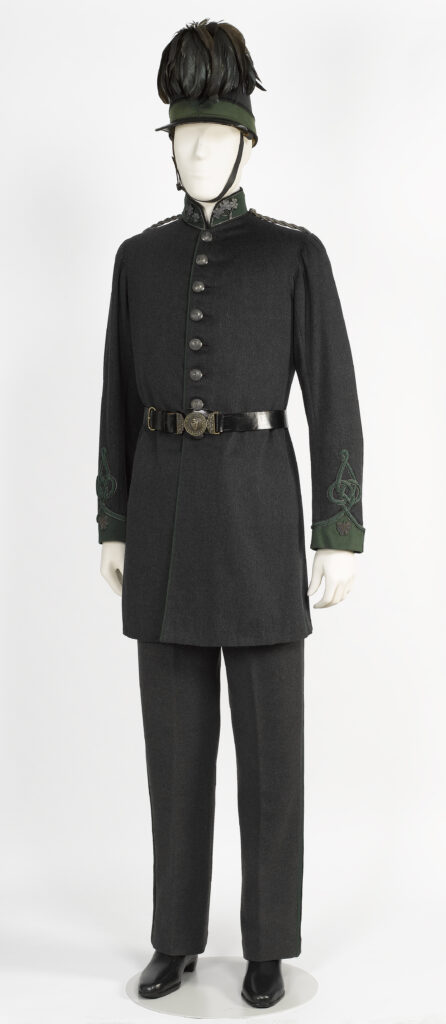
When the Ulster Volunteer Force and the Irish Volunteers were created in 1913 as private armies, there was a precedent. In 1859 the British government called for the formation of volunteer rifle units—known as the Rifle Volunteer Corps or more often the Volunteer Force—to defend against the threat of French invasion by Napoleon III. These units were run along the lines of a rifle club and were self-financing with a membership fee, very similar to the UVF and Irish Volunteers 54 years later. There was a certain irony to this fear, as France and Britain had fought as allies against Russia in the Crimean War only five years earlier.
On 5 December 1859 the Marquess of Donegal, along with nine Irish earls, seven Irish MPs and six other Irish marquesses, met at Freemason’s Tavern near Covent Garden to establish the London Irish Rifle Volunteers. It was decided that the uniform would be grey with green facings, as can be seen in this photograph, until it was replaced ten years later by a rifle-green uniform. This appealed to the British Army, who were happy to see these gentlemen amateurs not wear the red or scarlet uniforms of the regular army. Membership was open to those who had a connection with Ireland by birth, marriage or property. Officers had to recruit soldiers for promotion and by 1860 had a strength of 400 members, which increased to 1,017 by 1870; overall the Volunteer Force had 193,893 members. That year war broke out between Prussia and France; Britain remained neutral, but one officer and 40 members of the London Irish Rifles went in uniform to fight for France. When they returned, they were tried for fighting for a foreign state; the officer was fined and the others cautioned.
During the late nineteenth century the unit had a variety of interesting members, including Prime Minister Viscount Palmerston, Morgan John O’Connell, nephew of Daniel O’Connell, the Irish war correspondent William Howard Russell and the Fenian Denis Duggan, who served from 1862 to 1865 and was later involved in the rescue of Irish Fenians from Western Australia on the Catalpa.
The military value of the Rifle Volunteer Corps cannot be judged, as they never went to war, although some did volunteer to fight in the Boer War, and the volunteers were finally merged into the Territorial Army when it was formed in 1908. During the Second World War, when invasion seemed imminent again, the Local Defence Volunteers were established, later becoming the Home Guard. As for the London Irish Rifles, they fought in the First World War, famously at the Battle of Loos in 1915 by kicking a football as they attacked. During the Second World War they served with the 38th (Irish) Brigade in the invasion of Sicily and later at Monte Cassino.
Lar Joye is Dublin Port Company Heritage Director.