
Michael F.X. Hogan
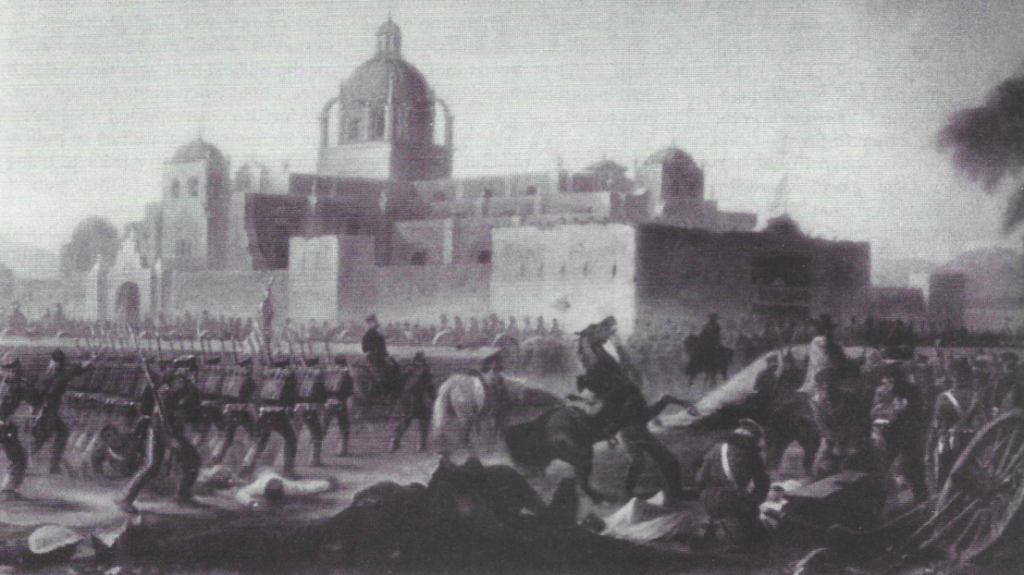
One of the least known stories of the Irish who came to America in the 1840s is that of the Irish battalion which fought on the Mexican side in the US-Mexico War of 1846-48. They came to Mexico and died, some gloriously in combat, others ignominiously on the gallows. Under a green banner they participated in all the major battles of the war and were cited for bravery by General Lopez de Santa Anna, the Mexican commander-in-chief and president. At the penultimate battle of the war these Irishmen fought until their ammunition was exhausted and even then tore down the white flag raised by their Mexican comrades, preferring to struggle on with bayonets until finally overwhelmed. Eighty-five of those captured were subsequently sentenced to bizarre tortures and deaths at the hands of the Americans.
The war begins
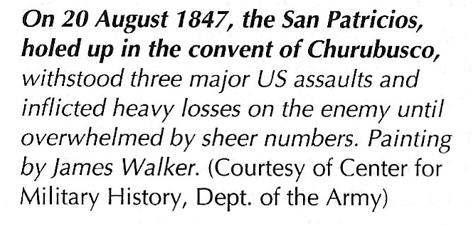
In the spring of 1846, the United States was poised to invade Mexico, its southern neighbour, ostensibly to collect overdue loans and indemnities. The real objective was control of the ports of San Francisco and San Diego, the trade route through New Mexico Territory, and the rich mineral resources of the Nevada Territory. The United States had previously offered $5 million to purchase New Mexico Territory and $25 million for California, but Mexico had refused.
President James K. Polk ordered General Zachary Taylor to take a position south of the Nueces River in Texas with a force of 4,000 men. By January 1846 the general had built a fort in what was Mexican, or at least disputed, territory on the northern banks of the Rio Grande in an effort to put pressure on the Mexicans to agree to a settlement. On 26 April 1846, a Mexican cavalry troop crossed the Rio Grande upstream of Taylor’s army. A patrol sent by Taylor to intercept them was attacked: eleven Americans were killed and five wounded. When word reached Polk he delivered his war message declaring that since the Mexicans had ‘shed American blood on American soil’ a state of war existed between the United States and Mexico.
John Riley of Clifden
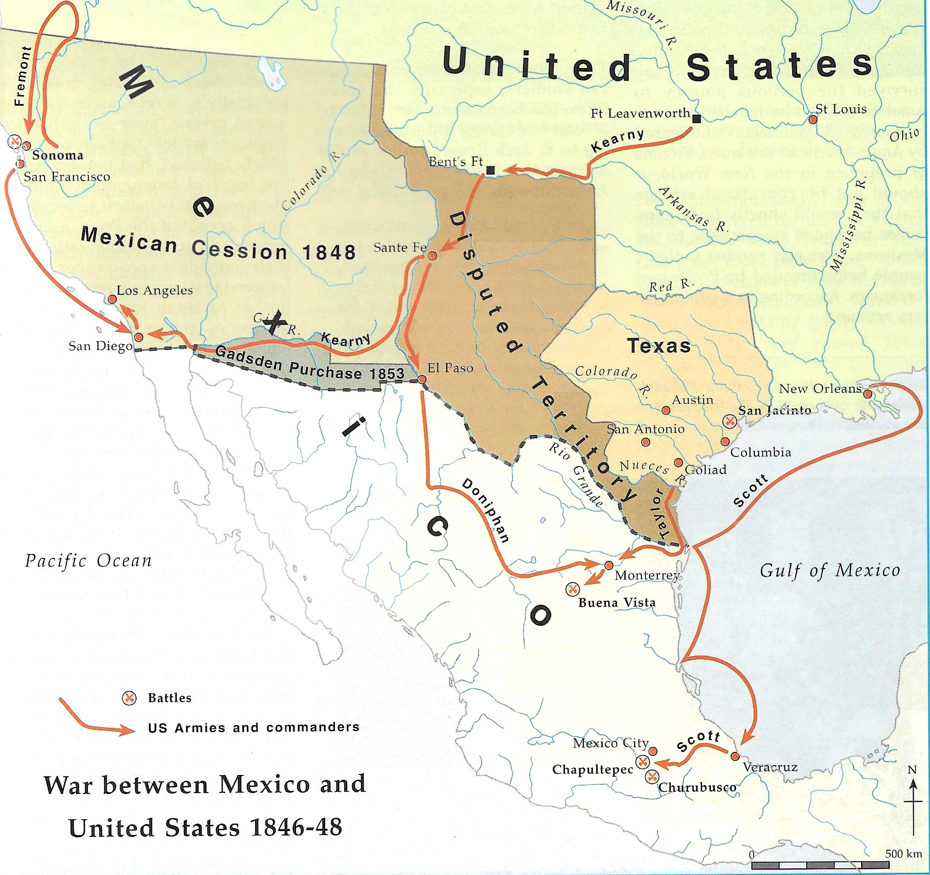
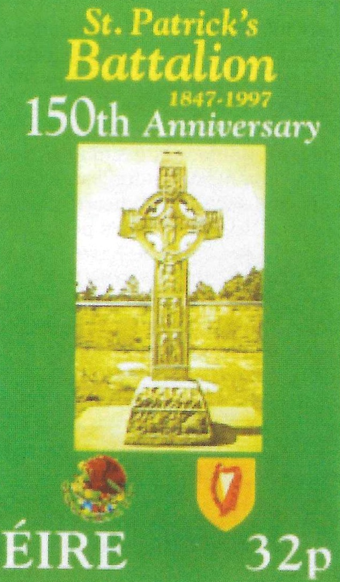
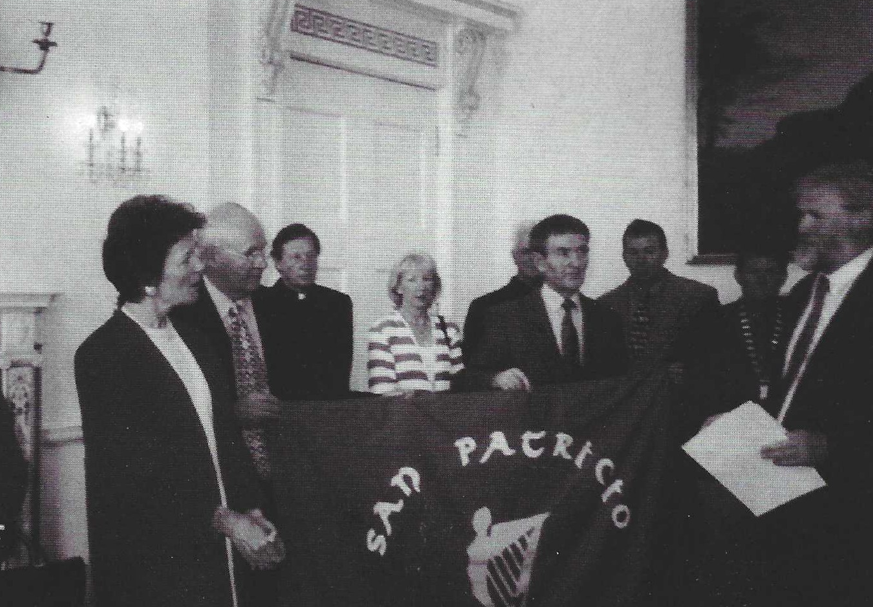
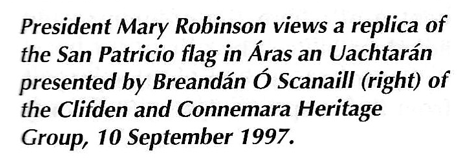
Prior to the declaration of war a group of Irish Catholics headed by John Riley deserted from the American forces and joined the Mexicans. Born in Clifden, County Galway, Riley was an expert on artillery and it was widely believed to have served in the British Army as an officer or a non-com while in Canada prior to enlisting in the US Army. Riley’s expertise was to turn this new unit into a crack artillery arm of the Mexican defence. He is credited with changing the name of the group from the ‘Legion of Foreigners’, and in designing their distinctive flag. Within a year, the ranks of Riley’s men would be swelled by Catholic foreigners resident in Mexico City, and Irish and German Catholics who deserted once the war broke out, into a battalion known as Los San Patricios or ‘Those of St Patrick’. They fought under a green silk flag emblazoned with the Mexican coat of arms, an image of St Patrick, and the words ‘Erin go braugh’ (sic). Their assistance was critical because the Mexicans had poor cannon with a range 400 metres less than the Americans. In addition, Mexican cannoneers were inexperienced and poorly trained. At the Battle of Buena Vista, for example, the San Patricios held the high ground and enfiladed the Americans. At one point they even wrested cannon from the enemy, and led General Taylor’s advisors to believe that the battle had been lost. Several Irishmen were awarded the Cross of Honour by the Mexican government for their bravery, and many received field promotions.
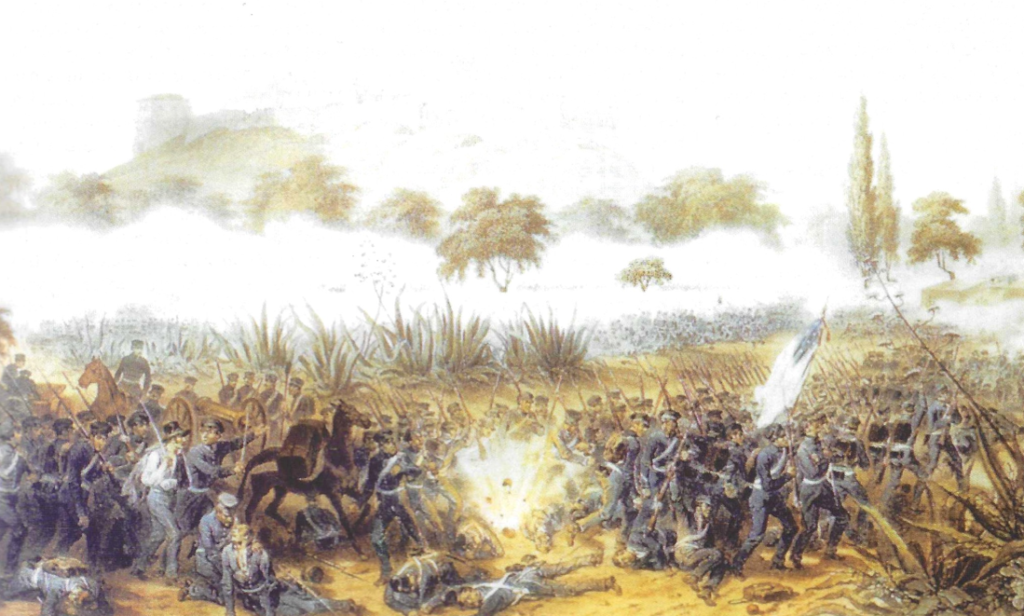
At the Battle of Churubusco, holed up in a Catholic monastery and surrounded by a superior force of American cavalry, artillery and infantry, the San Patricios withstood three major assaults and inflicted heavy losses on the enemy. Eventually, however, a shell struck their stored gunpowder, the ammunition park blew up, and the Irishmen, after a gallant counter-offensive with bayonets, were overwhelmed by sheer numbers. They were court-martialed, and then scourged, branded and hanged in a manner so brutal that it is still remembered in Mexico today.
In almost every Mexican account of the war, the San Patricios are considered heroes who fought against the unjust invasion of a peace-loving nation. In US histories, however, they are often referred to as ‘turncoats’, ‘traitors’ and ‘malcontents’ who joined the other side for land or money.
Reasons for desertion
It seems odd that anyone would desert from a superior force sure of victory, to join an obviously inferior one certain to be defeated. Even if, as most US accounts assert, there were offers of money or land from the Mexicans, there was plenty of free land to the west, much easier to come by than risking one’s life in combat against an American army. Simple desertion and refuge in the rich valleys of California would have accomplished that purpose. So why did they do it?
The Great Irish Potato Famine unleashed a wave of Catholic Irish emigration to the United States in the 1840s: American Nativism raised its ugly head in response. ‘All the world knows’, wrote historian Thomas Gallagher, ‘that Yankee hates Paddy.’ And so it seemed to those who had survived the perilous journey to America only to be labelled inferior by demagogic politicians and feared by Anglo-American workmen. Victims of prejudice in the New World, it should not be considered strange that they would shortly find themselves becoming sympathetic to the Mexicans. Here was another Catholic people being invaded by Protestant foreigners. According to a contemporary account:
On reaching Mexico they discovered they had been hired by heretics to slaughter brethren of their own church. On top of this they were confronted with the hatred of their fellow soldiers.
The intense prejudice of many American soldiers, especially the volunteers, has been commented upon by at least one careful historian. According to K. Jack Bauer, author of The Mexican War:1846-48, the majority of American soldiers
were products of a militantly Protestant culture which still viewed Catholicism as a misdirected and misbegotten religion. Although the regulars included a significant number of Catholic enlisted men, the volunteers did not. This strengthened the tendency to ignore the rights and privileges of the church in a Catholic country as well as increase the harassing of that church. Some of the volunteers’ acts, like the stabling of horses in the Shrine of San Francisco in Monterrey, so upset the Mexicans that they still mention it in modern works.
Origins of anti-Catholicism in the United States
America was a nation which was founded by Calvinists who, in rejecting the Church of England, had rejected the hierarchy of both Anglican and Catholic institutions and, in rejecting the spiritual hierarchy, had rejected the temporal one as well. Free to elect their own ministers, they were equally free to elect their own governors. To most Anglo-Saxons living in the United States, this is what it meant to be an American: free of European authority, both of popes and kings. Those who still clung to a hierarchical model, were considered regressive and unfit for self-government.
The Catholic Church was, to the Calvinist way of thinking, connected politically to a repressive and antiquated system, even more than the Anglican model. Catholics, it was widely believed, had not developed the habit of independent thought. They were still chained to a religion which accepted the Pope, a foreign power, as their authority, rather than their individual consciences. It was believed that not only were Catholics unable to think for themselves in matters of faith or morals, they were equally incapable of being part of a democratic system. Thus, by the early 1800s Catholicism was seen at best as retrograde, and—at worst—inimical to a democratic republic. As early as 1830 the American Bible Society urged the unity of Protestant sects to combat Rome’s influence in the West and expressed the belief that ‘His Holiness the Pope, has, within his larger grasp, already fixed upon this fair portion of our Union and knows full well how to keep his fold’.
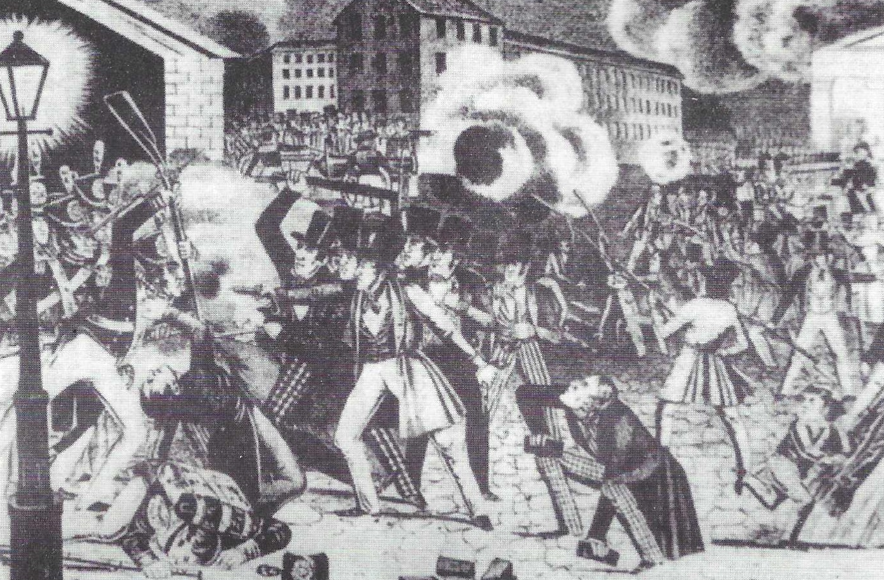
While in the early republic there had been some tolerance of Catholic minorities, this changed with the increased immigration of Irish Catholics during the 1830s and 1840s. Anti-Catholic riots broke out in Philadelphia in 1844 and, when they were over, the Irish ghetto lay in ruins, hundreds of homeless Irish roamed the streets, and two Catholic churches were burned to the ground.
Since solidarity in the face of commonly perceived oppression is a universal characteristic of any ethnic or religious group, it is hardly surprising that Irish Catholics would find unity among themselves in the service. As the war progressed and they witnessed more depredations against their co-religionists in Mexico, it is hardly surprising that some Irishmen felt they had more in common with the Mexicans than with the invading Americans. The destruction of Catholic churches in Mexico by the invading US Army and other depredations by mainly Protestant volunteers has also been well-documented by both sides. And, just in case they needed a reminder of the connection between the Americans’ treatment of the Irish and the abuse of Mexicans, Santa Anna’s propaganda leaflets were widely distributed:
Can you fight by the side of those who put fire to your temples in Boston and Philadelphia? Did you witness such dreadful crimes and sacrileges without making a solemn vow to our Lord? If you are Catholic, the same as we, if you follow the doctrines of Our Saviour, why are you murdering your brethren? Why are you antagonistic to those who defend their country and your own God?
Why indeed? Many Irishmen would be quick to see that higher loyalties should prevail and they would join the Mexican side. They would see that they had more in common with the Mexicans than with the invading army.
The Irish ‘race’
American nativists certainly saw similarities and were quick to point them out. The Mexican they asserted, like the Irishman, was unstable, ignorant, feckless, easily led, and incapable of participation in a republic. Using both the pseudo-science of phrenology and the more respectable science of physiology, contemporary American scientists determined that the short full figures of the Irish indicated that they were ‘inactive, slothful and lazy’. This was a stereotype also applied to the Mexican. The coarse red hair of the Irish showed that they were ‘excitable and gushing’. Their ruddy complexions indicated that they were selfish ‘with hearty animal passions’. Irishmen of this period are variously described as have a ‘hanging bone gait…the low brow denoting a serf of fifty descents…dark eyes sunken beneath the compressed brows’ with a look of ‘savage ferocity’. By the 1840s this legitimisation of negative racial characteristics had reached its peak.
Manifest destiny
Most of those who had settled in America in the eighteenth and early nineteenth centuries had no real sense of nationhood. Those in Virginia considered themselves Virginians, those in Texas, Texans or ‘Texicans’, and those from Maine, ‘Down Easters’. Allegiances were territorial rather than nationalistic. When the victorious US Army finally entered Mexico City they played three ‘national’ anthems: Hail Columbia, Yankee Doodle and the Star Spangled Banner. While there was no clear sense of nationhood, Americans were nevertheless in the process of defining who they were. They were doing this essentially by stating quite clearly what an American was not. In the 1840s he was not a Negro, not a Mexican, not an Indian and certainly not Irish Catholic. According to Dale T. Knobel
the Irish would be seen increasingly as set apart by visible conduct and appearance. This development coincided with national self-satisfaction that accompanied the working out of the United States’ Manifest Destiny through geographical expansion.
Manifest Destiny was another aspect of Calvinist belief. It held quite simply that the Anglo-American was predestined by God to inherit the entire American continent. Beginning with the ‘noble experiment’ in New Jerusalem (Salem, Massachusetts), the ‘City on the Hill’, this new breed would spread over the entire land-mass of the Americas, displacing indigenous people, and buying out or running off French and Spanish land holders in their inevitable march of progress. The inheritors of Manifest Destiny, it must be remembered, were white, Anglo-Protestants and they took steps to insure that the distinctions between them and others, whether religious or racial or quasi-scientific, were constantly emphasised to prove that they were deserving of this gift. Wrote one newspaper editor:
We are believers in the superintendence of a directing Providence, and when we contemplate the rise and amazing progress of the United States, the nature of our government, the character of our people, and the occurrence of unforeseen events, all tending to one great accomplishment, we are impressed with a conviction that the decree is made, and in the process of execution, that this continent is to be but one nation.
The scourging, brandings and hangings
In September 1847, the Americans put the Irish soldiers captured at the Battle of Churubusco on trial. Forty-eight were sentenced to death by hanging. Those who had deserted prior to the declaration of war were sentenced to whipping at the stake, branding, and hard labour. Most American historians contend that the punishments were neither particularly brutal nor unusual given the fact that there was no prescribed code.
However, the codified Articles of War (1821) and De Hart’s Practice of Courts-Martial (1847) governed courts-martial at that time which clearly stipulated the exact punishments these soldiers should have received. The Articles of War stipulated that the penalty for desertion and/or defecting to the enemy during time of war was death by firing squad. Hanging was reserved only for spies (out of uniform) and for ‘atrocities against civilians’. Nevertheless, forty-eight of the San Patricios were hanged: twenty-eight in San Angel, and thirty in Mixcoac.
Desertion prior to a declaration of war was punishable by ONE of the following punishments: branding on the hip in indelible ink, fifty lashes, or incarceration at hard labour. However, the San Patricios received more than fifty lashes, ‘until their backs had the appearance of raw beef, the blood oozing from every stripe’, according to one American witness. These same Irishmen were also branded with ‘D’ for deserter on the cheek by a red-hot iron, and they were sentenced to imprisonment at hard labour.
The sentence of the court, according to the Articles of War, should always be carried out promptly—’to prolong the punishment beyond the usual time would be highly improper, and subject the officer who authorised or caused such to be done, to charges’. In the case of the last group of thirty San Patricios to be hanged, this article was cavalierly ignored.
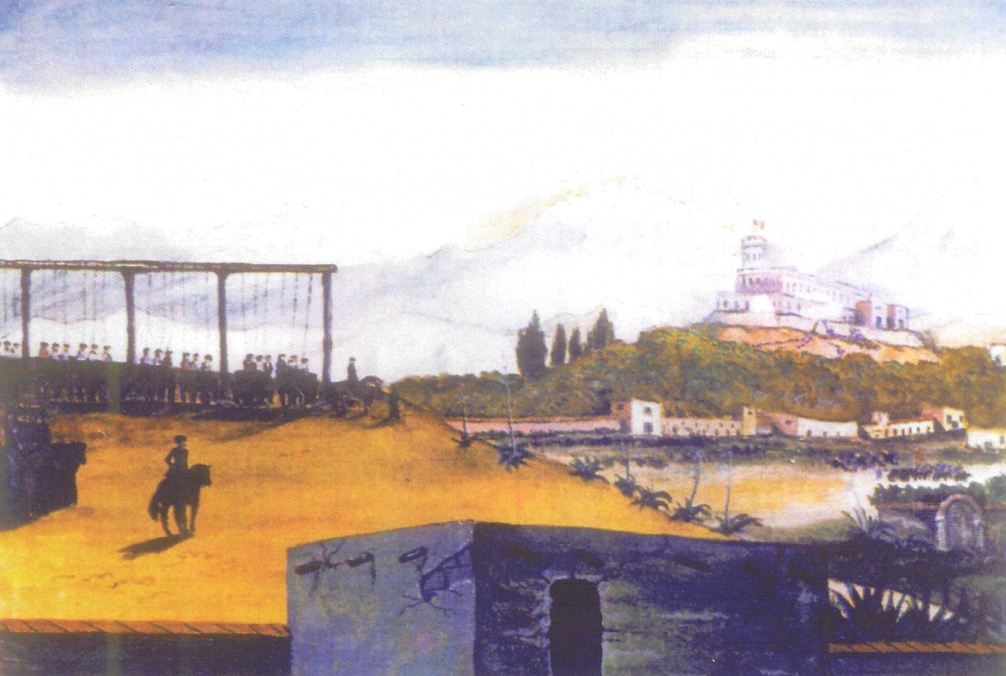
At dawn (approximately 5am) on 13 September 1847, some days after the first group of twenty-eight had been executed, Col. William Harney ordered the remaining San Patricios to be brought to a hill in Mixcoac a few kilometres from Chapultepec Castle, near Mexico City, where the final battle of the war was being fought. Nooses were placed around the necks of each the men as they stood on wagons. Harney then pointed to Chapultepec Castle in the distance and told the prisoners that they would not be hanged until the American flag was raised in victory over the castle.
Meanwhile the Battle of Chapultepec raged on. Finally, at 9:30am, the Americans scaled the walls of the castle, tore down the Mexican flag, and raised the Stars and Stripes. With that, Harney drew his sword and gave the order for execution. A month later Harney was promoted to Brigadier General and accompanied the Commander-in-Chief in a triumphal march through Mexico City.
The punishments ordered for the San Patricios and the way they were carried out expressed more than the judgement of the court. They smacked of contempt and repulsion indicative of religious and racist reprisals. In spite of the fact that over 5,000 US soldiers deserted during the Mexican War, only the San Patricios were so punished, and only the San Patricios were hanged.
The Conquest of Mexico and ‘Celtic-Americanism’
Fuelled by Manifest Destiny and its concomitant of racial and religious animosity, the American government dictated terms to the Mexicans in the Treaty of Guadalupe Hidalgo in 1848. Over two fifths of Mexican territory was annexed, half if disputed Texan territory is included, and out of it the United States would carve California, Nevada, New Mexico, Arizona, Utah, Wyoming and parts of Kansas and Colorado. It was a profitable American adventure, a conquest to put Napoleon to shame, and all done in the name of democracy and Manifest Destiny.
Among all the major wars fought by the US, the Mexican War is the least discussed in the classroom, the least written about, and the least understood by the general public. Yet, it added more to the national treasury and to the land mass of the United States than all other wars combined. In its aftermath, so much new territory was opened up, so many things had been accomplished, that a mood of self-congratulation and enthusiasm pervaded the United States. The deserters from the war were soon forgotten as they laboured in the gold fields of California, homesteaded in California, or as the 1860s approached, put on the grey uniform of
the Confederacy or the blue of the Union. Prejudice against the Irish lessened, as the country was provided with a ‘pressure valve’ to release many of its new immigrants westward.
As Irish veterans returned from the Civil War and gained political power, they began increasingly to be seen as a branch of the white race (‘Celtic American’) by the so-called scientific theorists who had previously denied them that privilege. The Catholic Irish in the United States, anxious to be assimilated, gladly accepted the new designation. Ironically, the American-Irish would be among the first to disassociate themselves from the San Patricios and promote the notion that it was not an Irish battalion at all!
Commemorations
Each year commemorations are held in San Angel in Mexico to honour the Irish who died in the war. A marble plaque in the town square reads ‘In Memory of the Irish Soldiers of the Heroic Battalion of San Patrick Who Gave Their Lives For The Mexican Cause During the Unjust North American Invasion of 1847’ followed by the names of seventy-one of the men. In Clifden, County Galway, birthplace of John Riley, a similar ceremony is held each September 13th.
Michael F.X. Hogan is Head of the Humanities Department, Colegio Americano, Guadalajara, Jalisco.
Further reading:
*M.F.X. Hogan, The Irish Soldiers of Mexico (Guadalajara 1997).
R.R. Miller, The Shamrock and the Sword (Norman 1987).
J. K. Bauer, The Mexican War:1846-1848 (New York 1974).
L.C. Martinez, La Intervencion Norteamericana en Mexico (Mexico 1991).
*Available from University Press of the South, 5500 Prytania Street, Suite 421, New Orleans, LA 70115, USA, for US$49.95.