
By Loretto Leary
In the second half of the nineteenth century, Irish women became the largest female migrant labour force in the United States. Arriving in the wake of the Great Famine/An Gorta Mór and its prolonged aftermath, they entered American households at a moment of intense transformation in domestic labour. Industrial capitalism, urban growth and shifting gender norms reshaped household work into a waged occupation, while élite families increasingly relied on live-in servants to sustain middle- and upper-class respectability. By 1900, more than half of all Irish-born women in the United States were employed in domestic service, a figure unmatched by any other immigrant group.

Yet the centrality of Irish women to American domestic life stands in stark contrast to their representation in popular culture and historical memory. Rather than skilled workers and migration strategists, Irish domestics were reduced to caricature through the figure of ‘Bridget’, a stereotype that framed them as unruly, incompetent or threatening. This article argues that Irish women were not marginal figures but essential actors in the making of Gilded Age America. Beginning with the early post-Famine household, represented by Connecticut’s Lockwood–Mathews Mansion, and culminating in the highly systematised service economy of Newport’s mansions, it situates Irish women’s labour at the intersection of gendered migration, racial formation, architecture and cultural memory.
FAMINE, FEMALE MIGRATION AND DOMESTIC SERVICE
The Great Famine (1845–52) permanently altered Irish migration patterns. While emigration had long been part of Irish rural life, the post-Famine period saw a dramatic feminisation of migration. Young, single women increasingly emigrated alone rather than as dependants within family groups. Domestic service offered immediate employment, room and board, and the possibility of saving wages, advantages rarely available to immigrant women in factories or informal labour.
Most Irish women arrived as English-speaking and accustomed to household labour, attributes that made them attractive to American employers. Live-in service provided food security and shelter at a moment when immigrant neighbourhoods were overcrowded and unsanitary. Wages earned in service were rarely confined to the household; they circulated transnationally through remittances that sustained families in Ireland and financed chain migration. Letters sent home advertised wages and opportunities, reinforcing the feminised character of Irish migration.
Domestic service also functioned as transitional labour. Many Irish women expected to leave service upon marriage, and many did. Nonetheless, for several decades it remained the principal occupational entry point for Irish women in America. By the 1870s, domestic service employed more women than any other occupation nationally, and Irish women were disproportionately represented within it. This demographic reality formed the foundation of both élite domestic culture and Irish-American community formation.
LOCKWOOD–MATHEWS MANSION: AN EARLY LABORATORY OF ÉLITE DOMESTICITY
The Lockwood–Mathews Mansion in Norwalk, Connecticut, constructed between 1864 and 1868, offers a revealing early case-study of Irish domestic service in élite American households. Built as a year-round residence by a newly wealthy financier, the house pre-dates the seasonal extravagance of Newport and captures an earlier phase of post-Civil War élite domestic life. Here, Irish domestic servants, many of them first-generation Famine migrants, entered élite households at close range.
For these women, domestic service represented survival rather than opportunity. Live-in employment provided stability in an unfamiliar society. The architecture of Lockwood–Mathews reflects élite anxieties surrounding this arrangement: kitchens were placed below ground, servants’ stairs minimised contact with family spaces, and living quarters emphasised supervision over comfort. Such spatial organisation reveals an early effort to integrate Irish female labour while containing its perceived threats.
Significantly, this moment pre-dates the full development of the ‘Bridget’ stereotype. Irish women were not yet comic figures; they were subjects of concern. Employers worried about Catholic practices, sexual respectability and female independence. Unmarried women earning wages within the home unsettled Victorian ideals of femininity and domestic hierarchy. At this foundational stage, control preceded caricature. Irish servants were managed and closely watched before they were mocked.
NEWPORT AND THE EPOCH OF DOMESTIC SERVICE
By the late nineteenth century, Newport, Rhode Island, had become the summer capital of American wealth. Its mansions, The Breakers, Marble House, The Elms and Rosecliff, represent the apex of Gilded Age domestic organisation. Unlike Lockwood–Mathews, these were seasonal residences requiring large, rotating staffs capable of sustaining elaborate rituals of leisure and display. Irish women dominated this labour force.
In Newport domestic service became industrialised. Kitchens functioned as production centres; hierarchies of cooks, maids and assistants operated with precision. Architectural segregation was intensified through servants’ corridors, back stairs, bell systems and basement workspaces, ensuring that labour remained invisible even as it was indispensable. Irish women were no longer novelties within élite households; they were the system itself.
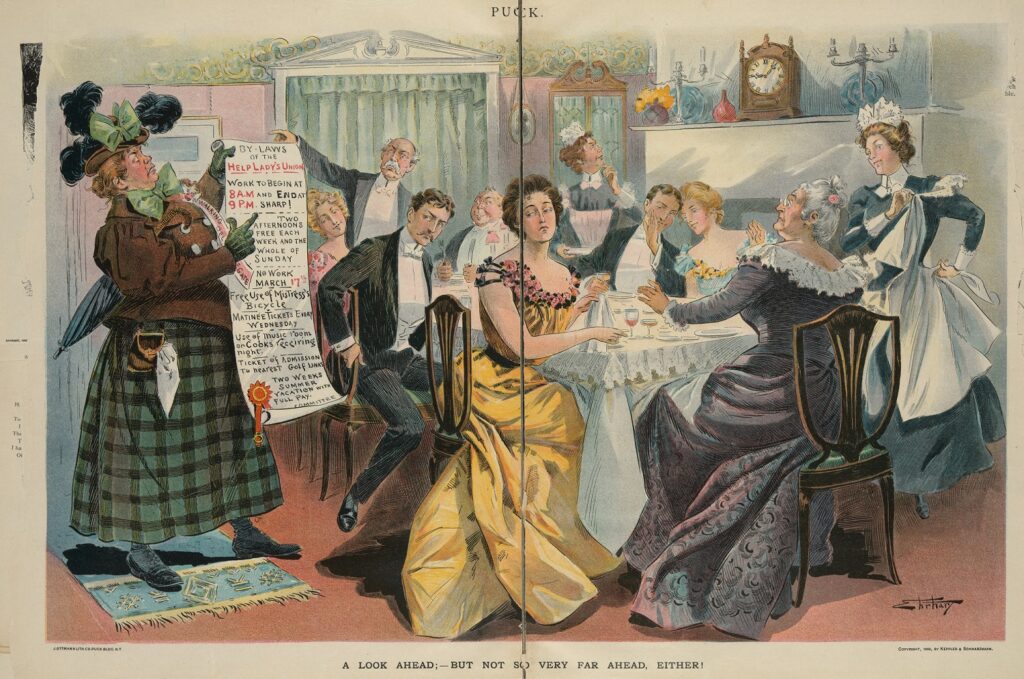
With scale came heightened anxiety. Employers complained of turnover, wage demands and servants’ social lives beyond the mansion gates. Irish women’s mobility, their ability to leave one household for another, shifted the balance of power within domestic labour. What had once been framed as familial service was now unmistakably wage labour. This transformation generated what contemporaries called the ‘servant problem’, a discourse that blamed servants rather than structural changes in labour relations. Newport thus marks the moment when Irish women’s labour was most essential, most organised and most systematically erased from élite self-representation.
CREATING ‘BRIDGET’—REPRESENTATION AND CONTROL
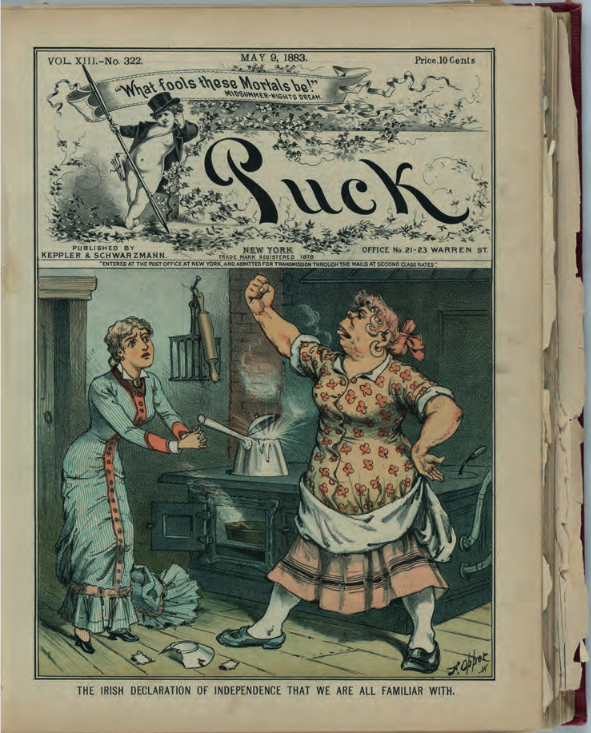
It was in this context that ‘Bridget’ emerged as a cultural figure. Derived from a common Irish name, ‘Bridget’ or ‘Biddy’ became shorthand for the Irish domestic servant in American popular culture. She appeared in joke books, household manuals, vaudeville routines and satirical magazines such as Puck. The caricature was contradictory: Bridget could be incompetent or domineering, ignorant or cunning. What unified these portrayals was not realism but anxiety.
The Bridget stereotype resolved contradictions inherent in domestic service. Employers depended on Irish women while resenting their independence. Humour transformed structural tensions, wage labour inside the home, female autonomy and Catholic difference into personality flaws. The ‘servant problem’ became one of character rather than class. Yet negative portrayals coexisted with positive depictions emphasising Irish servants’ honesty, loyalty and moral discipline. Employers frequently valued Irish women even as they repeated stereotypes about them.
RACE, WHITENESS AND THE KITCHEN
Domestic service was also a site of racial negotiation. In the mid-nineteenth century, the Irish occupied an ambiguous position within American racial hierarchies and were frequently depicted as ‘not quite white’. Domestic service placed Irish women in intimate proximity to middle-class white families, making their racial status both visible and contested.
Comparisons between the Irish ‘Bridget’ and the Black ‘Mammy’ illuminate how race structured domestic stereotypes. While Mammy was portrayed as loyal, asexual and permanently subordinate, Bridget was depicted as mobile, ambitious and threatening. Both stereotypes stabilised élite domesticity while obscuring exploitation. The kitchen became a battleground where femininity, whiteness and labour were policed.
These dynamics persisted into the twentieth century through early American cinema. Films produced between 1895 and 1917 inherited Bridget from print culture, repeatedly staging Irish servants as disruptive forces within domestic space. At the very moment when Irish women were leaving service for clerical, retail and educational work, the stereotype was being fixed on screen. Representation outlived reality.
By the early twentieth century, the daughters of Irish domestics increasingly rejected service. Education, urbanisation and changing labour markets opened new opportunities in teaching, clerical work and retail. Service came to be associated with the past rather than the future. Yet the legacy of Irish domestic service endured. Wages earned in kitchens funded parishes, schools and families. Irish women became household financial managers and community-builders, shaping Irish-American life from the ground up.
CONCLUSION
Irish domestic servants were foundational to Gilded Age America. From the early post-Famine households of Lockwood–Mathews to the elaborate service systems of Newport, Irish women sustained élite life while navigating surveillance, stereotype and structural inequality. Yet their labour has largely vanished from public memory. Mansions are celebrated; servants are forgotten.
The figure of Bridget endures because she absorbs anxieties about immigration, gender, race and labour. Recovering the history of Irish domestic servants requires moving beyond caricature to restore women as workers, migrants and agents. If Lockwood–Mathews represents the foundation of Irish domestic service and Newport its epitome, then the task of historians today is to ensure that the women who built American domestic life are no longer confined to the margins of memory or reduced to a joke.
The ‘Gilded Age’, a term introduced by Mark Twain, refers to a time that appeared prosperous and golden on the surface while masking deep inequality and injustice beneath. The growing popularity of servant and ‘downstairs’ tours suggests a shift in public curiosity towards what lies beneath the veneer. Visitors are increasingly interested not only in opulence but in operation, how these houses functioned and who maintained their polished image. Bridget, at last, is receiving the attention she deserves.
Loretto Leary is the Education and Cultural Director of Ireland’s Great Hunger Museum of Fairfield, currently researching the mass burials of Irish Famine immigrants in America.
Further reading
H.R. Diner, Erin’s daughters in America: Irish immigrant women in the nineteenth century (Baltimore, 1983).
C.H. Dow, Newport: the city by the sea: four epochs in her history (Newport, 1880).
M. Lynch-Brennan, The Irish Bridget: Irish immigrant women in domestic service in America, 1840–1930 (Syracuse, 2009).
A. Schultz, ‘The Black Mammy and the Irish Bridget: domestic service and the representation of race, 1830–1930’, Éire-Ireland 48 (3) (September 2013).