
By Patrick R. Redmond
Undoubtedly, the highest visibility of people of colour in Ireland has historically, together with music and acting, been in sport. Recent immigration has enlarged this catchment, with first- and second-generation athletes of African heritage like Chiedozie Ogbene and Rhasidat Adeleke becoming well-known celebrities.
However, the phenomenon of the African athlete in Ireland goes back to the years following the Second World War, when, after the passing of the 1948 British Nationality Act, the country became a popular destination for British African students. Other factors included what Theophilus Ejorh described as the ‘colonial-cultural imperialistic nexus’ between Irish missionaries and the Igbo of south-eastern Nigeria; a shortfall of local students attending Trinity College, Dublin, in the wake of the Catholic ‘ban’; and the lack of universities in Anglophone Africa.
‘PRINCE’ ADEGBOYEGA FOLARANMI ADEDOYIN
For all their athletic prowess, these visitors arrived not on athletic scholarships but to study bona fide degrees. Invariably they came from the indigenous élites, and it was not unusual to see a ‘student athletic prince’. Adegboyega Folaranmi Adedoyin, from ‘the royal house of Ijebu-Remo’ in western Nigeria, was the most notable, studying medicine at Queen’s University, Belfast, from 1943. The former Irish shot-put champion David Guiney recalled him as ‘gentle, unassuming, entertaining and with a subtle humour that endeared him to everyone’.
Adedoyin the athlete first drew attention at the combined Amateur Athletics Union of Éire/Northern Ireland Amateur Athletics Association (AAUE/NIAAA) inter-association championships in June 1945, when he won the high jump and long jump and came second in the triple jump and 120yds hurdles. He won all three jumps again along with the 120yds hurdles at the 1946 Irish Amateur Athletics Board (IAAB) championships; the IAAB was the newly formed body that brought together the AAUE and the NIAAA in national championships and international selections (Olympic participation was still determined by partition). ‘Is there another athlete in the world who could emulate the performance put up’ by Adedoyin, asked the Irish Independent.
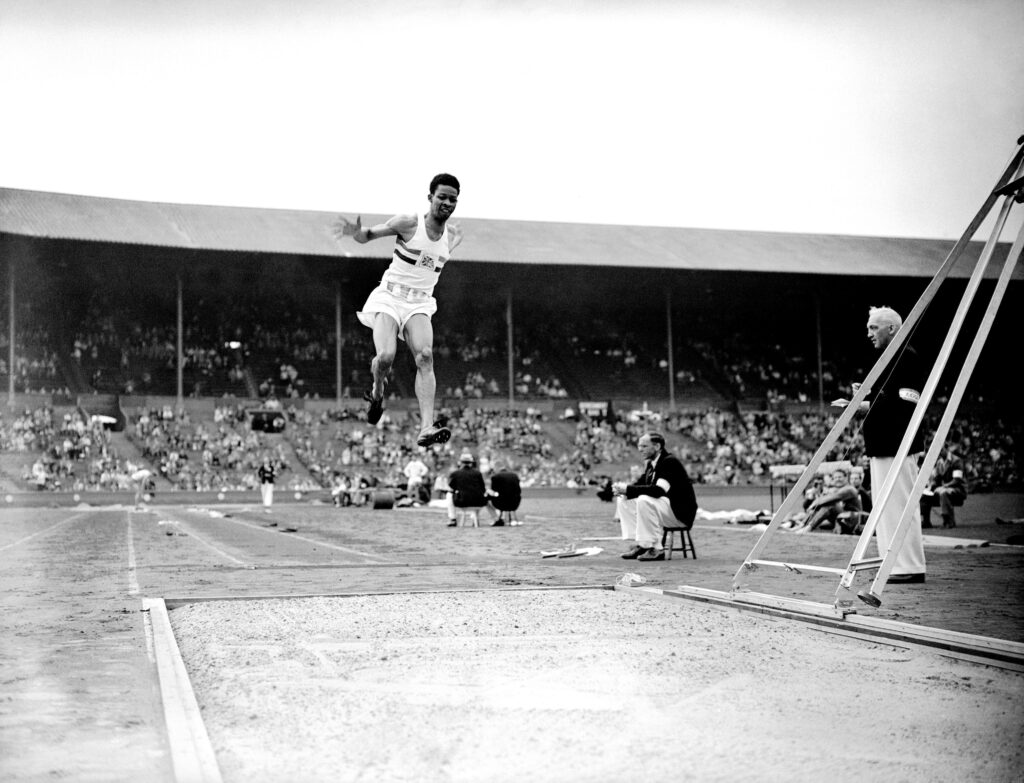
Adedoyin regained his Irish titles in 1947 and 1948 and was selected for Ireland twice. His debut in the 1947 triangular international against England and Scotland in Edinburgh proved crucial; he took the high jump, long jump and 120yds hurdles, as Ireland came second to England in overall points despite winning most firsts. He also represented Great Britain at the 1948 London Olympics (the last Olympiad before Nigeria sent its own team), coming fifth in the high jump, although Guiney would later assert that Adedoyin would have preferred to have competed for ‘his adopted country’—Ireland—instead.
His title attracted some cynicism. He insisted on being listed as ‘Prince A.F. Adedoyin’ in any programme, provoking the Irish sprinter James Patrick Reardon to suggest that Nigeria was ‘littered with princes’. Guiney recalled, however, that when the competitors entered the dining hall after one meeting in Dublin between Queen’s and Trinity they were met with ‘an absolute riot of colour’ of around 20–30 Nigerians in ‘traditional’ robes: ‘And they all bowed ceremoniously when our Addy made his appearance’, reflected the shot-putter. ‘From there on, it was a truly regal procession … It had all the evidence of a papal or royal occasion.’ After greeting his fellow countrymen, Adedoyin turned to his Irish colleagues and merely winked—‘And we never again doubted Addy’s lineage’.
JOHN COKER
Many sports benefited from African students. Trinity’s cricket team had Okikiolu Oluwaji ‘Kiki’ Coker, a medical student who had represented Nigeria while a schoolboy. ‘Mention of gramophone records reminds me that collecting them—with particular interest in light music and calypso—is one of the hobbies of [Coker]’, the Evening Herald once reported in a gossip column.
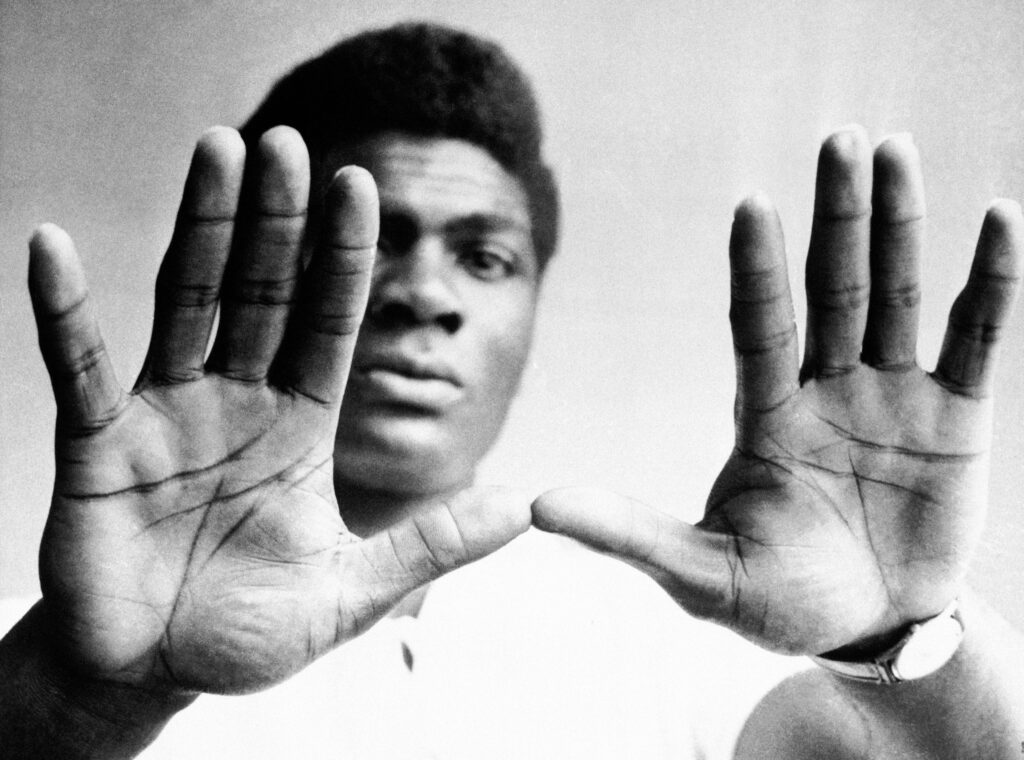
Boxing saw, amongst others, John Coker (no relation), a future Sierra Leonian Olympian and sparring partner of Henry Cooper, who was encouraged to take up the ‘sweet science’ by former Irish Olympian Fred Tiedt. He also played rugby for Trinity. The Irish Independent noted Coker as ‘the coloured man’ who was a ‘great favourite with the crowd’. His defeat by a Derry-based English soldier at the 1963 Irish junior boxing championships almost caused a riot in Dublin’s National Stadium, with the Kilkenny People’s boxing correspondent writing: ‘When the decision was announced bedlam broke loose, and the slow hand clapping, feet stamping and shouting continued until the close of the night’. Letters of protest followed in the Dublin press; one from ‘Be honest’ in the Evening Herald described the verdict as a ‘disgraceful decision’, adding that the ‘crowd were justified’ in protesting: ‘Coker deserves great credit for the sportsmanlike manner in which he accepted the unfair decision and at least he can bring home to his native Sierra Leone the knowledge that the Irish boxing fans do believe in justice for all’.
NIGERIANS IN THE LEAGUE OF IRELAND
It was soccer, however, that witnessed most African involvement. At least six Nigerians played in the League of Ireland or the second-tier Leinster and Munster Senior Leagues. The first was Francis Archibong, who played twice for Bohemians in the pre-season League of Ireland Shield of 1948, making him one of the first black Africans to play at a top-flight European football club. The Munster Express wrote of his debut in Waterford: ‘It was a novel experience for Kilcohan Park patrons to witness, for the first time in the history of senior soccer in Waterford, the inclusion of a coloured player amongst the teams competing … The crowd liked the young Nigerian and were generous in their appreciation of his playing.’
When the University College of Cork Football Club was re-established in 1952, African footballers became a visible part of its teams. The athlete Patrick Ozieh, who broke the Irish javelin record in 1954, played a few games for the first XI alongside Augustine Ezenwa. In Dublin, Fidelis Ezemenari joined UCD in 1954, and Gabriel Ojo followed him in 1967 after a failed career at Sligo Rovers.
FRANCIS OBIAKPANI
The most prominent African footballer was medical student Francis Obiakpani, who was described in the Irish Independent as the ‘coloured UCD outside left who has troubled several League of Ireland full backs’. He arrived in Ireland in November 1948 but, despite reports that he had played previously under the name ‘O’Brien’, did not feature for UCD until the 1952 all-Ireland university Collingwood Cup. Playing alongside future tánaiste Brian Lenihan in the final, Obiakpani scored the third goal in the 4–2 defeat of University College Galway, leading to a call-up for the Republic’s upcoming amateur international against England. Missing the following year’s Collingwood Cup final, he returned in 1954 against Queen’s University, assisting the winner by allowing a pass through his legs for a teammate to score.
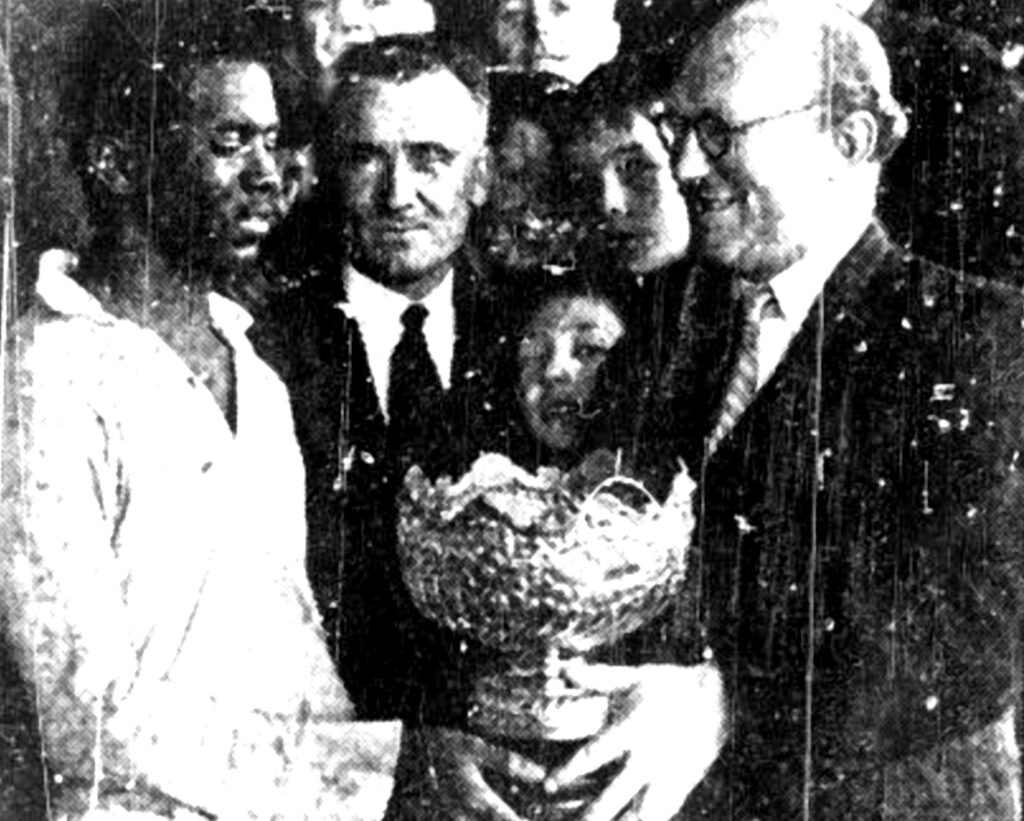
Obiakpani took every opportunity to play football in Ireland. He captained the Mater Hospital side in the hospitals’ soccer championship final against Mercer’s Hospital in 1954. The competition was sponsored by the Irish Independent and the match report pictures him being presented with the cup by its sports editor, Mitchel Cogley.
It is for his performance in the FAI Cup that Obiakpani is best remembered. UCD returned from Sligo Rovers in February 1953 with a commendable 3–3 draw, before losing 3–2 in the replay in Dublin. Seamus Devlin of the Irish Press noted that Obiakpani hit the woodwork twice, adding: ‘The Nigerian student played himself into the hearts of Dublin and Sligo followers with a display of plucky, clever football, but the trouble was that there were not another six or seven of the same stamp on the UCD team who kept pegging away to the final whistle …’.
Obiakpani left for London in 1956 to study at the Royal College of Surgeons. The circumstances of his death remain a mystery. One report lists him as being killed in the 1967 Asaba massacre during the Nigeria–Biafra war, but later a 1975 Nigerian medical directory cited him as working at Lagos General Hospital.
CAPTAINS AND ADMINISTRATORS
Black sportsmen in Europe were no longer rare by the 1950s, but what was remarkable in Ireland was how the African students captained and administrated varsity clubs. Ozieh was listed on the UCC FC committee, while Obiakpani captained both Mater Hospital and UCD. In 1955 Trinity College appointed ‘Kiki’ Coker as its cricket club’s ‘most popular captain’, with Trinity News observing that it ‘has been most successful so far this term under his leadership’. He had previously been honorary secretary of the Pavilion and Grounds Committee of the Dublin University Central Athletic Club (DUCAC).
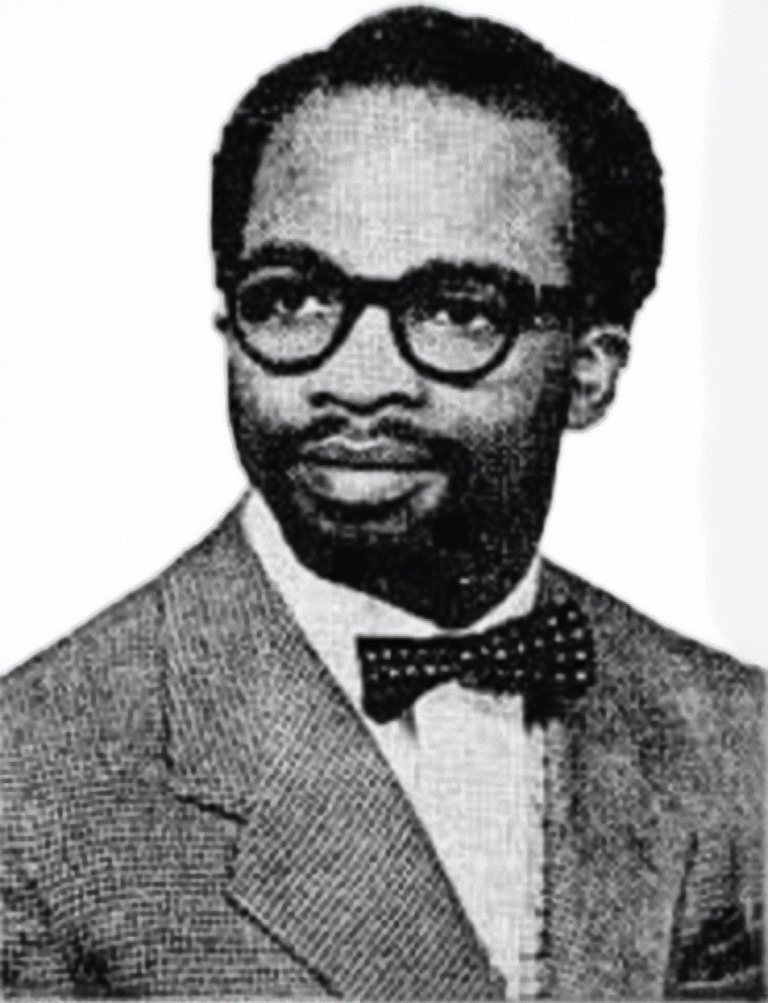
In 1958 John Oladipo Oladitan was elected to lead DUCAC, where ‘his genial personality and gift for organisation have already made him a very popular and efficient captain’. Oladitan won the Irish long jump and triple jump titles that year and would captain Nigeria at the 1960 Rome Olympics. Trinity News noted his ‘immaculate and colourful dress, from bowtie and London-tailored sports jacket to his brown suede shoes’, suggesting a wealthy background. Oladitan wrote in his autobiography that he was offered the captaincy of DUCAC twice previously, ‘but I declined on each occasion in consideration of my final degree examination which I wanted to devote maximum time to’. Perhaps the highest honour was Adedoyin’s captaincy of the 1947 Irish athletics team.
Such appointments should be contrasted to Britain, its Commonwealth and the United States. African-American athletes in US white universities were still decades away from sporting leadership, while it would not be until 1960 that an overwhelmingly non-white team like the West Indies cricket team would have a black captain.
Despite this positivity, post-war Ireland was still a difficult place for Africans. Landladies often turned down offers of accommodation arranged by phone when they saw the student. Then in 1964 a high-level spat broke out between the Irish and Nigerian governments following a number of serious racist attacks in Dublin, often concerning relations with Irish women, which resulted in at least one student losing an eye.
Ireland, however, was also a post-colonial nation. Talk of Obiakpani’s Irish call-up and Adedoyin’s national team captaincy suggested an indifference to skin colour amongst Irish sporting administrators, while universities also eschewed discrimination. Certainly, sporting life held little in the way of a colour bar for Africans in Ireland, even if things were different outside on the streets.
Patrick R. Redmond was awarded a Ph.D by De Montfort University, Leicester, for his thesis ‘The footballer of African heritage in Ireland (1948–2004): migration, identity and racism’.
Further reading
C.A. Ebelebe, Africa and the new face of mission: a critical assessment of the legacy of the Irish Spiritans among the Igbo of southeastern Nigeria (Lanham MD, 2009).
B. Fanning, Migration, and the making of Ireland (Dublin, 2018).
‘Gerrytastic’, ‘Early football players of colour in the League of Ireland’, in A Bohemian Sporting Life (https://abohemiansportinglife.wordpress.com/tag/francis-archibong/).
C. Manning, ‘Frank Obiakpani, the Nigerian college colossus’, Póg Mo Goal, 5 April 2017 (https://pogmogoal.com/league-of-ireland/frank-obiakpani-the-nigerian-college-colossus/24778/).