
By Anna Rose Garvey
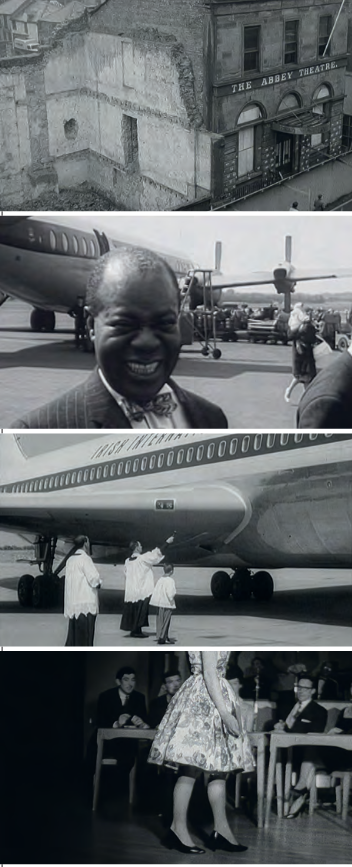
Gael Linn was established in 1953 to promote and revitalise Irish language and culture through a variety of means, which would eventually include music, film and educational initiatives. A most successful and accessible early venture was the establishment in 1956 of the Amharc Éireann newsreel, the first regular indigenous cinema newsreel since the Irish Events series of the 1920s.
The series was seeded in 1955 when Ernest Blythe, then chair of Comdháil Náisiúnta na Gaeilge (National Irish Language Council), lent Gael Linn £100 to produce a short film for cinema. This ‘pilot’ would become the first of a long-running newsreel series—Gael Linn’s Amharc Éireann. From 1956 to mid-1957 the series consisted of short single-story films that were distributed to cinemas throughout the country on a monthly basis. Their popularity was immediate, and by 1959 the series had evolved into a more traditional weekly newsreel, with each issue containing four separate stories from around the country. The series continued until 1964, when the immediacy of television as a means of delivering daily news led to a marked decline in the relevance and popularity of the cinema newsreel.
A total of 267 editions of the Amharc Éireann series were produced. The key production team consisted of Colm Ó Laoghaire (producer); Vincent Corcoran and Jim Mulkerns (camera); Peter Hunt (sound); Breandán Ó hEithir and Máirtín Ó Cadhain (scriptwriters); Pádraic Ó Raghallaigh (voice-over) and Gerard Victory (composer). Other crew members included George Morrisson, Nick O’Neill, Val Ennis and Morgan O’Sullivan.
Although Gael Linn’s Amharc Éireann production ceased in late 1964, its impact on Irish cultural identity still resonates today. The range of Irish-interest subjects covered (from hard news stories to magazine-style items) provide vivid snapshots of the rapid development of modern Ireland during a particularly progressive period under the stewardship of T.K. Whitaker, secretary of the Department of Finance, and Taoiseach Seán Lemass.
Economic and industrial progress is documented through a broad array of stories such as the introduction of innovative prefabrication in schools, the opening of a chewing-gum factory and the launch of Ireland’s first oil-fired power station. Urban development is seen in the demolition of the Theatre Royal and the old Abbey Theatre, and the building of the Adelphi Cinema. International visitors such as Louis Armstrong, Margaret Rutherford and Princess Grace are captured, while ordinary folk enjoy ploughing championships, fleadh ceoils, sporting events, ballroom dancing, hunting, shooting and ‘lovely legs’ competitions.
The IFI is delighted to present 250 films from the Amharc Éireann series as part of Seachtain na Gaeilge 2026, with the support and partnership of Gael Linn and our app provider, Axonista. Films are discoverable via a newly developed interactive map, available at https://ifiarchiveplayer.ie/map/. Viewers are invited to explore the collection in depth, browse by decade or search specific locations to reveal stories connected to places of personal or historical significance.
THE LAST OF THE OLD ABBEY THEATRE
1961 / 1 min
The old Abbey Theatre is demolished as the architects of the new building, Michael Scott and Ronnie Talon, look on.
BELFAST GREETS ‘SATCHMO’ (LOUIS ARMSTRONG)
1962 / 1 min 3 secs
Crowds welcome Louis Armstrong at Belfast airport for a day-trip to the city.
ANNUAL BLESSING OF AER LINGUS FLEET
1963 / 50 secs
A priest conducts the annual blessing of Aer Lingus aircraft on the runway of Dublin Airport.
LOVELY LEGS CONTEST
1961 / 41 secs
A ‘lovely legs’ competition is held in a Dún Laoghaire dancehall to raise money for the Voluntary Workers’ Association.
Anna Rose Garvey is Digital Platforms Assistant at the Irish Film Institute.