
LINDEN MACINTYRE
Irish Academic Press
€19.99
ISBN 9781785375750
Reviewed by
Eamonn Gardiner
Eamonn Gardiner tutors in History at the University of Galway.
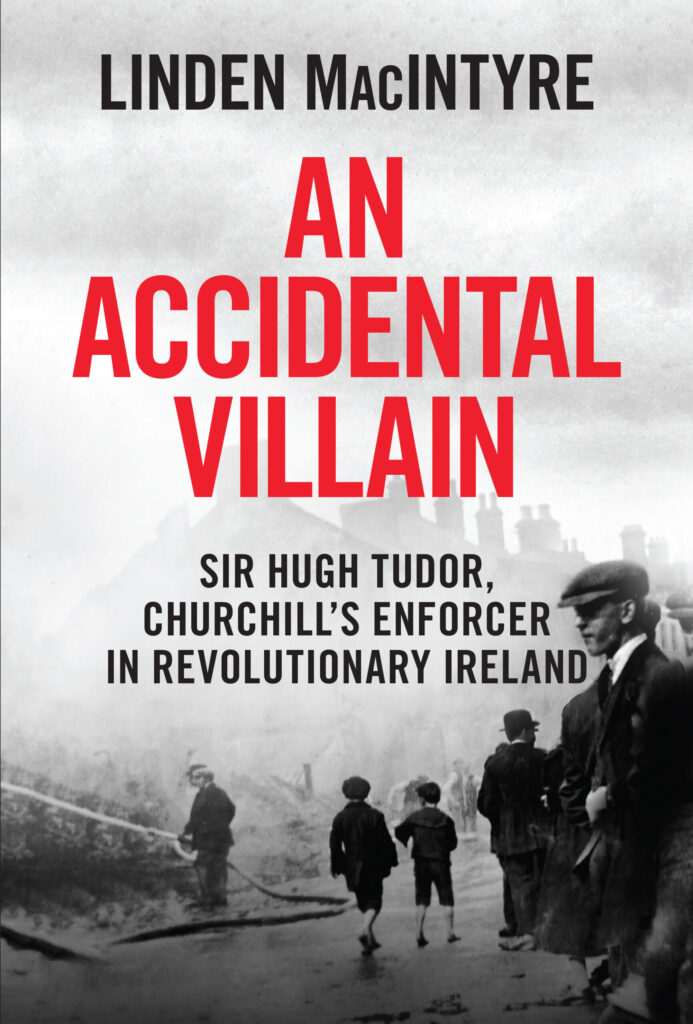
Language is important—or, rather, how we use language. The correct punctuation can exert profound change on how a sentence is interpreted, how a question is phrased, how meaning is subtly altered. Reading Linden MacIntyre’s biography of Sir Hugh Tudor, I was struck many times by the subtle truth and wisdom of this statement. Working through the text, I found myself repeatedly drawn back to the title and, certainly in my view, an inconsistency: in this case I felt that the addition of a question mark was warranted. Was General Henry Hugh Tudor ‘an accidental villain’?
Born in Devonshire in 1870, Tudor’s father was subdean of Exeter Cathedral. A scion of the British imperial golden era, Tudor embarked on his military career in 1890, graduating from the Royal Military Academy, Woolwich, and earning a commission in the Royal Horse Artillery. Seriously wounded in 1899 at the Battle of Magersfontein during the Second Anglo-Boer War, he demonstrated considerable personal strength and depth of character to return to active service. It was during the First World War, however, that he rose to professional prominence.
For an artilleryman, the Great War was the stuff of dreams—an unending siege line, in which artillery played an increasingly important role. The lack of an adequate supply of artillery shells during 1915 led to the eponymous ‘Shell Crisis’, forever cementing the centrality of indirect fire in support of infantry operations. Indeed, the ill-conceived landings at Gallipoli, which were exacerbated by a shortage in the supply of artillery shells, served as a precipitating factor in Winston Churchill’s own odyssey to frontline service and a momentous rekindling of his friendship with Tudor.
The ‘Gallant Gunner General’, as Major-Gen. Tudor became known, laid claim to several tactical innovations during the conflict, including the ‘creeping’ and ‘box’ barrages. These tactically astute support mechanisms played to their creator’s technical strength, earning him considerable plaudits among the upper echelons. Under considerable and effective fire from the enemy, on more than one occasion troops under Tudor’s command held fast and the general himself demonstrated considerable personal valour. By the time of the Armistice, Tudor was regarded as a man who could achieve results in the most trying of circumstances.
For the stoic Tudor, few things in life were as fundamentally important as the friendships he had formed throughout his military service. The most consequential of these was certainly his lifelong acquaintance with Winston Churchill. Having initially met whilst serving as junior officers in India, the two were destined to engage with each other through a succession of imperial conflicts, such as the Boer War, the Great War, Ireland and eventually the British mandate in Palestine. Churchill was the catalyst for Tudor’s introduction to the Irish conflict, the latter being persuaded to serve as the ambiguously titled ‘police advisor’ in a conflict marked by its ambivalence. If Tudor showed any discomfort with the actions of the police forces that he was leading (the Royal Irish Constabulary, replete with ‘Black and Tan’ reinforcements, and the Auxiliary Division), he gave little indication.
Disappointingly, the chapters on Ireland and the Great War hold precious little fresh information for the enthusiastic scholar. Instead, they read like a Boy’s Own magazine, rehashing well-trodden anecdotes of Tudor’s interactions with Churchill and his personal bravery at the front. Conspicuously, there is little mention of Tudor’s interactions with his own staff, subordinates and superiors. While he is rightly well regarded as a master tactician in his field, there is little space given to how he was regarded by his peers and the command hierarchy. Overall, he seems to have been poorly regarded by both military and civilian peers alike. MacIntyre notes that contemporaneous journal entries regard Tudor as politically naive, insensitive to the undercurrents rife in bureaucratic life.
There is also little that historians can draw on to rehabilitate Tudor’s character during this period of service. For a committed diarist, it seems quite odd that he actively chose not to record daily occurrences. Even allowing for a personal reticence to commit pen to paper chronicling a ‘dirty war’, it seems unorthodox that an experienced military commander would not record military engagements and verbal orders (or non-orders) with which he enthusiastically engaged. Nowhere is this more apparent than in Tudor’s reconciling of the difference between what the prime minister, David Lloyd George, said and what he meant. As Mark Sturgis (assistant undersecretary in Dublin Castle) noted, Tudor displayed ‘passive approval’.
There was an almost total dissatisfaction with Tudor’s apparent lack of empathy, wilful ignorance regarding the political realities of his roles and tone-deafness to the concerns of colleagues, superiors and subordinates. This is perhaps indicative of the difficulty he faced as a proficient battlefield commander, making the transition to a more dynamic, more opaque operating environment. It is fair to say that he was also ill prepared for the intense and subversive power struggles taking place within the political establishment itself.
To be fair to Linden MacIntyre’s biography, it does uncover considerable detail on what was regarded by many to be the subject’s twilight years, from his estrangement and very public separation from his wife to his self-imposed exile in Newfoundland. Perhaps a Canadian historian was always going to be the most capable of re-examining this quixotic period of a very enigmatic character.