
BY DONAL FALLON
WEXFORD ORAL HISTORIES GO ONLINE
The Digital Repository of Ireland (DRI) continues to provide an important online home for Irish primary source materials, and great credit is due to Wexford Library and Archives for uploading four collections of oral history recordings, which are now freely available to researchers internationally. The collections include ‘Memories of World War I—County Wexford Oral History Project’, gathered during a roadshow in 2014 when members of the public shared heirlooms and stories relating to local men. There are endless hours to be spent browsing the DRI, including the excellent Fáilte Ireland collection of images, digitised by Dublin City Library and Archives.
THE UNITED STATES OF AMERICA AT 250
With this being the 250th anniversary of American independence, expect many events throughout the year highlighting Irish connections to the birth of the United States. The Irish America 250 group, described as a non-partisan grouping ‘intent on placing the Irish at the centre of America’s 250-year celebration’, have launched the year with the unveiling of a plaque in Cork’s Blarney Street to General Stephen Moylan, aide-de-camp to Washington and the man often credited with coining the phrase ‘United States of America’. Patrick Long’s entry on Moylan in the Dictionary of Irish Biography is well worth reading, noting that after the war ‘he remained in the thoughts of Washington, who as first US President appointed Moylan commissioner of loans in Philadelphia in 1793’.
THE MAN FROM CASTLE ISLAND
Last December marked the centenary of the birth of Con Houlihan. It would do him a great disservice to describe Con as a sports journalist, given the extraordinary depth of his interests in all matters literary and cultural. Now a GoFundMe campaign has been launched to restore Con’s homestead in his native Castle Island (two words, he insisted). It is spearheaded by locals, who hope that ‘by creating a place where people can connect with Con’s life, stories, and spirit, we can inspire future generations and attract visitors who appreciate the richness of Irish literary and sporting heritage’. Marking the recent centenary, a new painting by the celebrated Kerry artist Liam O’Neill was unveiled in the back bar of The Palace on Dublin’s Fleet Street. For more, see www.gofundme.com/f/con-houlihans-cottage-project.
STROKESTOWN PARK FUNDING
There was welcome news for Strokestown Park, home of the National Famine Museum, with the announcement of a €1.2 million investment from the Fáilte Ireland Regenerative Tourism and Placemaking Scheme. John O’Driscoll, Irish Heritage Trust general manager at Strokestown Park, welcomed the funding and noted that ‘this new project will revitalise Strokestown Park estate’s extraordinary natural and cultural assets, linking education and heritage with biodiversity and community well-being … The extensive programme of works will respect Strokestown Park’s historic character and natural heritage, with new infrastructure designed to complement the landscape.’
INTERNATIONAL RECOGNITION FOR IRISH FOOD HISTORY
Comhghairdeas mór to Máirtín Mac Con Iomaire and Dorothy Cashman, whose Irish food history: a companion (reviewed in HI 33.3, May/June 2025) continues to receive significant international recognition. A landmark publication from the Royal Irish Academy, the edited collection received a special recognition award at the 31st Gourmand World Cookbook Awards in Riyadh in November. The work includes chapters on subjects as diverse as Jonathan Swift and food, the story of food in prehistoric Ireland and Maura Laverty’s food writing. The work is an extraordinary achievement that crosses disciplines of academic research and it is freely available online at www.arrow.tudublin.ie/.
A REMINDER OF THE SPIRIT GROCER
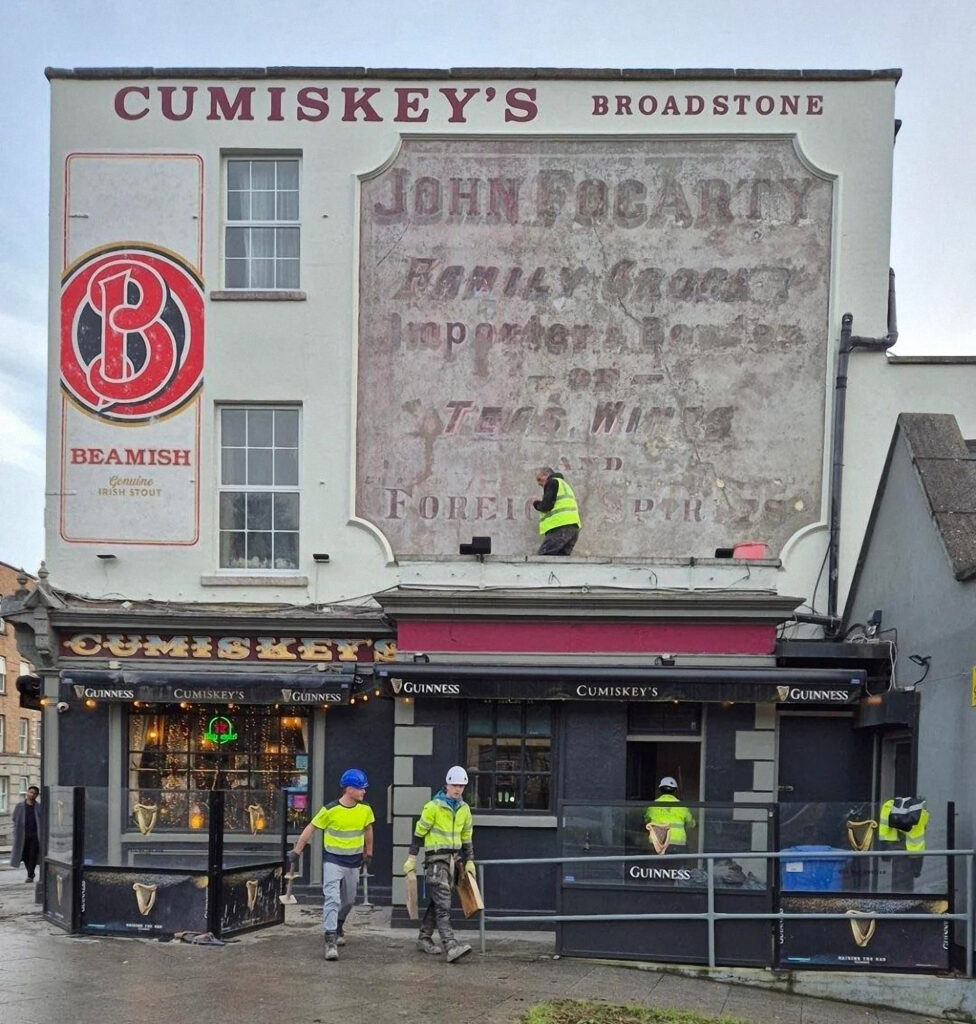
Cumiskey’s of Broadstone is not merely the nearest public house to History Ireland’s editorial office but is also a great one by any standards. Recently, work on the front of the building has revealed a beautiful and historic hand-painted advertisement for what was once John Fogarty’s, noting that it was not only a public house but also a family grocer. The combination of grocer and public house was not universally popular in the late Victorian and Edwardian age, with the suffragette newspaper The Irish Citizen arguing that ‘women’s societies should agitate for the abolition of the spirit grocer’s licence. A large part of the drinking among women is due to this spirit grocer’s licence. How many women, and even men, who would shrink from being seen going into an open bar find an excuse to buy something else in order to slate their alcoholic thirst surreptitiously?’ It’s a beautiful piece of signage and will hopefully be preserved long into the future.