
BY DONAL FALLON
1916 ACTION MAP
Marking the 110th anniversary of the Easter Rising, the Military Archives have released a new interactive map that shows where 2,611 recognised participants were active during Easter Week across the island (https://www.militaryarchives.ie/en/online-collections/military-service-pensions-collection/irish-revolution-1916-1923/easter-rising-1916). The map will be useful for those trying to get a picture of the action beyond the main garrison sites and can demonstrate how luck (or the absence of it) shaped the week of individual Volunteers. As an example, the Rialto Bridge is marked owing to the arrest of two Volunteers there on Easter Monday. They would spend the week in Richmond Barracks. These have been busy months in the Military Archives, with a range of new material online as well as improved search functionality across existing collections.
COBH CHRONICLE ONLINE ARCHIVE
Congratulations to all at the Cobh Chronicle on the launch of their excellent online archive (www.cobhchronicle.ie/). Inaugurated in 2020, the publication is run on a not-for-profit basis, seeking ‘to gather the historical knowledge, experiences and expertise of the local community’. Five years of material is now available for free on a user-friendly website, with articles including Pádraig Ó Maoláin’s examination of the ‘Whaleboat Tragedy’ of 1877 and Marita Foster’s study of Archbishop Mannix and the Cobh connection.
DONEGALL ROAD WORKHOUSE REMEMBERED
No part of the island escaped the horror of the Great Hunger, even if death-tolls were drastically different in places. A new plaque on Belfast’s Donegall Road marks the site of a workhouse that opened its doors in 1841 and which became a place of burial for victims of the crisis. Historian Robyn Atcheson noted that, ‘With this memorial, we are acknowledging the working poor, the sick and the hungry who passed through the workhouse as well as those who died as a result of epidemics and whose families could not afford a grave’.
DRESSED TO IMPRESS
In the story of Irish fashion there are few names as important as Sybil Connolly. As her biographer Robert O’Byrne notes, ‘she managed to make the sale of clothes to markets previously not open to Irish fashion seem entirely effortless’. An impressive collection of items relating to Connolly has gone on display at Limerick Museum, with Dr Zara Power noting that ‘this exhibition brings together a remarkable collection of Connolly’s work, including rarely seen garments, among them a piece worn by Máirín Lynch, wife of former Taoiseach Jack Lynch, as well as maquettes, sketches, and a selection of her interior design objects. Kindly on loan from the Hunt Museum, and Cork Public Museum, this exhibition offers a rare opportunity to view a much-loved collection that is not normally on public display.’ The exhibition runs until the end of July.
INTERNATIONAL RECOGNITION FOR 14 HENRIETTA STREET
The 14 Henrietta Street museum has been announced as a winner of one of Europe’s most prestigious awards for heritage, the European Heritage Award/Europa Nostra Award. While colloquially known in Dublin as the ‘Tenement Museum’, the house tells the much broader story of a Dublin address through centuries of a changing city. Congratulating the museum, Dublin’s lord mayor highlighted the importance of its ongoing oral history work and noted that the award ‘also honours the thousands of lives that passed through the doors of this house over more than 300 years’.
CATALPA ANNIVERSARY MARKED
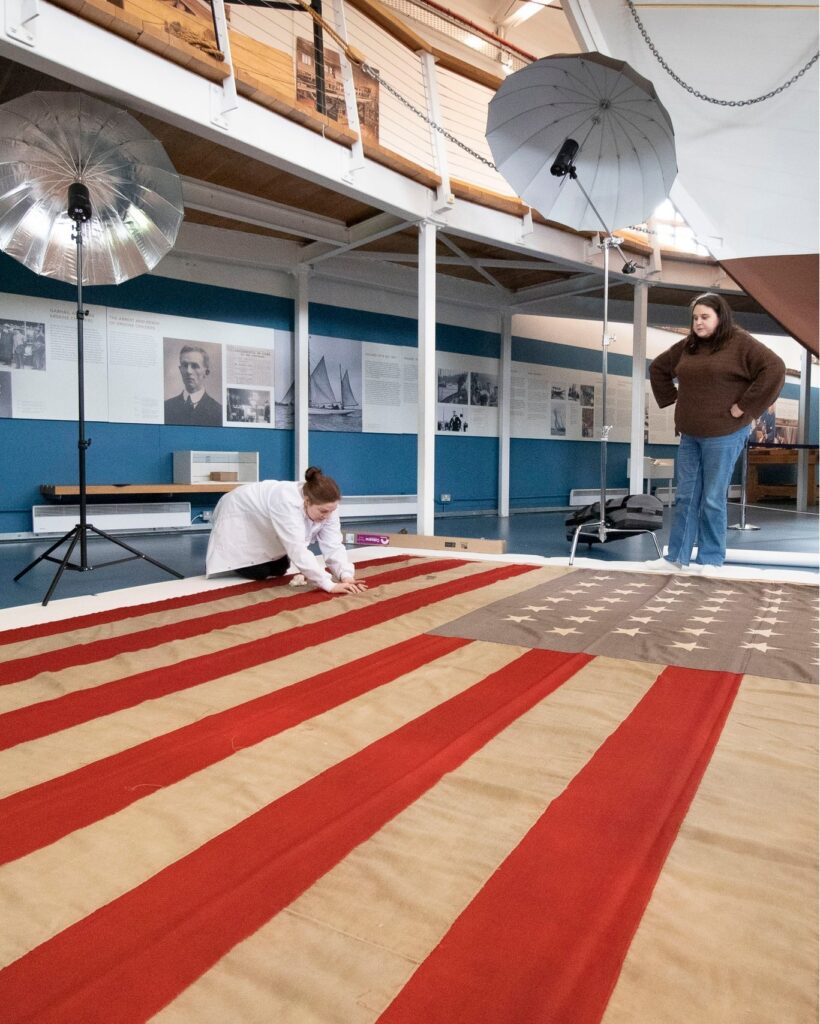
The recent display of the flag of the Catalpa—marking the 150th anniversary of the Fenian jailbreak from Fremantle Prison in April 1876—brought huge numbers of visitors to the National Museum of Ireland at Collins Barracks over a busy April weekend, coinciding with the launch of the 1926 census. The National Museum of Ireland noted that, ‘measuring more than four metres by three metres, it is the largest flag in the national collection. Its size prevents it from being shown in standard gallery spaces, making this a rare opportunity for the public to view this important historic object.’ There are further plans for letters relating to the Catalpa escape to be displayed from the collections of the National Library of Ireland, ensuring ongoing public interest in the anniversary.