
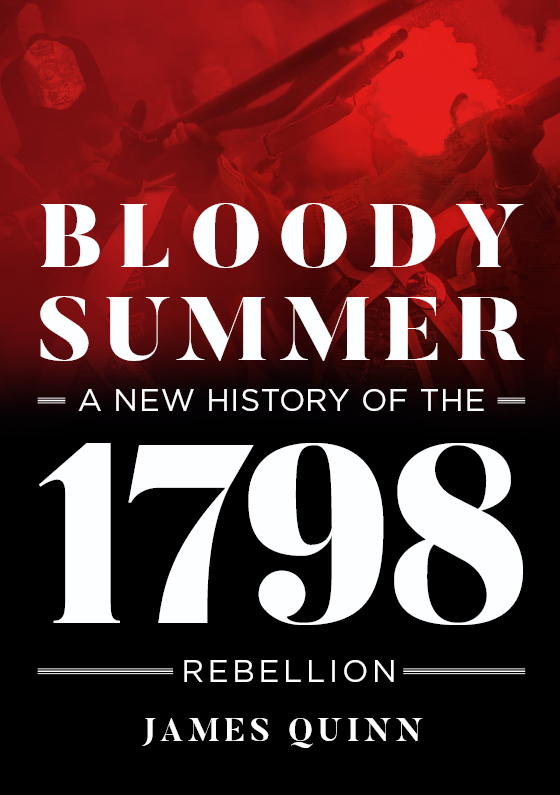
JAMES QUINN
UCD Press
€30
ISBN 9781068502347
REVIEWED BY
Timothy Murtagh
Timothy Murtagh is a Research Fellow with the Virtual Record Treasury of Ireland, Trinity College, Dublin.
The literature on the 1798 rebellion is unusually crowded for an event that remains, for many readers, oddly elusive. Its narrative complexity, geographical fragmentation and moral ambiguity have long posed challenges for historians seeking to balance explanation with coherence. James Quinn’s Bloody summer sets itself an ambitious but deceptively modest task: to provide a clear, concise and up-to-date narrative history of the rebellion that is intelligible to non-specialists without flattening the scholarship of the past several decades. It succeeds impressively. Quinn is well known as a historian of late eighteenth-century Ireland, particularly through his work for the Dictionary of Irish Biography and his biography of Thomas Russell. That earlier study was notable for its stylistic clarity and sensitivity to the ideological fractures and contingencies that shaped radical politics in the 1790s, qualities much in evidence here. Bloody summer is crisply written, tightly structured and clearly the product of long familiarity with both the archival record and the interpretative debates surrounding the rebellion.
Narrative accounts of 1798 inevitably operate in the shadow of Thomas Pakenham’s The year of liberty (1969), a work whose vivid storytelling helped define the field for a generation but also left significant interpretative gaps. Earlier regional studies, notably Daniel Gahan’s now under-used work on Wexford and A.T.Q. Stewart’s influential studies of Antrim and Down, added important texture, while the 1998 bicentenary generated a substantial body of scholarship that complicated older narratives, particularly around popular loyalism, sectarian violence and state repression. Yet much of this literature has struggled to reach a wider audience, and key questions, especially concerning the motivations of ordinary loyalists and rebels, remain under-explored. Quinn does not claim to resolve these problems. Rather, he offers what is arguably most needed now: a reliable and readable point of entry into the rebellion for a new generation of readers.
The opening chapter, ‘Ireland in the eighteenth century’, immediately distinguishes Bloody summer from Pakenham’s approach by providing a succinct overview of longer-term structural tensions within Irish society. Quinn draws deftly on recent scholarship, balancing S.J. Connolly’s ‘ancien régime’ interpretation of the penal laws with a clear sense of their social and cultural impact. He sketches the emergence of patriot opposition and briefly notes economic and demographic pressures, situating the rebellion within a recognisably eighteenth-century context. Chapter 2 examines the impact of the American and French revolutions, incorporating work by Vincent Morley, Pádraig Ó Snodaigh and others on political communication and mobilisation, before moving into a concise account of the United Irishmen that draws on the classic studies of Nancy Curtin and Marianne Elliott.
However, the book’s real strengths emerge in Chapter 3, ‘War, conspiracy and counter-revolution, 1793–9’. Quinn offers a nuanced account of the impact of war, the radicalisation following the failed Fitzwilliam viceroyalty in 1795 and the increasingly coercive turn of government policy. He integrates the difficult literature on Defenderism with clarity and caution, and is particularly effective in highlighting fractures within the radical movement, differences between Dublin and Belfast networks and the transformation of the United Irish organisation under repression, issues often blurred in earlier narrative histories.
The central chapters trace the rebellion itself with admirable economy. Chapter 4’s account of the abortive Dublin rising and the explosion of violence in Leinster is clear-eyed and unsensational. Quinn does not shy away from atrocities, whether at Dunlavin, Carnew or Scullabogue, though the latter is treated briefly, perhaps too briefly for some readers. His treatment of Wexford captures both the momentum of rebel success and the chaos that accompanied it, without resorting to overstated claims about a coherent ‘Wexford Republic’. Accounts of New Ross and Arklow are level-headed and judicious. Chapter 5 maintains a coherent national narrative as it pivots between Ulster, south Leinster and Munster, integrating Stewart’s work on the northern rebellion while remaining clear about its limitations. Its discussion of Munster is particularly welcome, shedding light on a region which is too frequently ignored in standard accounts of the rebellion. The Connacht rising of 1798, covered in Chapter 6, is handled with similar assurance, from Bantry Bay and Humbert’s landing to the capture of Wolfe Tone and Napper Tandy’s abortive expedition.
The final chapters broaden the analytical frame, with three chapters dedicated to ‘Causes’ and ‘Consequences’ and ‘Representations’. Quinn’s treatment of the aftermath of rebellion, its human costs and the persistence of violence into the early nineteenth century usefully resists the tendency to rush straight to the Act of Union. These chapters are undoubtedly the most original sections of the book, particularly the discussion of the afterlives of exiled rebels within transatlantic reform movements.
If there is a limitation to Bloody summer, it lies in what is necessarily sacrificed to concision. Individual voices and motivations, especially among rank-and-file participants, rarely come into sharp focus, and readers interested in the mental worlds of those who committed sectarian violence in places such as Scullabogue or Wexford town may find the analysis frustratingly brief. Folkloric and legendary dimensions of popular memory also remain largely offstage. These are, however, conscious trade-offs rather than flaws. Quinn has written a fast-paced, authoritative and humane account that refuses to become mired in historiographical trench warfare. In doing so, he has produced what may well become the standard introductory history of the 1798 rebellion for years to come, a genuinely ‘new’ history in the sense that matters most: one that makes a complex and troubling episode intelligible to readers encountering it for the first time.