
By Daragh Fitzgerald
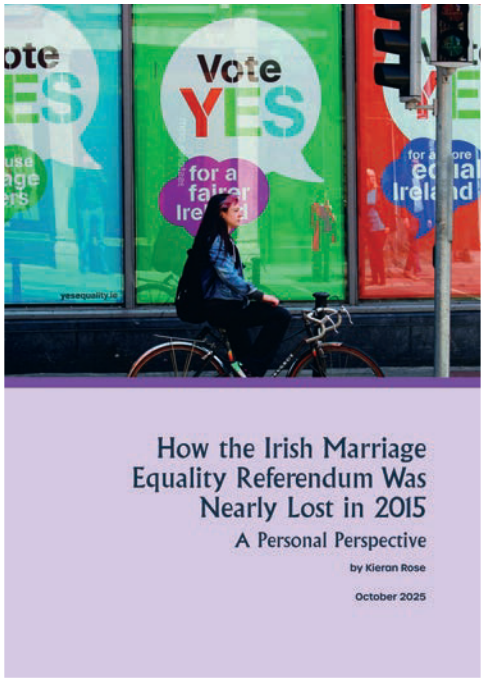
We begin the new year with a new uachtarán, after Catherine Connolly’s resounding victory in October’s presidential election. While her campaign was helped by the incompetence of her opponents, you can only beat who you are up against, as Jim Gavin should know. Connolly’s independent background and vigorous campaign involving the participation of various elements of civil society ensured that she secured the highest proportion of first-preference votes in a contested presidential election in the state’s history. In empowering local communities, Connolly’s campaign evidently learned lessons from recent progressive campaigns such as the Marriage Equality referendum in 2015. The struggles faced by those advocating a ‘Yes’ vote is documented in Kieran Rose’s How the Irish Marriage Equality referendum was nearly lost in 2015. Rose explains how some sections of the Yes campaign were reluctant to create a broad democratic movement and were even complacent, taking victory for granted. Victory was, of course, achieved after an independent review recommended opening the Yes campaign up to broader civil society.
Regardless of for whom one voted—Connolly, Humphreys or Brian Boru, which was just one name that appeared on the plethora of spoiled votes—it is a testament to how far we have come as a nation that those of us who reside in the south of our island have the privilege of choosing our head of state. A little over a century ago, the House of Windsor ruled all of Ireland through an unelected lord lieutenant and chief secretary, garrisoned the island with thousands of soldiers and propped up the landed gentry who dominated political, social and cultural life to the detriment of the men (and women) of no property. The Lismore (O’Callaghan) estate under William Robert Hood Rochford, 1891–1902, in counties Cork, Limerick and Tipperary draws out a vivid social history of what life was like for the tenants, land agents, subagents and ‘rent warners’ who lived and died under these conditions. The estate encompassed a staggering 42,000 acres and had its seat at Shanbally Castle. The ‘Big House’ allegedly had one more window than Buckingham Palace and was ultimately blown up not by the IRA but by the Land Commission in 1960.
Finding Mary: the untold story of an Inishowen murder, 1844 details a harrowing story of murder, desperation and survival from the nineteenth century. Angela Byrne, author of the recently published Irish Historic Towns Atlas for Ballyshannon, recounts how a fourteen-year-old domestic servant, Mary Doherty, was brutally murdered while her employers were at Mass. Official attention was quickly drawn to Daniel McKeeny. A conviction could not be secured, however, and McKeeny was instead transported to Van Dieman’s Land on a previous charge of sheep-stealing. While in gaol awaiting trial, Daniel shared a cell with 27-year-old Michael Gallagher, who was himself to be transported Down Under for stealing two heifers. Michael claimed that Daniel confessed Mary’s murder to him and, as his family’s sole breadwinner with a sick dependent mother, appealed for clemency from the lord lieutenant in return for providing testimony against Daniel. Michael’s story, however, was deemed concocted to secure his own release, and the cellmates were both ultimately shipped across the waves.
While transportation to a penal colony could befall those who fell foul of the law, other Irish people facing desperate conditions at home crossed the seven seas in their millions seeking a brighter future—by the late nineteenth century, 50% of people who had been born in Ireland would die elsewhere. While most of these individuals are forgotten by all but their descendants, history has been kinder to some Irish seafarers, whose stories are presented in Famous Irish mariners. St Brendan of Clonfert, who was said to have crossed the Atlantic in the sixth century, combating the sea monster Jasconius on his journey, has chapels dedicated to him in Scotland, Sicily, Malo Bay (until it was destroyed by Allied bombing in 1944) and the United States, where he is the patron saint of the navy. Irish mariners are held in high regard in many South American countries too—William Brown and Peter Campbell are national heroes in Argentina and Uruguay respectively, being founders of these nations’ navies, while Irishmen also founded the Brazilian and Ecuadorian navies.
The conditions on the ships taking Irish migrants across the world could be horrific, with disease rampant, while ‘fever’ was a merciless killer of those who remained at home too. ‘Fever’ as understood in the early nineteenth century encompassed the three distinct diseases of typhus, typhoid and relapsing fever, diseases that festered in the crowded damp environments of urban centres like Dublin. Pre-Famine fever epidemics: a case study of the Cork Street Fever Hospital, Dublin outlines how such epidemics were combated, using the Cork Street Fever Hospital and the fever outbreaks of 1817–19 and 1826–7 as case-studies. This hospital opened its doors in 1804 after a three-year campaign by wealthy philanthropic-minded Dubliners to relieve the local poor, in the absence of any modern public healthcare system. The hospital later moved its operations to Cherry Orchard and the site is now run by the HSE, providing services to children with additional needs.
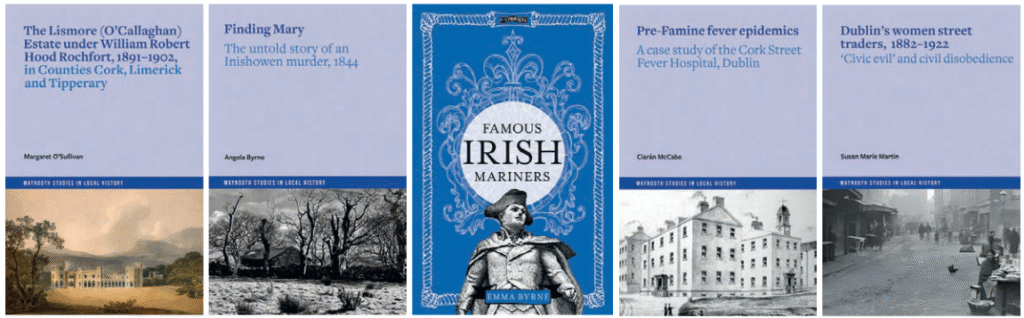
The Liberties is one of many neighbourhoods where women street traders could be heard selling their wares down the years. Such women are so iconic that they have become personified in the unofficial mascot of Dublin, the fictional Molly Malone (who died of a fever, of course!). Women street traders have been a staple of Dublin life for centuries, counted amongst those who welcomed King James II to the city in 1689 and depicted in James Malton’s eighteenth-century rendition of College Green, while Jonathan Swift even composed verses ‘for the women who cry Apples’. Dublin’s women street traders, 1882–1932 discusses the working lives of these women as they navigated the changing constitutional situation of the island and faced repression from a state that was born on the promise to ‘cherish all children of the nation equally’. Such characters can still be found on Moore Street, a site that has itself been neglected by the state despite its social and historical importance.
Donal Fallon’s The Dublin pub: a social and cultural history documents the songs and stories of Dublin’s public houses, described by Stephen Gwynn as our equivalent of Parisian cafés. Literary, artistic and revolutionary cadres frequented many pubs that still serve Dubliners today, like the Long Hall and the Bleeding Horse, two centres of Fenian conspiracy. Robert Emmet was said to have organised his insurrection from the Brazen Head, which his ghost still haunts in lieu of a final resting place, while Tone’s spectre has been seen at nearby Tailors’ Hall, once the site of the ‘Back Lane Parliament’ but now a trendy Liberties bar. Some pubs in the city get their name from colourful citizens, like the Hairy Lemon, named after a 1940s Dublin dog-catcher, or Dudley’s on Thomas Street, named in honour of Thomas Dudley, known to most of us as ‘Bang Bang’. Other fantastically named spots like the Horseshoe and Magpie have fallen to progress.
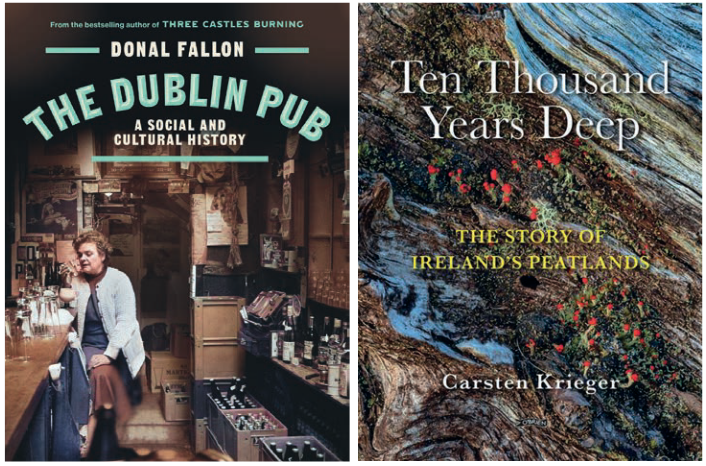
Ten thousand years deep: the story of Ireland’s peatlands is concerned with the bogs, fens and heaths of the island and by necessity takes a longer view of history, as these marshlands developed over millennia. Once believed to be gateways to the Otherworld, Ireland’s peatlands are certainly time capsules from another world to our own, being repositories of Bronze Age jewellery, ancient currachs and the bodies of people sacrificed to the gods of the land.
Kieran Rose, How the Irish Marriage Equality referendum was nearly lost in 2015: a personal perspective (https://kieranrose.ie).
Margaret O’Sullivan, The Lismore (O’Callaghan) estate under William Robert Hood Rochford, 1891–1902, in counties Cork, Limerick and Tipperary (Four Courts Press, €11.65 pb, 64pp, ISBN 9781801511780).
Angela Byrne, Finding Mary: the untold story of an Inishowen murder, 1844 (Four Courts Press, €11.65 pb, 96pp, ISBN 9781801511742).
Emma Byrne, Famous Irish mariners (O’Brien Press, €17.99 hb, 168pp, ISBN 9781788494922).
Ciarán McCabe, Pre-Famine fever epidemics: a case study of the Cork Street Fever Hospital, Dublin (Four Courts Press, €11.65 pb, 64pp, ISBN 9781801511797).
Susan Marie Martin, Dublin’s women street traders, 1882–1932 (Four Courts Press, €11.65 pb, 72pp, ISBN 9781801511773).
Donal Fallon, The Dublin pub: a social and cultural history (New Island Books, €26.95 hb, 272pp, ISBN 9781835940242).
Carsten Krieger, Ten thousand years deep: the story of Ireland’s peatlands (O’Brien Press, €24.99 hb, 160pp, ISBN 9781788494861).