
By Daragh Fitzgerald
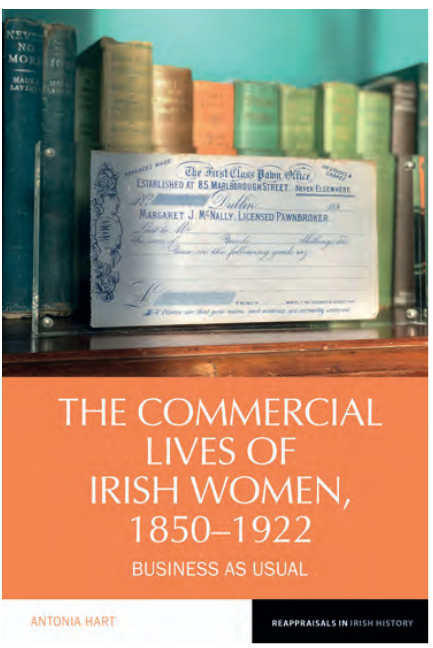
An American visitor to our shores recently asked me whether Catherine Connolly was Ireland’s first female president and was delightfully surprised to hear that three of our last four presidents have been women. While we still have a lot to do regarding the position of women in Irish society, that we have gone from Magdelene laundries and fierce debates over the permissibility of divorce to electing a third woman as our head of state since 1990 is surely an achievement to be proud of. Until relatively recently women were marginalised in historiography, but there has been an explosion of interest and enquiry into the experiences of women across Irish history, particularly the revolutionary period. The commercial lives of Irish women 1850–1922: business as usual is a case in point and bucks a lot of assumptions regarding women’s ability to participate in commercial life over a century ago. Women were visible and engaged in Irish business as far back as 1800, when 50 women in commerce were listed in the Dublin Directory. In 1894, 10% of businesses on Dublin’s Sackville Street were run by women, and at the turn of the century close to 20% of pawnbrokers in the city were women. Women entrepreneurs were also active in hospitality and retail, while some ran private schools and music academies. Of course, most women in paid employment in this period were domestic servants, accounting for 18% of total employment by 1881.
Colum Kenny’s Myths and lies of ‘the Irish revolution’ seeks to challenge deep-seated shibboleths regarding ‘the Irish revolution’ (if there really was one), with particular focus on the Anglo-Irish Treaty. In this respect, it is consciously revisionist (in both a literal and, in places, pejorative sense). Kenny surgically dismantles the widely held belief, originated by Frank Pakenham, that Arthur Griffith undermined the Treaty negotiations by making ‘startling and secret concessions’ to Lloyd George that he would not break on Ulster. Pakenham’s account itself seems to be based on a much later conversation with the former Tory leader and Treaty negotiator Austen Chamberlain. Griffith rather gave Lloyd George assurances that he would not publicly repudiate proposals for a boundary commission, as the British government were about to put them before a meeting of Conservatives and Unionists and feared that open nationalist opposition would scupper the boundary commission in utero. Like many nationalists, Griffith was primarily guilty of naivety around partition rather than the treachery that is alleged. Elsewhere, Kenny dismisses social issues as ‘marginal’ during the revolutionary period, evidenced by Labour ‘stepping aside’ in the 1918 general election. While this episode remains controversial, particularly for those on the left, this is not a fair portrait of the upheavals across Ireland in this period. If social issues were marginal, why did Labour win so many seats in the June 1922 election, which some see as a referendum on the Treaty? Kenny notes that there were dozens of soviets established nationwide—there were in fact over 100 in Munster alone—yet land agitation and cattle-drives are notable for their absence. Cherry-picked quotes distancing Irish revolutionaries from the Bolsheviks and describing them as ‘the most conservative-minded revolutionaries that ever put through a successful revolution’ help Kenny’s argument, but others from the likes of Thomas Johnson, Liam Mellows and Constance Markievicz could suggest a very different story. In both cases such partisan positions would be unconvincing. While Ireland in 1920 was not Russia in 1917, class mattered a lot during the Irish revolution, as it still matters today.
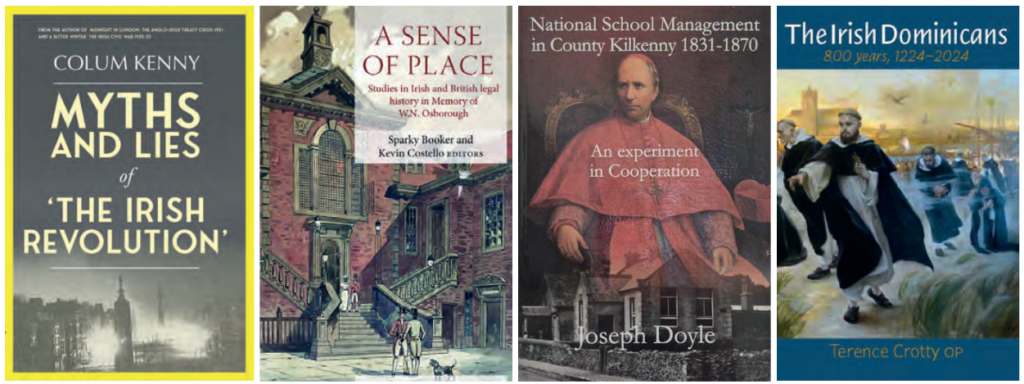
Winston Churchill emerged from this period with a sullied reputation in Ireland and so, while readers will not be surprised that Churchill could be dishonest, they may be unaware that he was accused of libel, and almost taken to court, by an Irish soldier after the Second World War. Eric Dorman Smith of Cootehill was commissioned in the Northumberland Fusiliers and won a Military Cross for his bravery in the Great War before being made deputy chief of general staff in the Middle East in 1942, helping the defence of Egypt. Dorman and his superior, Sir Claude Auchinleck, were removed from their positions when they refused to launch a counter-offensive on German forces which they believed would be disastrous. Dorman later felt that he had been libelled by Churchill when he described the episode in his memoir, The hinge of fate. The tribulations of Dorman, who later allowed the IRA to use his Cavan estate for training during the Border Campaign, can be found in A sense of place: studies in British and Irish legal history in memory of W.N. Osborough. This collection is dedicated to a titan of legal history, W.N. Osborough, who helped set up the Irish Legal History Society and re-establish legal history as an undergraduate option in university law degrees.
While Irish history is obviously full of conflict and division, cooperation with the imperial authorities is also a recurrent theme, and perhaps most evident in the nineteenth-century National School scheme. National School management in County Kilkenny, 1831–1870 is a great example of how local history can demonstrate how government policies operated in real life and shaped lived experiences, while also taking the reader through a national story—in this case one of collaboration, as well as conflict, between the Irish Catholic hierarchy and the Commissioners of National Education.
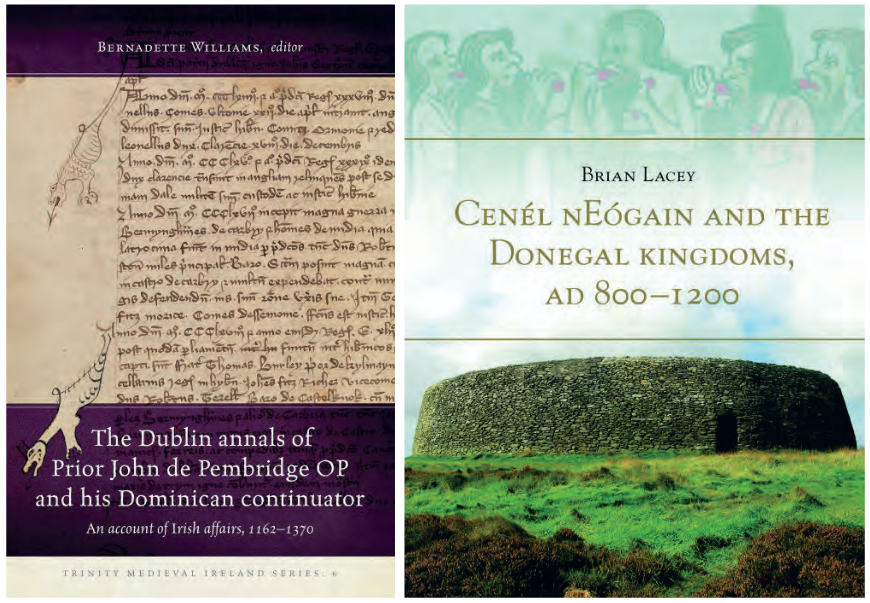
The Irish Dominicans: 800 years, 1224–2024 traces the long history of this order in Ireland. The Dominicans arrived in Ireland from Bristol in 1224, and by 1229 the order’s reach spread from Cork in the south of Ireland to Tallinn in north-east Europe. Those who want to delve further into the early history of the order in Ireland should look no further than The Dublin Annals of Prior John de Pembridge OP and his Dominican continuator: an account of Irish affairs, 1162–1370. Skipping forward, Dominicans ‘sound on the national question’ stored gelignite at their college in Newbridge for the Easter Rising, and the college was later repeatedly surrounded by Black-and-Tans and Auxiliaries. While it was never raided, the Dominican Church on Dominick Street (hence the name), St Saviour’s, was in 1921. This church was long associated with nationalism, holding public recitations of the rosary for the centenary of 1798, and it was also where Patrick Pearse received communion before the Rising. Irish Dominicans could be found across the political spectrum. Fr Rupert Roche was a military chaplain in the British Army, ending up in Murmansk as Britain tried to crush the Bolshevik revolution. Roche’s party were captured by the Reds and all were executed except for the Dominican, who was released on account of his cloth. Godless communists?
Brian Lacey’s Cenél nEógain and the Donegal kingdoms, AD 800–1200 is concerned with the Gaelic kingdom which came to dominate Ulster as it spread across modern Derry, Tyrone and Armagh. The leading families of the dynasty were the O’Neills and Mac Lochlainns, while their chief rivals were the O’Donnells. The O’Neills and O’Donnells squabbled for Ulster until the Tudor Conquest, at which point Ulster was the most Gaelic part of Ireland.
Antonia Hart, The commercial lives of Irish women 1850–1922: business as usual (Liverpool University Press, €115 hb, 240pp, ISBN 9781836244844).
Colum Kenny, Myths and lies of ‘the Irish Revolution’ (Eastwood Books, €20 pb, 320pp, ISBN 9781916742963).
Sparky Booker and Kevin Costello (eds), A sense of place: studies in British and Irish legal history in memory of W.N. Osborough (Four Courts Press, €55 hb, 398pp, ISBN 9781801511810).
Joseph Doyle, National School management in County Kilkenny, 1831–1870 (Geata Buidhe Books, €25 pb, 231pp, ISBN 9781036930677).
Terence Crotty OP, The Irish Dominicans: 800 Years, 1224–2024 (Dominican Publications, €30 pb, 468pp, ISBN 9781905604517).
Bernadette Williams (ed.), The Dublin Annals of Prior John de Pembridge OP and his Dominican continuator: an account of Irish affairs, 1162–1370 (Four Courts Press, €49.50 hb, 316pp, ISBN 9781846829659).
Brian Lacey, Cenél nEógain and the Donegal kingdoms, AD 800–1200 (Four Courts Press, €49.50 hb, 352pp, ISBN 9781801511711).
Conchubhair Ó Crualaoich and Kevin Whelan, Gaelic Wexford 1400–1660: culture, landscape, settlement (Cork University Press, €59 hb, 454pp, ISBN 9781782050827).