
By Aisling Heffernan
A recent sale in Adams Auctioneers, Dublin, featured a painting of Charles Campbell, forever linked to a chance discovery that unveiled one of the nation’s most famous archaeological treasures—the 5,000-year-old Neolithic passage tomb of Newgrange.
In 1699 the site was nothing more than an unassuming hill on Campbell’s lands. Seeking materials for road construction, Campbell directed his workmen to gather stones from the mound. By a stroke of luck, their excavations quickly uncovered the elaborately carved entrance stone, halting the destruction and revealing the magnificent passage tomb that had lain hidden for over five millennia.
Today, Newgrange stands as one of Ireland’s Prized UNESCO World Heritage Sites and a National Monument, drawing visitors from across the globe. It is Ireland’s most visited archaeological site, not just for its age but also for its astounding engineering and unique astronomical sophistication. The monument’s most celebrated feature is its precise alignment with the rising sun on the winter solstice (21 December). This feat of Neolithic architecture centres on a feature known as the ‘roof box’, a small opening positioned directly above the main entrance. Each year, at dawn on the shortest day, the rising sun’s light pierces the darkness through this roof box, travelling down the long inner passage to dramatically illuminate the cruciform chamber within. This breathtaking event, orchestrated by ancient hands, remains a powerful testament to the builders’ advanced understanding of the cosmos.
Campbell’s fateful decision to build a road inadvertently pulled a monument of international significance out of the shadows, ensuring that the legacy of Ireland’s ancient inhabitants would shine brightly for generations to come. The man who reportedly became the second person to enter the 5,000-year-old chamber was far from naïve about its significance. He had built his legacy on conquest and commerce.
Campbell was a prominent, wealthy and politically connected figure in late seventeenth- and early eighteenth-century Dublin society. Of Scottish descent, his family settled in Ulster during the plantation. A successful lawyer with offices on Capel Street, he managed the estates and real estate transactions for several notable persons and merchants. Following the Williamite victory (1690–1), he dramatically increased his fortune by becoming an owner of forfeited estates, purchasing over 3,100 acres across five counties (including Meath, Cavan and Antrim) between 1702 and 1703. In 1693 he had secured a coat of arms, eager to prove his family’s lineage back to the influential Clan Montgomery. His father had served as a captain in Montgomery’s regiment, helping to put down the 1641 rebellion. His 1725 will was a testament to his fortune, leaving his granddaughter a conditional legacy of £6,500 (equivalent to approximately £2 million today). Campbell was a fixture on the Irish political scene. His influence is evident in his parliamentary involvement, serving on no less than 48 committees between 1715 and 1723. His deep interest in history and political activity led him to recognise the magnitude of the Newgrange find immediately. This led, shortly after the discovery, to a crucial meeting with the pioneering Welsh antiquary Edward Lhwyd. Lhwyd’s subsequent survey became the first scholarly documentation of the ancient site.
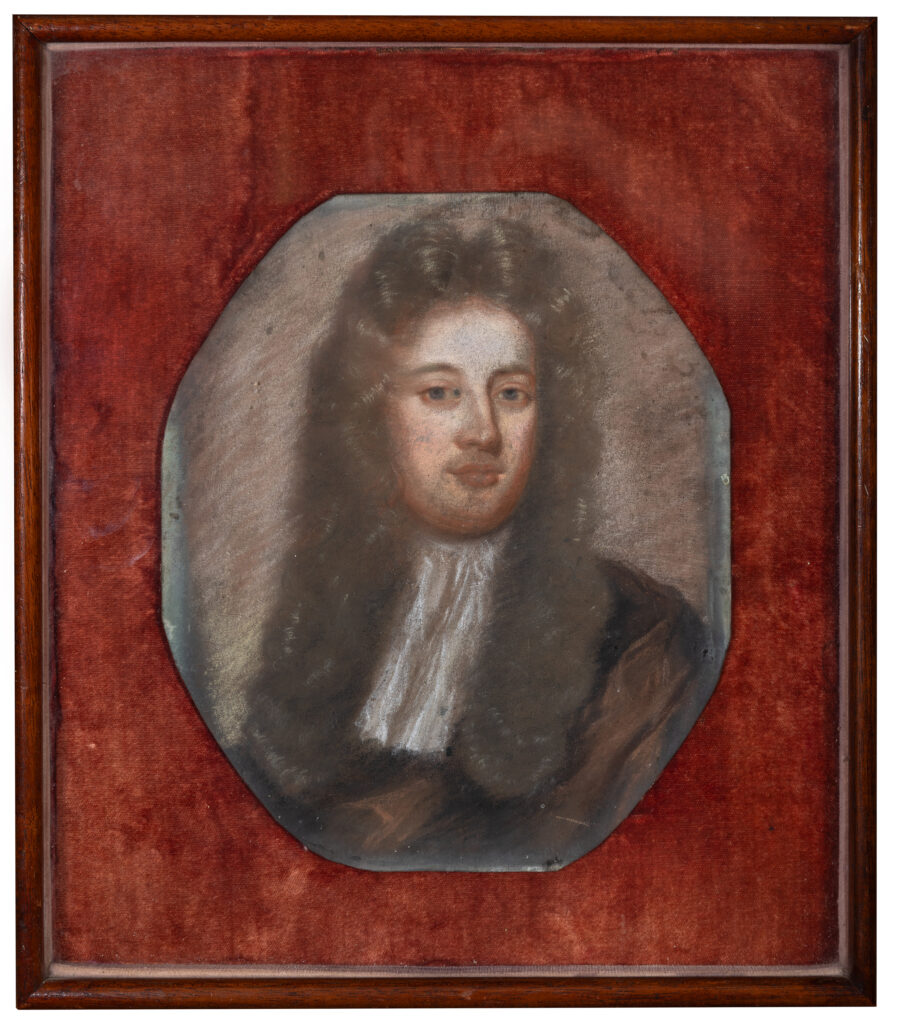
Intimate details of Campbell’s life are preserved in the Caldwell Papers (held by the Royal Irish Academy) thanks to the marriage of his sister, Catherine, to his law partner, Andrew Caldwell. Campbell’s only daughter, Anne, tragically fell to her death from scaffolding near Westminster Abbey during the coronation of King George I in 1714, leading to the dramatic legal fight over the subsequent inheritance. Letters confirm that his wife, Katherine (née Tisdall of Charlesfort House, Kells, Co. Meath), was in London in 1705–6 seeking medical treatment from Dr Hans Sloane. This presence in the capital coincides with the activities of artist Edward Luttrell, who ran a popular portrait raffle. Historians speculate that Campbell, through a commission or a lucky draw, may have sat for a portrait by Luttrell, potentially sponsored by his friend and kinsman Hugh Montgomery, 2nd Earl of Mount Alexander.
Edward Luttrell (c. 1650–1737) was a British artist noted for pioneering the use of pastels on prepared copper plates. This innovative technique, which he began using around 1680, combined his skills in pastel portraiture and mezzotint engraving. Luttrell wrote a manuscript in 1683—‘Epitome of painting, containing breife directions for drawing, painting, limning and cryoons’—which detailed his pastel techniques, including recipes for pastels and methods of mixing pigments. The painting has been authenticated by Neil Jeffares, author of the Dictionary of pastellists before 1800, and is attributed to Luttrell in the online edition. On the verso there is a handwritten reference to W.R. Haliday, who could be Lt. Col. William Robert Haliday (1809–78) of Clifden, near Holywood, Co. Down, who came from a medical family long established in that area. The Haliday family, like the Montgomerys and Campbells, had come to Ireland from Scotland.
Charles Campbell’s story is a fascinating snapshot of the turbulent period in which he lived—a shrewd businessman and powerful politician whose quest for road stone accidentally gave Ireland one of its greatest archaeological treasures.
Aisling Heffernan is an art historian and collector, with a particular interest in seventeenth-century Irish art, military history and women’s histories.