
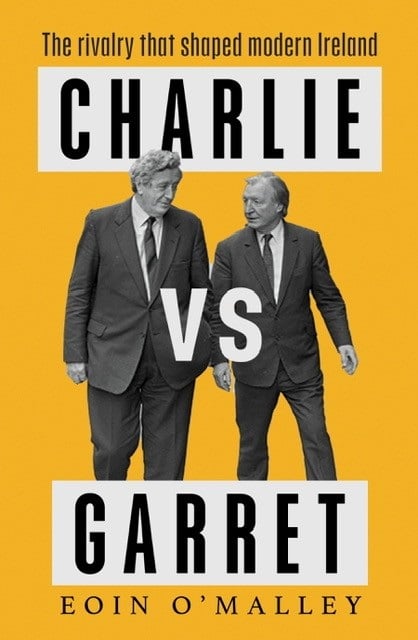
EOIN O’MALLEY
Eriu
€23.99
ISBN 9871804442685
REVIEWED BY
Brian Girvin
Brian Girvin is Honorary Professor of Contemporary Politics at the University of Glasgow.
Charles J. Haughey and Garret FitzGerald dominated Irish politics for nearly a decade during what was an especially turbulent time. Ireland was the ‘sick man’ of Europe for much of this period, with high inflation, taxation, unemployment and emigration. This led Joe Lee to conclude in 1989 that Irish citizens had been poorly served by its political and economic élite. Eoin O’Malley has imaginatively focused on FitzGerald and Haughey to explore Irish politics between 1977, when FitzGerald became leader of Fine Gael, and 1992, when Haughey retired from active politics. Between 1979 and 1992 Haughey and FitzGerald alternated as taoiseach. This is a well-told story that highlights the personal input and the political output of the individuals. O’Malley believes that both men were alike in being chiefs rather than chairmen. They centralised power in the taoiseach’s office and drove policy, remaking their respective parties in their image. Despite their rivalry, O’Malley believes that policy differences between the two men were not great, though this can be questioned. He makes the case that the actions (and perhaps non-actions) of Haughey and FitzGerald shaped Ireland over the following decades. He covers a lot of ground in a relatively short book, but does so incisively and is not afraid of passing judgement on the failures of the two individuals involved.
FitzGerald and Haughey were contemporaries at UCD, which at that time was effectively a Catholic university in all but name. Both were pugnacious in their views, confident in their abilities and forward-looking. They were hard-working, intelligent and focused on politics. O’Malley considers Haughey to have been a ‘pragmatist’ while FitzGerald was an ‘optimist’—useful distinctions. He also claims that neither man wanted ‘power as an end in itself’ but were progressive modernisers who sought to bring about ‘positive social change’. In the case of Haughey this is open to question, even on the basis of the evidence provided by the author. He acknowledges that Haughey always had an eye on the impact of what he was doing. He characterises him as ‘an alpha male, who needed to be in control, and to be seen in control’. Haughey’s actions as taoiseach ‘showed a willingness to abuse power or disregard norms that were to have a long-term impact on the Irish state’. He was also insecure and vain, degrading politics while spending vast amounts of other people’s money, the equivalent of €27 million in 2023 value. He continuously dodged serious decision-making in respect of the economy. His January 1980 speech on the challenges the economy faced was well received even by critics, yet he engaged in self-serving and short-term interventions to secure re-election rather than make the hard decisions required. In retrospect, Haughey achieved little of note besides splitting his party, opposing progressive reforms and the Anglo-Irish Agreement. His only distinctive policy was social partnership, which was a good one. His memory is irretrievably linked to the devastating revelations of various tribunals which were extremely critical of his actions. It took Ireland a long time to recover from these and other scandals. It is ironic that Haughey’s greatest success as taoiseach occurred when he was constrained by leading a minority government (1987–9) or in coalition with the Progressive Democrats (1989–92).
In some respects the book is a study in failure. Neither Haughey nor FitzGerald achieved what they intended, but the consequences of failure were different in each case. FitzGerald is the more interesting character. He started his political life as a right-wing conservative who opposed Noël Browne’s mother-and-child scheme. O’Malley describes him as ‘intellectually arrogant’, but he was also intellectually curious and dynamic in terms of policy-making. He remained a devout Catholic while becoming the face of liberal Ireland during the ’80s, transforming his party and negotiating the Anglo-Irish Agreement. O’Malley is very hard on FitzGerald, describing him as incompetent and accusing him of ‘strategic naivety’ in not preparing the ground for his constitutional crusade or the 1986 divorce referendum. There is some truth in this, but the author fails to appreciate the obstacles to change. It is unlikely that there could have been any other outcome to the eighth amendment referendum, but FitzGerald eventually opposed the change. On divorce, there is some validity in the criticism that not enough had been done to prepare the public for a referendum. But one can also seriously underestimate the strength of conservative Ireland during the 1980s, which comprised the hierarchy, Fianna Fáil and the Catholic right. For instance, Haughey refused to participate in the Oireachtas Committee on Marital Breakdown, while actively promoting the bishops’ opposition to Barry Desmond’s liberalisation of the contraceptive laws in 1985. Fianna Fáil’s opposition to the divorce referendum was instrumental in defeating the measure. What needs to be fully explained is why the voting on the eighth amendment and the divorce referendum overlapped constituency by constituency.
This is not to paper over Fitzgerald’s or Fine Gael’s failures while in government, but it is to recognise that Fine Gael and Labour were promoting a liberal alternative to an inflexible and intolerant Ireland. This alternative failed during the 1980s but gained considerable traction after the election of Mary Robinson as president. The Anglo-Irish Agreement was Fitzgerald’s greatest achievement and established the foundations for the peace process that followed. In retrospect, 21st-century Ireland reflects FitzGerald’s vision rather than Haughey’s. The book is a welcome addition to studies of this period in Irish politics, addressing issues that will repay further study.