
By Nigel Johnston
Of the significant punctuation points in pre-Famine history the cholera epidemic of 1832–3 is a subject deserving of further attention. From contemporary sources we know that the disease broke out with some force in India during 1817 and had spread through Asia, the Baltics and the rest of Europe by the late 1820s. On 23 October 1831 the disease appeared in Sunderland and moved quickly north into Scotland. It arrived on Irish shores during the month of March 1832, initially affecting Belfast, then Dublin, before quickly spreading to Cork by the following month. In little over twelve months cholera would rise to epidemic proportions in Ireland, killing an estimated 50,000 people. With a growing population of approximately 7.7 million by 1831, Ireland would prove especially vulnerable to an epidemic that was virulent and contagious in equal measure. As it transpired, some pockets of habitation around the country managed to escape, but for those persons or families stricken with the affliction death usually came in three to twelve hours. Doctors, for the greater part, were selfless in their execution of duty but lacked the medical knowledge to offer effective treatment. In fact, it would take another two decades before the disease would be better understood as one that spread through contaminated water or food and was especially contagious in areas of poor sanitation. What was beyond dispute, however, was that cholera affected all sections of society, especially those of the religious or medical classes who came into close contact with the malady.
‘REPORT ON THE PREVENTION OF SPASMEDIC CHOLERA’
Documents from the Chief Secretary Office Registered Papers held at the National Archives, Ireland, reveal much about the public perception of cholera, both at government level and among the mass of the common people. What is clear from the papers is that the administration in Dublin Castle took the impending emergency seriously. Reacting to ominous reports of the arrival of cholera from across the water, the leading Irish officials immediately set in motion a plan to meet the emergency. The greater part of these preparations is encompassed within a ‘Report on the Prevention of Spasmedic Cholera’ submitted to the lord lieutenant by the General Board of Health, Dublin, in November 1831. These recommendations were, to all intents and purposes, a national strategy for the protection of public health in Ireland. Central to the plan was a broad facility to enable the appointment of local officers of health plus a board of health for each parish, all underscored by an act of parliament.
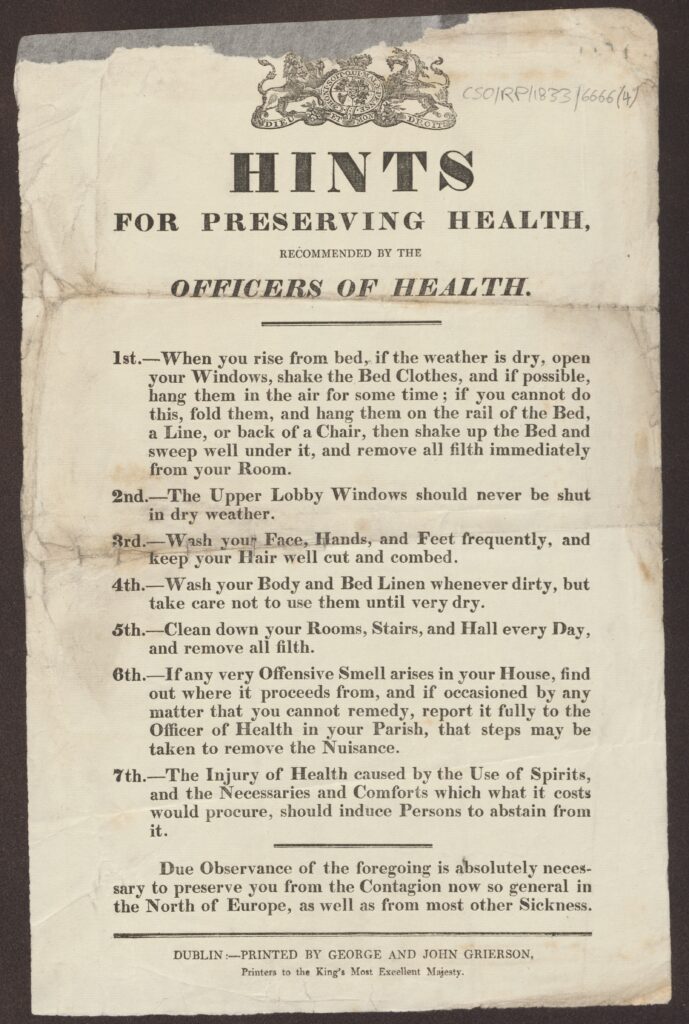
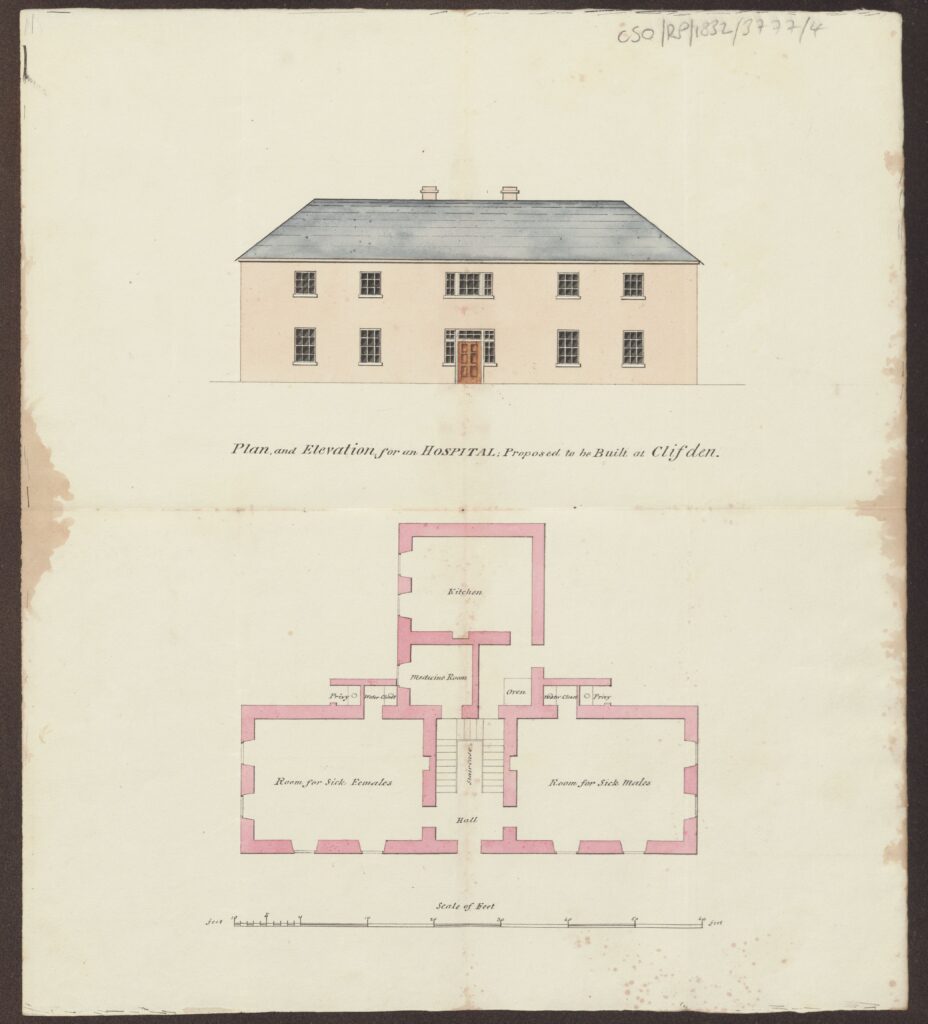
Other key highlights of the report include the formulation of quarantine measures for shipping, the curtailment of large public assemblies, recommendations on cleaning infected dwellings and the use of purpose-built carriages to convey sufferers to infirmaries. To protect against transmission of the disease, a strong emphasis was placed on domestic cleanliness. In many parishes printed handbills were displayed, such as ‘Hints for Preserving Health Recommended by the Officers of Health’. As the epidemic took hold, existing civic facilities were often converted to use as infirmaries. In a few cases new hospitals were proposed to be built, such as that for Clifden, Co. Galway, in July 1832 (p. 34).
SUPERNATURAL PROTECTION
Government efforts to curtail the spread of cholera were not especially well received by sections of the Irish lower classes. An example of this was remarked on in the town of Cashel, Co. Tipperary, by police magistrate Dr Gerald Fitzgerald. He informed the government in August 1832 that the people refused to go to the cholera hospital and even concealed the disease. In large districts of the west of Ireland, where high levels of contagion were recorded, popular resistance took a more extreme form. In Tubbercurry, Co. Sligo, during the summer of 1832, John Burke took to the streets with other protesters, holding a placard which read ‘reform, no tithes, no taxes, no cholera, no doctors’. A dread of coming into contact with cholera often provoked uncharacteristic behaviour in rural residents. One such incident is recorded by Captain Vignoles, chief magistrate of Ennis, Co. Clare, who found that a diseased man by the name of Foley was entirely deserted by his relatives. Following his death, the ‘country people were assembled with the avowed intention of setting fire to the house and burning it and the body together’.
In the midst of such exceptional circumstances, between 9 and 15 June 1832 there appeared amongst large sections of the Catholic poor a ritual to harness supernatural protection against cholera. According to archival sources, the origin of this unique movement was the reported sighting of the Virgin Mary over the altar at the chapel of Charleville, Co. Cork. All who reputedly saw the apparition insisted that the Virgin had promised to prevent the further spread of cholera, provided that they participate in the distribution of ‘powders or ashes’ left behind on the altar. In the event, those who acted as distributers brought little sachets of ashes to four or five dwellings in their own localities. As they did so, prayers prescribed by the Virgin were offered. As members of each household took possession of the charms, they in turn went out and repeated the same process of distribution until the whole community had been reached. In the space of six days the custom had spread from the south of Ireland through the midlands right up to County Donegal. As the ritual moved from county to county, the type of protective charm utilised by the people might vary in nature, switching from ashes in the south to include, for example, turf, straws, twigs or stones in other districts.
Another facet of belief in the supernatural amongst the Catholic poor is recorded in police reports from the midlands and south-east. According to rumours circulated by the lower orders in that region, a number of towns, such as Roscrea, Co. Tipperary, Castlecomer, Co. Kilkenny, and New Ross, Co. Wexford, were consumed by fire from heaven. Such devastation, it was commonly understood, was a direct result of some sort of providential judgement, as was the appearance of cholera itself. A letter sent to Dublin Castle by Chief Constable Hatton of Dunlavin, Co. Wicklow, reported that the common people in his locality believed that the whole of Queen’s County (Laois) had been annihilated by a ball of fire on account of a curse pronounced by Dr James Doyle, Catholic bishop of Kildare and Leighlin. It would appear that the curse was associated with a strongly worded ‘Pastoral letter against Whitefeet and Blackfeet in Queen’s County’ issued by Doyle in May 1832. The ball of fire was thought by country folk to be a punishment for swearing false oaths at the trials of those accused of serious crime or outrage. Hatton also states that the country people believe that ‘two angels had descended to whom they were ordered to offer up seven prayers’. As a deterrent against a fiery judgement or death by cholera, the common people, as elsewhere, engaged with considerable enthusiasm in distributing smouldering turf and other charms throughout the surrounding countryside.
‘WHOLE ACCOUNT OF MISS JANE NUGENT’
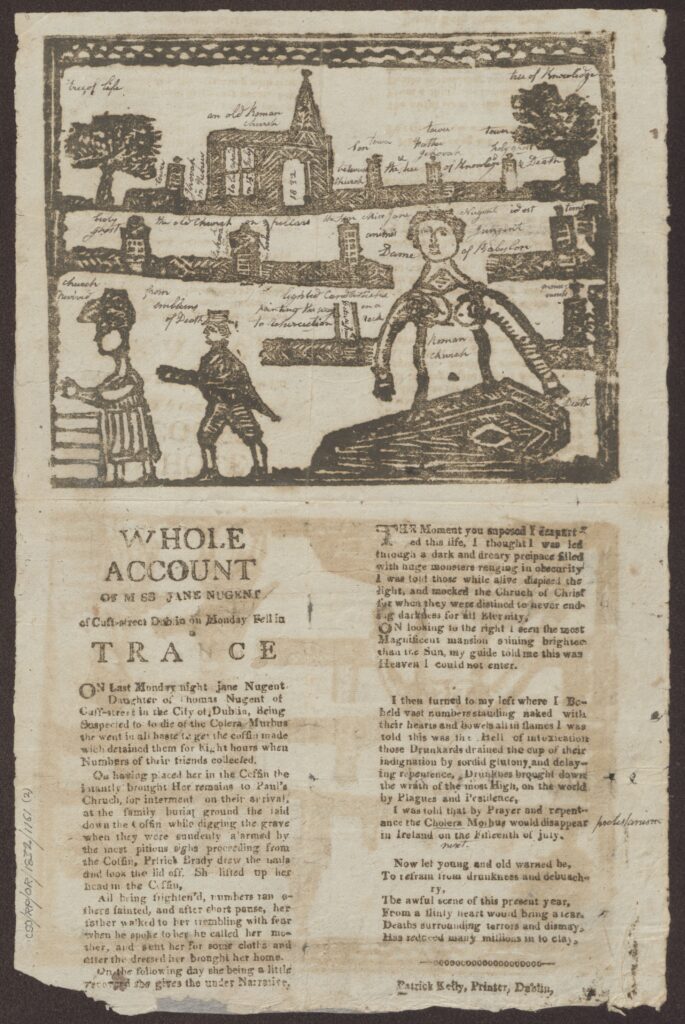
A distinct but equally intriguing supernatural story is that of Jane Nugent, who apparently met her end from cholera in late June 1832. Details of this episode are related to us in a fascinating tract—‘Whole Account of Miss Jane Nugent of Cuff-street, Dublin, on Monday Fell in Trance’ (p. 33). According to the tract, Nugent, being unconscious, was thought to have passed away some time earlier from the disease, so steps were immediately taken to have her prepared for burial in the graveyard used by St Paul’s Church, Dublin. Just as the grave was being dug, with the coffin closed up and the remains ready for interment, a human voice was heard from within. One of the undertakers immediately drew the nails and took the lid off, at which point Nugent lifted up her head in the coffin. This caused great commotion in the graveyard, with some mourners fainting and others dashing away!
In the second section of the tract, Nugent describes her experiences of the hereafter. Hell, she remarks, was ‘a dark and dreary precipice filled with huge monsters ranging in obscurity’, while heaven appeared as a ‘most magnificent mansion shining brighter than the sun’. Her warning to the living was that the twin evils of gluttony and drunkenness had brought the judgement of heaven upon Ireland, as demonstrated in the present cholera epidemic. She added, with a prophetic slant, ‘I was told that by prayer and repentance the cholera morbus would disappear in Ireland on the fifteenth of July’.
Nugent’s mystical tract is crowned with a custom-made banner head replete with symbols of spiritual significance. A number of annotations have been added at various points within the main illustration, all in the hand of Revd Thomas Hayden, rector of the parish of Rathcoole, Co. Dublin. He enclosed the tract in a letter to the Anglican archbishop of Dublin. Hayden’s scribbles on the tract are a mixture of simple pious observations and a thinly veiled critique of the Catholic Church. As to the tract itself, he alleges that ‘thousands are distributed’. Now an ageing figure in a rapidly changing political landscape, the rector felt threatened by the sectarian rhetoric of anti-tithe speakers in his own locality. He was alarmed by the Tithe War (1830–6) and, more broadly, by the spread of O’Connellite politics. His letter stated that he had personal recollections of the 1798 Rebellion and supposed that the lower orders were in preparation for a general uprising. Less than a decade earlier, he recalled, the Catholic labouring classes had been brought to the point of hysteria by the broad distribution of Pastorini’s prophecy, which anticipated the annihilation of the Protestant religion in the year 1825.
As an old clergyman feeling besieged in his own parish, Hayden understood the date of 15 July 1832 not as the end of cholera in Ireland but rather as the date of a broad uprising by the lower orders against the establishment. In the event, Nugent’s prophecy for the cessation of cholera on that exact date appears to have been a little short of the mark. But we can forgive her for that, as she was unconscious. In fact, cholera would continue to trouble the Irish population down to the spring of 1833 and beyond.
Nigel Johnston is an archivist with the National Archives, Ireland.
Further reading
G. Allmond, ‘Pandemic cholera in Belfast, 1832’, History Ireland 28 (4) (2020).
S.J. Connolly, ‘The “blessed turf”: cholera and popular panic in Ireland, June 1832’, Irish Historical Studies 23 (91) (May 1983), 214–32.
T. Dunne, ‘“The whole of the Queen’s county was in a blaze”: the blessed turf and the fire from heaven’ (https://laoislocalstudies.ie/the-whole-of-the-queens-county-was-in-a-blaze-the-blessed-turf-and-the-fire-from-heaven/).
F. Gallagher, ‘Mapping the miasma: the geographies of a forgotten Irish epidemic’ (https://pdfs.semanticscholar.org/3cd5/7b9ba87e192dd8dd45c944d4514df87a1e5b.pdf).