
By Ciara Fahy
The Forster and Kelly family papers, preserved in Clare County Archives, document more than three centuries of Irish history. They include leases, wills, correspondence and estate accounts, but it is the rent books and ledgers that most clearly show the everyday running of estates in north Clare and the gradual decline of landlordism.
The Forsters arrived in Ireland in the seventeenth century. Captain Francis Forster was a grandson of Sir Thomas Forster, lord chief justice of the King’s Bench. A dragoon officer in the army of Charles I, he remained after the wars of 1649–53 and acquired land in Galway, Roscommon, Mayo and Clare. His name appears in the Books of Survey and Distribution, evidence of shifting land patterns after the Cromwellian wars. By 1763 Robert Forster, son of Patrick Forster, was leasing Rinroe, near Corofin, from Edward O’Brien of Dromoland. John Forster inherited in 1813. Griffith’s Valuation in 1855 records the family as holding 200 acres at Rinroe, valued at £33.17.0.
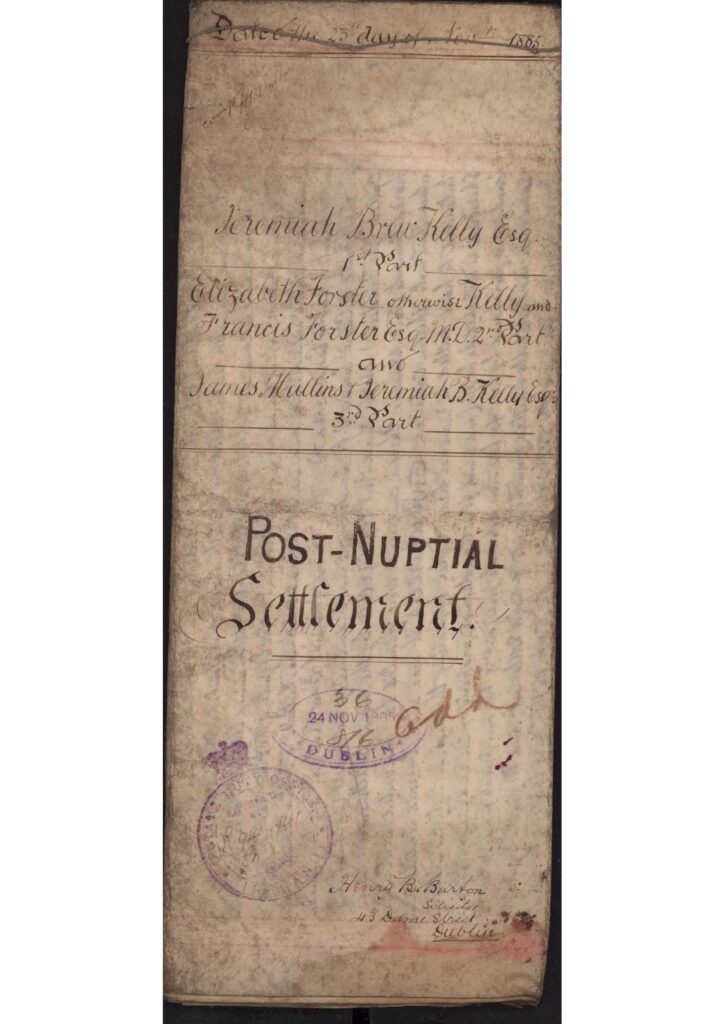
The Kellys were of Gaelic stock, originally from the kingdom of Uí Maine. In the 1860s Jeremiah Brew Kelly purchased Porte House, an eighteenth-century house and demesne at Ruan, adjoining the Rinroe lands. In November 1885 his daughter Elizabeth married Francis Forster of Rinroe. Their marriage settlement survives in the archive, as do documents from the late 1890s relating to disputes and agreements over Jeremiah Brew Kelly’s estate. The Landed Estates website (https://landedestates.ie/) also records that in the late eighteenth century Porte House was associated with the O’Loghlens of Newtown. Colman O’Loghlen lived there, and the family produced Sir Michael O’Loghlen, who became MP for Dungarvan in 1834, master of the rolls and later attorney general. According to newspaper accounts, the house stood unoccupied for some years until Jeremiah Kelly of Dysart purchased it in the 1860s. When he died in 1882, he left extensive farms to his sons and £800 to the parish priest of Ruan to build a new chapel; the house itself remained in family hands.
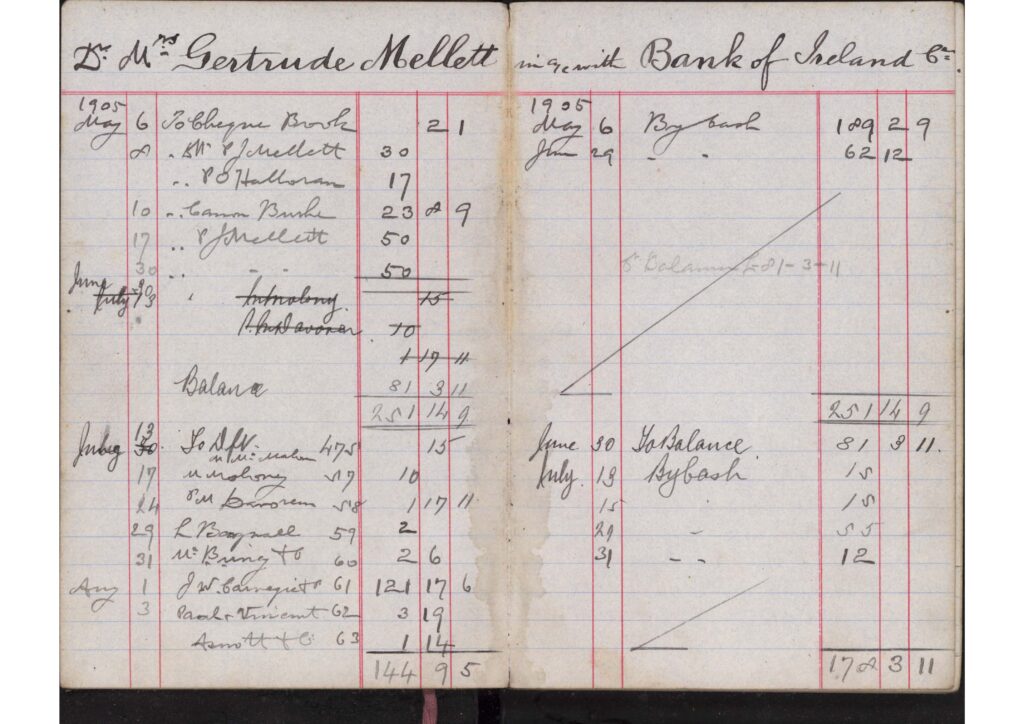
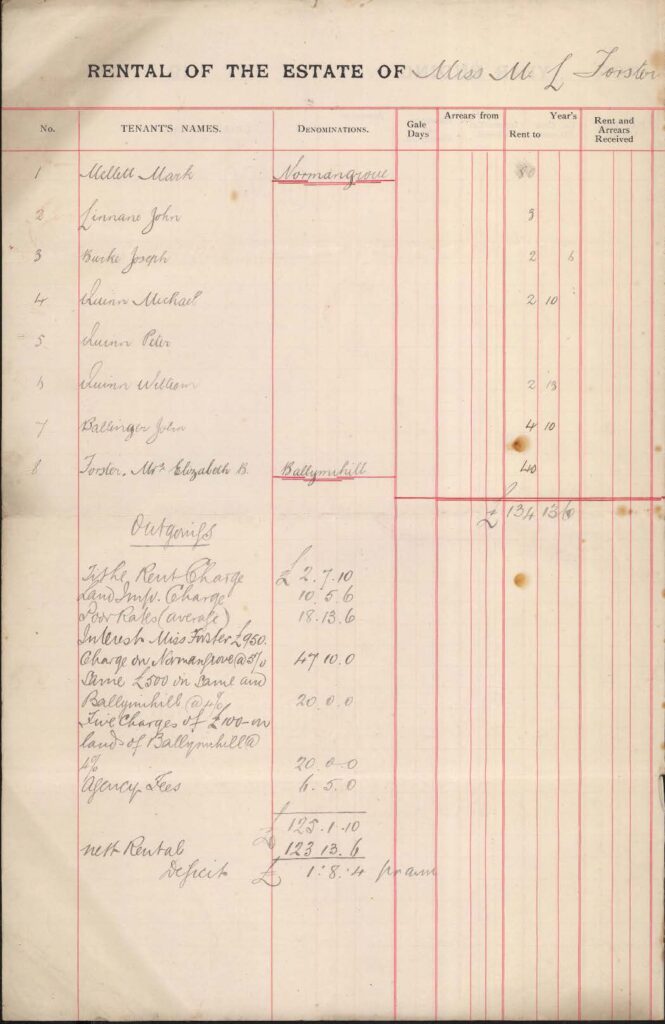
The rental volumes give a clear picture of the estates in their later years. A rental from c. 1900 lists properties in Ballymihill and Normangrove townlands. Between 1901 and 1917, further accounts cover Lisheena, Applevale, Drummina, Porte and Market Street in Ennis. An account book of Gertrude Mellett, who lived at Porte, records rent received between 1905 and 1914. Rentals for 1911–12 include headings such as tithe rent, poor rate, income tax and annuities. By the early 1930s the accounts show grazing rents, interest on land bonds and compounded arrears, marking the change brought about by the Land Acts. Among the most striking documents is a 1691 pardon for James Forster, issued by General Godard van Ginkel just days after the Battle of Aughrim. Family members fought on the Jacobite side, with one later counted among the ‘Wild Geese’ in France.
The papers also preserve the names of those who managed the estates. In the early years Henry de L. Willis of Ennis kept the books, and later Charles O’Keane, son of the well-known agent Marcus Keane, drew up the accounts. Other items include a 1911 court summons issued by Daniel O’Loghlen against Francis Forster, records from Ennistymon petty sessions in 1914 at the death of F.B. Forster, and correspondence with the Irish Land Commission in 1916.
The wider history of the families also appears. Frank Forster-Kelly was granted permits to carry arms in 1918 and 1924, the latter signed by General Michael Brennan of the National Army. In 1929 grazing agreements were made with farmers in Ruan and Garvillaun. In 1934 John Montague Kelly swore an affidavit before the Estates Commissioners. Later records from the 1960s to the 1990s document compulsory acquisition by Ennis Urban District Council of derelict houses and stores once entered in the rent books.
The late nineteenth‑century disputes over Jeremiah Brew Kelly’s estate, involving Francis and Elizabeth Forster and Gertrude Mellett, reveal the tensions of the Land War era, when inheritance and tenancy were contested even within extended families. Newspaper accounts add more recent detail. After Jeremiah Kelly’s death, Porte House was occupied at times by his widow Bridget, by his son Jeremiah and later by Francis Kelly. Gertrude Mellett lived there after her marriage to Patrick Mellett in the 1890s, and later generations of the Kelly family remained connected with the house well into the twentieth century.
The collection was donated to Clare County Archives by Frances O’Halloran in 2013, with a later accrual in 2019. Rent books and accounts might look ordinary but they tell real human stories. They record who rented and who owned land, how money changed hands and what people spent in daily life. When read alongside family letters and related legal documents, they document the loss of local landlords’ power in north Clare.
Ciara Fahy is Clare County Archivist.