
By Damian Murphy
The modern origins of Kenmare demesne date back to the early eighteenth century and a Queen Anne-style house built (1724–5) by Sir Valentine Browne (1695–1736), 5th Baronet and 3rd Viscount Kenmare, on an estate inherited from his father, the exiled Nicholas Browne (1664–1720), a Jacobite who had forfeited his life interest in it after the Battle of the Boyne. The estate soon boasted ‘gardens planted with large nurseries of fruit and timber trees [and] a large and pleasant park well wooded and stocked with deer’, but it was not until the second quarter of the nineteenth century, when Valentine Browne (1788–1853), 2nd Earl of Kenmare, was made a member of His Majesty’s Privy Council of Ireland (1834), that access was controlled by a gatekeeper, who was provided with the most charming of gate lodges.
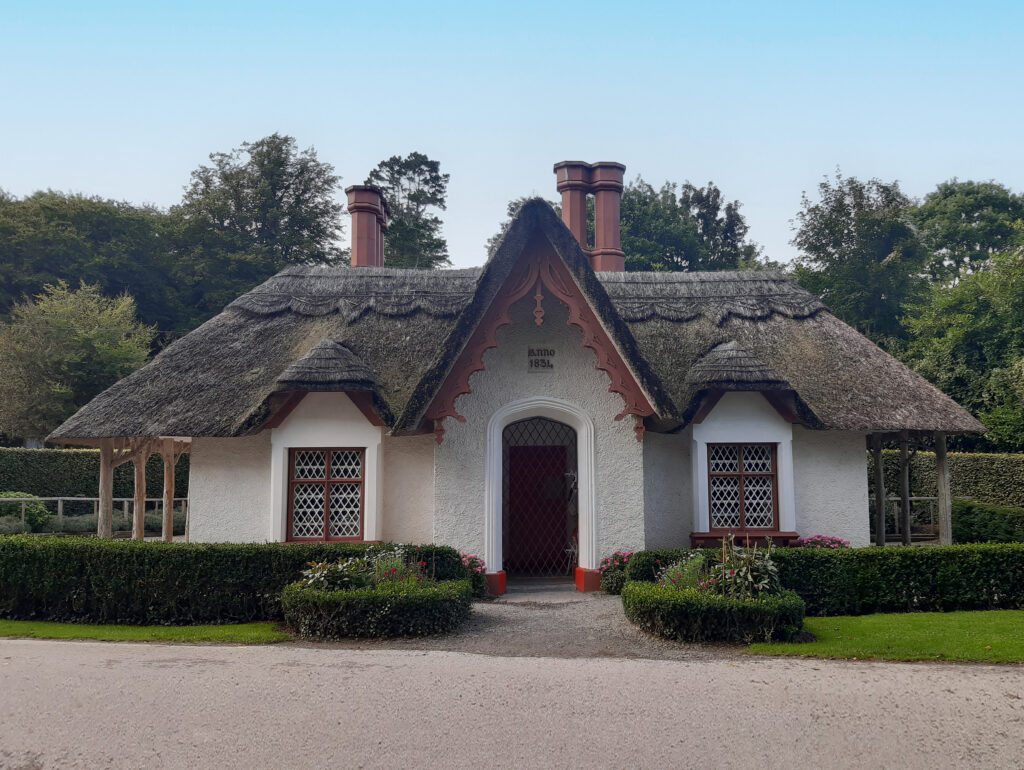
Deenagh Lodge is by an architect not known to have ever visited Ireland and was copied with modifications from the design for an ‘Under Gamekeeper’s Hut’ published by Thomas Frederick Hunt (1790–1831) in Half a dozen hints on picturesque domestic architecture in a series of designs for gate lodges, gamekeeper’s cottages and other rural residences (1825). Hunt believed that ‘buildings of this class should be very simple’; accordingly, his plan consisted ‘of only two Rooms and a Shed for Fuel’, an open porch at the centre giving access to a hall, a living room and a sleeping room on either side, the shed at the rear completing the cruciform footprint. The Killarney version deviated from the plan by substituting a larger return, with additional rooms for the shed.
The avenue-facing façade belies the simplicity of the internal accommodation. Epitomising the cottage orné style, it centres on an open porch with moulded Tudor door-case, the panel overhead inscribed ‘Anno 1834’; the steeply pitched gable is decorated with scalloped bargeboards given heart-shaped and palmette terminals. The rooms on either side of the hall are lit by corbelled windows with cruciform mullions and lattice glazing bars. The hipped thatched roof is given a decorative raised ridge and, deeply overhanging at either end, is carried on rustic arcades or loggias of roughly hewn tree trunks, shown delicately entwined with creepers in the original illustration ‘drawn on stone’ by George Pyne (1800–84). It was smothered in ivy in early photography by Robert French (1841–1917) but is now free from greenery. The original design called for oversized chimney-stacks book-ending the ridge but, at Killarney, the stacks are centralised and asymmetrically placed, the clustered and coupled octagonal pots enhancing the picturesque effect.
The Brownes eventually gave each entrance to their estate its own unique gate lodge, some tasteful, others gauche, but never bettered Deenagh Lodge. It has stood sentry in the shadow of the spire of St Mary’s Cathedral for almost two centuries, has outlasted the original Kenmare House and its late nineteenth-century replacement, the extravagant but short-lived Killarney House (1877–8), and has seen a private demesne reborn as a public domain. As seasonal tearooms managed by the National Parks and Wildlife Service and staffed by Down Syndrome Kerry, it is now a popular stopping point for visitors to Killarney National Park.
Damian Murphy is Architectural Heritage Officer, National Inventory of Aarchitectural Heritage. Series based on the NIAH’s ‘building of the month’, www.buildingsofireland.ie.