
By Joseph E.A. Connell Jr
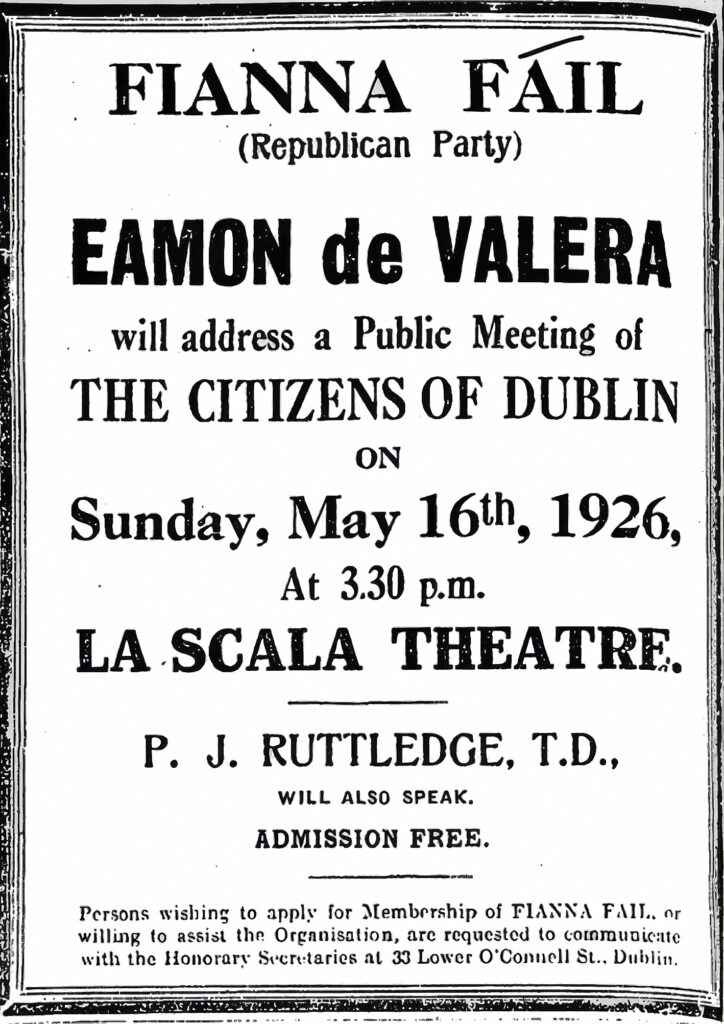
On 16 May 1926 Éamon de Valera founded the Fianna Fáil (‘Soldiers of Destiny’) Party from opponents of the Anglo-Irish Treaty, which established the Irish Free State. Its expressed main aim was to create a united Irish republic, politically and economically independent of Britain. Originally abstentionist, the following year de Valera led his party into the Dáil and took the oath of fealty to the British monarch, in contrast to his position before the Irish Civil War. Since 1927, Fianna Fáil has been one of Ireland’s two major parties, along with Fine Gael since 1933.
The Fianna Fáil website describes its founding:
‘It was visionary, idealistic, and committed men and women who founded Fianna Fáil, in the La Scala Theatre, Dublin, in 1926, under the leadership of Éamon de Valera. What followed was a momentous national movement encompassing the ideals of a united Ireland, social and economic advancement, and equal opportunities. Fianna Fáil entered government for the first time in 1932 and in 1937 the Irish people ratified Bunreacht na hÉireann, the Irish constitution.
Fianna Fáil, under the leadership of Seán Lemass, implemented the First Programme for Economic Expansion which opened up our economy, encouraged foreign direct investment and set our country on a path of economic advancement.
The education and welfare of Irish people has always been a core value of Fianna Fáil.’
The Encyclopaedia Britannica defines the party as follows:
‘The party’s ideology has some enduring aspects, notably a commitment to Irish unity, to the Irish language, and to neutrality, though these commitments are essentially aspirational and occasionally merely rhetorical. Generally, the party has been pragmatically cautious on most issues. It has broadly supported an interventionist approach to economic management and, particularly in recent years, has sought agreement on economic policy among major economic interest groups. Socially radical and redistributive in its early years, it soon became more conservative, and it was particularly so under Taoiseach Charles Haughey on such issues as divorce. From the 1940s it promoted itself as the only possible source of stable government.’
In the early 2000s, Fianna Fáil leader Bertie Ahern affirmed the party’s catch-all stance by defining it as a party that ‘looks out for the small ranking guy, the middle-ranking guy and assists the big guy’. This contrasted with the more working-class orientation that Fianna Fáil had in its early years. In 1926 Seán Lemass described it as ‘a progressive republican party based on the actual conditions of the moment’, while upon winning the 1932 general election newly elected Fianna Fáil TD Seán Moylan proclaimed that Fianna Fáil’s win meant a victory of ‘the owners of the donkey and cart over the pony and trap class’. The Fianna Fáil party of the 1930s has been described as an economically socially democratic one that sought to create an economically independent state via protectionist policies, based on its culturally nationalist thinking.
During the leadership of Seán Lemass in the 1960s, Fianna Fáil began to utilise some corporationist policies (embracing the concept of ‘social partnership’), taking some influence from the Catholic Church. It also moved away from autarkic thinking and towards a firm belief in free trade and direct foreign investment.
The party dominated Irish political life for most of the twentieth century, and since its foundation either it or Fine Gael has led every government. Between 1932 and 2011 it was the largest party in the Dáil, but latterly with a decline in its share of the vote; from 1989 onwards, its periods of government were in coalition with other parties.
Joseph E.A. Connell Jr is the author of The Terror War: the uncomfortable truths of the War of Independence (Eastwood Books, 2022).