
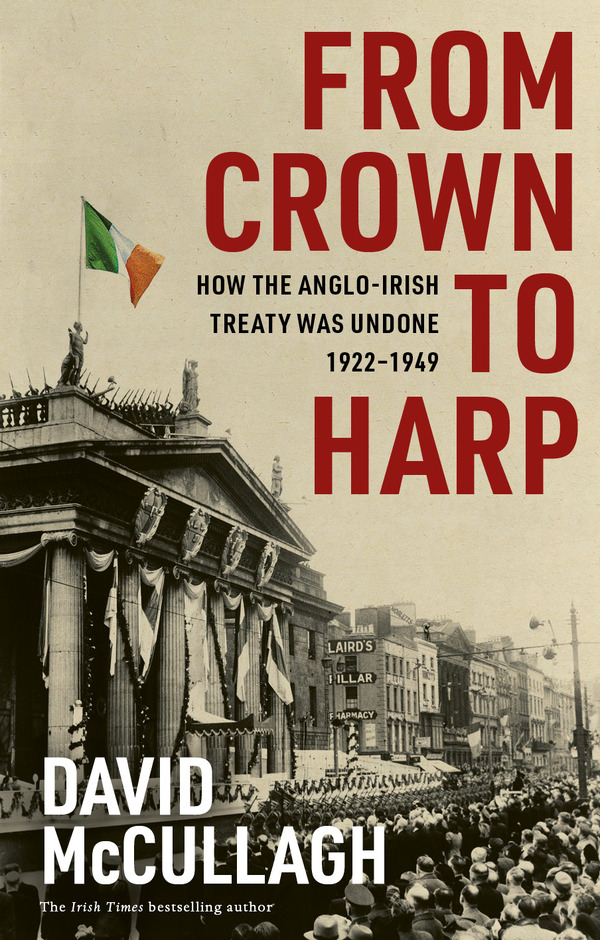
DAVID MCCULLAGH
Gill Books
€26.99
ISBN 9781804581469
REVIEWED BY
John Gibney
John Gibney is Assistant Editor with the Royal Irish Academy’s Documents on Irish Foreign Policy programme.
On 19 December 1921, during the acrimonious Dáil debates that followed the signing of the ‘articles of agreement’ that became the Anglo-Irish Treaty, Michael Collins gave the best-known (if much-misquoted) defence of the document that he and his colleagues had signed in London a fortnight earlier: that it gave Ireland ‘not ultimate freedom … but the freedom to achieve it’. The subject of David McCullagh’s new book is how the process envisioned by Collins worked itself out over the next three decades. The author wears many hats, including that of being a scrupulous and considered historian and biographer. From crown to harp is a natural complement to his works on the inter-party government, Éamon de Valera and John A. Costello. Its subject-matter overlaps with all three but is important enough to warrant a book in its own right.
This isn’t just a book about Irish history; it is essentially about Ireland’s relationship to the British Empire in the decades after the signing of the Treaty. Having been conquered and colonised in the early modern period, the island of Ireland was uneasily integrated into the United Kingdom up to 1921. Thanks to the efforts of the independence movement after 1916, in 1921–2 26 counties were shifted from the UK into the evolving British Empire/Commonwealth with the somewhat amorphous designation of a ‘dominion’. The settlement of the ‘Irish question’ devised by the British in 1920–1 had two aspects: partition was to satisfy Ulster Unionists, while a measure of independence for the remaining 26 counties was on offer for Irish republicans. But a republic was not on offer under any circumstances. One of the British red lines was the maintenance of their global empire; a complete Irish separation was not on the table lest it set a dangerous precedent for other imperial possessions.
Infamously, this wasn’t enough, and in Ireland civil war was the consequence, fought between the supporters and opponents of the Treaty. The end of the Civil War was one of the terminal points of the recent ‘Decade of Centenaries’, but there is a story to be told about what came after and McCullagh tells it well, with considerable scholarship. Support for the Treaty did not generally mean enthusiasm. Beginning in 1922 and throughout the 1920s, the pro-Treaty political leadership—figures like Collins himself, W.T. Cosgrave, Kevin O’Higgins and others—tried to loosen the bonds of the original Treaty and expand the practical scope of the independence offered by dominion status, often doing so in concert with other dominions (especially Canada and South Africa) within an empire that was continuing to evolve. The objective of Irish politicians and diplomats in the 1920s was to shape that evolution in ways that maximised Irish independence in real and symbolic ways.
Cosgrave and his colleagues were adamant about obtaining the fullest measure of Irish independence possible but did so within the bounds of the Empire and emerging Commonwealth; his successor, Éamon de Valera, less so. Throughout the 1930s de Valera and his government hollowed out the Treaty settlement through both constitutional innovation and ingenious chicanery, retaining a link to the British Empire through the concept of an ‘external association’. This was an idea that he had tried to impress upon the British in 1921 but which came into its own in the 1930s, whereby the independent Irish state would, of its own volition, choose to associate itself with the Empire rather than be forcibly bound to it. De Valera was surprisingly conscious of British sensitivities and was willing, prior to the Second World War at least, to effectively keep Ireland within the Commonwealth. In part this was dictated by the hope that such an umbilical cord might satisfy Ulster unionists and aid the achievement of Irish unity, an idea that had been shared by figures like O’Higgins in the 1920s. Ultimately, however, Irish leaders on either side of the Treaty divide would prioritise the sovereignty of the southern state over unity.
The final break with the Commonwealth came in 1949 under Taoiseach John A. Costello, a man who had never been convinced about the concept of external association and took matters to what he deemed a logical conclusion. Ironically, he did so at a time when the same concept was becoming a possible formula by which the British could retain links to the states emerging from an empire that was beginning to dissolve in the post-war world. McCullagh’s impressive and very readable book amply illustrates that the ‘Irish question’, so to speak, of the 1920s, ’30s and ’40s was also an imperial question.
This is a history that is largely high-political, with a focus on diplomacy and often-arcane constitutional questions that McCullagh makes intelligible in a very readable and often entertaining way, with a good eye for anecdote and telling details and a refreshing willingness to offer up his own judgements on his subject. Political history has traditionally been over-represented in Irish historical writing but a willingness to correct that imbalance shouldn’t negate the importance of the subject that McCullagh has tackled here. This is an exemplary example of serious scholarship presented for a wider audience without being watered down in any way, and it is also a great read.