
History teaching in Northern Ireland recent second-level school texts
Peter Collins
As we saw in the last issue of History Ireland (Winter 1994) Irish history has constituted a major area in the curriculum in the South since the formation of the state. In the North the situation has been more problematic, with schools divided essentially into two systems, as indeed they still are.
In the state schools and in the mainly Protestant voluntary grammar school system, it is fair to say that the attitude was that Irish history was best left alone. In many Catholic schools, Irish history took second place to the teaching of world or even British history and the bulk of it was largely uncritically nationalist in orientation and did not take into account or empathise with the views of the unionist community. None will bemoan this state of affairs more than present-day teachers. Many recognise that it has contributed in considerable measure to the continuing unhappy state of community relations. The perpetuation of myths and shibboleths has continued in the vacuum left by the failure to inculcate proper historical reality in the schools. It was only at A level that any significant study of Irish history was undertaken and by then, it could be argued, many young minds had already begun to close.
Changes for the better
This situation has dramatically changed in recent years, due to government policy innovations in education. The introduction of a common core curriculum has ended the situation where each school essentially chose its own curriculum, subject to approval by the inspectorate. The Department of Education, Northern Ireland (DENI) has made Irish history part of the core, with the addition of the related cross-curricular themes of Education for Mutual Understanding (EMU) and Cultural Heritage in other subject areas. There is no doubt that the current troubles have been a catalyst in these developments in that they are related to the government’s wish to improve community relations. If many adults are too far gone in their polarised attitudes, it is hoped that there is still time to broaden the outlook of children while they are still at school.
Subliminal propaganda?
There has been criticism from some quarters that this policy amounts to social engineering or subliminal propaganda on the part of the department. However most professionals working in history in the education service are agreed that these changes are valid educationally as well as socially worthwhile. Schools have also benefited greatly from additional funding provided for these programmes as well as for associated curriculum projects such as the European Studies Programme and the Young Historian Scheme. The other spin-off from this new dispensation has been the production of text-books which address the new core curriculum. It has been particularly gratifying to see that the publishing world, both regionally and nationally, has responded with appropriate texts of a very high standard, not least because they have given the job to serving teachers or educationalists not long out of the classroom.
Junior cycle
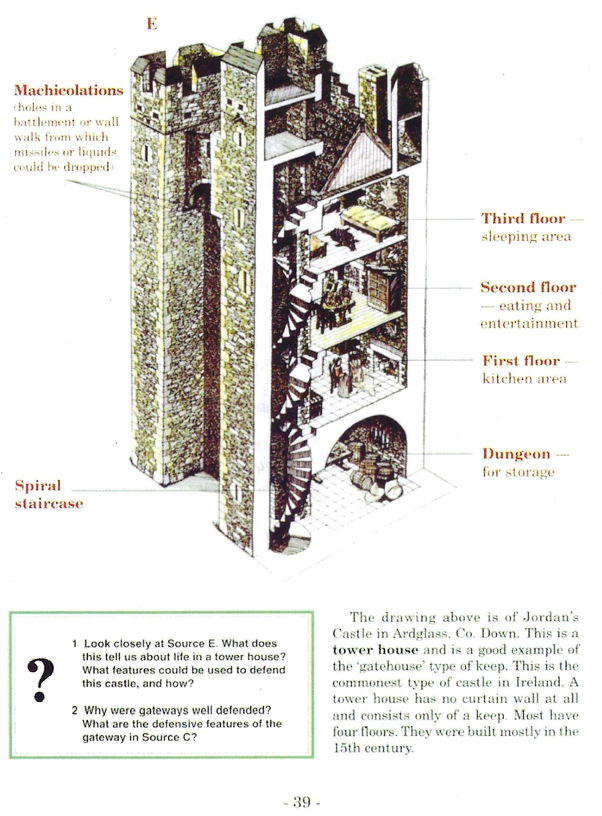
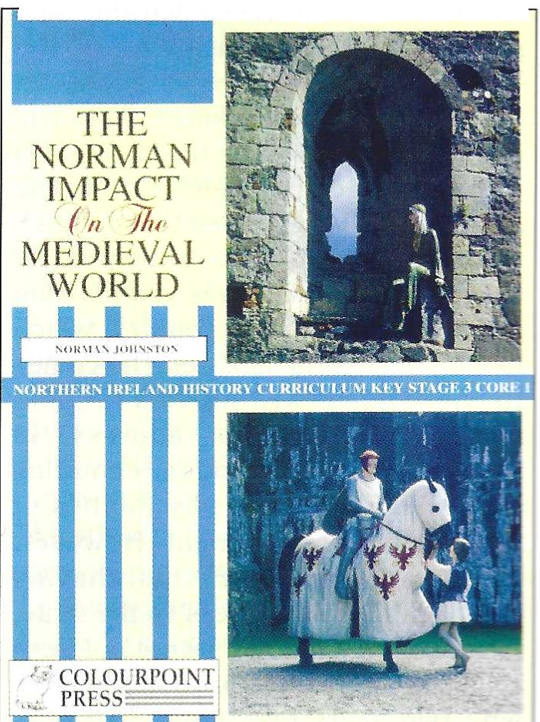
The common core for year eight (the equivalent of second year in Southern second-level schools) deals with the Normans in Europe, Britain and Ireland. It has, till now, been a problem for teachers to get a single text which covers the whole core. However the Omagh-based Colourpoint Press has brought out The Norman Impact in the Medieval World by Norman Johnston, head of history at Omagh Academy. This the third of a series dealing with the new syllabus and its full colour production is an improvement on the earlier two (discussed below). It uses many fine photographs of Norman castles, churches and ruins as well as extremely good illustrations and maps. The text is clear and informative and, with many associated exercises and tasks, is aimed at a wide ability level. Where possible Irish examples are used. In dealing with the Normans in Ireland the book is as comprehensive as one could wish, with a particularly useful case study of John de Courcy and Ulster which more than nudges classes towards trips to Carrickfergus Castle and Down Museum. Without a doubt this must supersede any previous text on the subject.
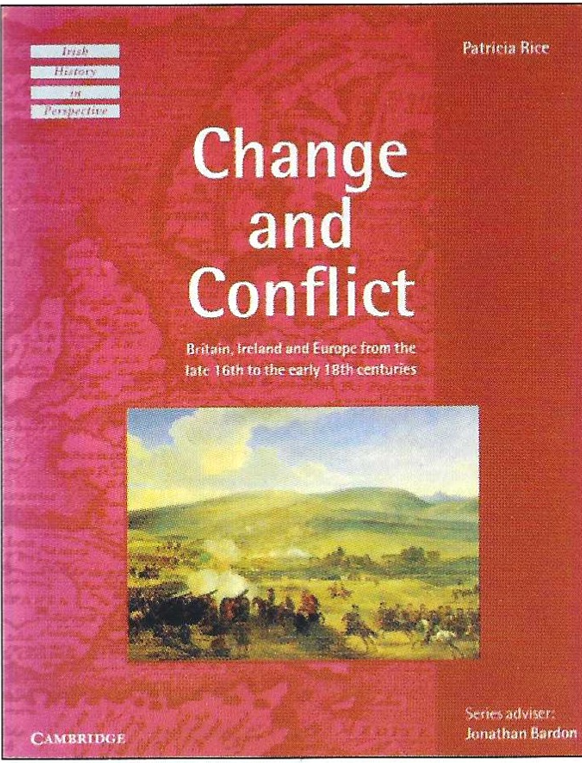
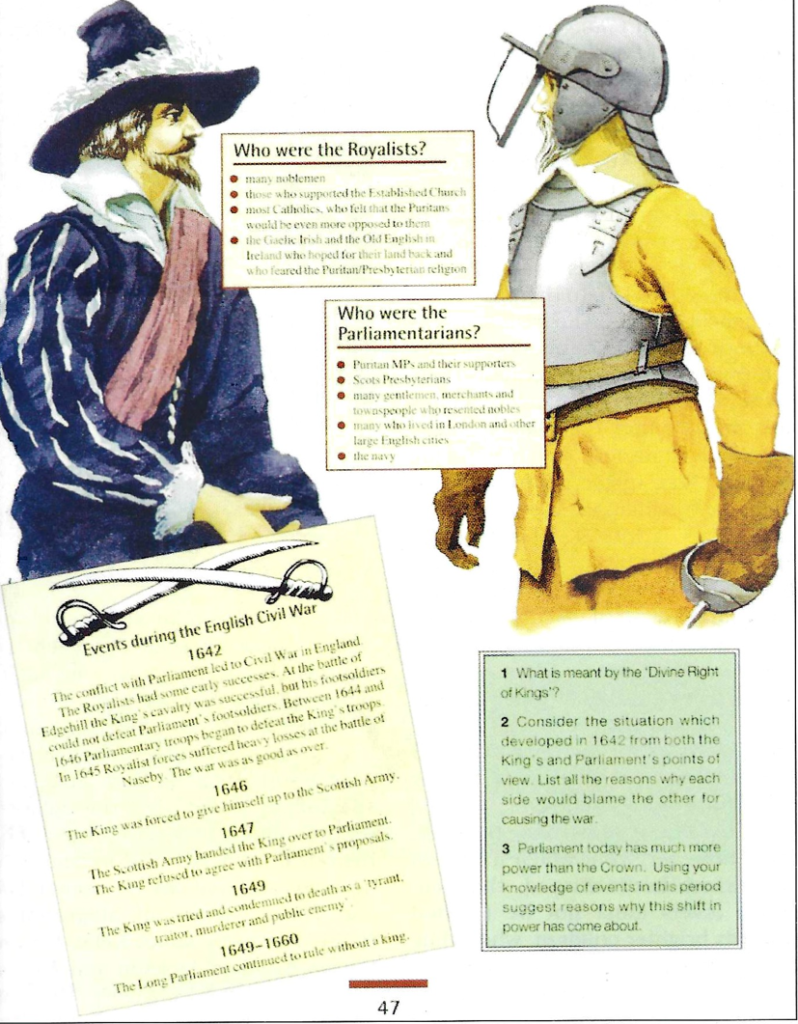
For year nine, core two, Colourpoint have produced Britain, Ireland and Europe from 1570-1745, by Norman Johnston, Audrey Hodge, Russell Rees from Omagh Academy and Austin Logan, an adviser with the Western Education and Library Board. However in this case there is a worthy rival in Change and Conflict, Britain, Ireland and Europe from the late 16th to the early 18th centuries, published by Cambridge and written by Patricia Rice of St Louis’ College, Belfast. Both texts comprehensively address all the areas in the core. The Cambridge book has the advantage of full colour, while Colourpoint’s has the merit of exercises and tasks that more directly relate to the prescribed attainment targets. The Irish sections in both cover the effects of the Reformation, the Armada, the various plantations, 1641, Cromwell, James and William and the legacy of the Treaty of Limerick. As an epilogue Patricia Rice projects forward to Home Rule, while the Colourpoint volume takes a look at the Jacobite Pretenders. As both do the job they set out to, it behoves teachers to see for themselves which is more suitable for their particular pupils.
For year nine, core three, Colourpoint’s original book in the series was Ireland and British politics from 1870-1921 by Audrey Hodge and Russell Rees. To date no publisher has produced a challenger dealing with this era. It must bear the criticism, however, from which its series successors have learned, that language levels must not be pitched
towards brighter children, who, while they preponderate in grammar schools, are in a minority in the school population as a whole. The publishers have taken this into account and are bringing out a revised version this spring. In fact the original sold out largely to A level students and to general readers because it covers the important period from the first Home Rule bill to partition in a clear and readable way and with many fine illustrations. It puts in the shade many other volumes written for the adult market. In fact Colourpoint are considering bringing out another version, minus the school exercises, aimed directly at the general reader. Finally, two productions of the European Studies Project, based at the Manor House, Ulster Folk and Transport Museum, Cultra, County Down, deal with the Normans, colonies and plantations. These take the form of loose leaf binders, containing many photocopiable exercises and illustrations with a very clear and concise text. They are an excellent supplement particularly for giving out homework exercises in those schools where it is perhaps not a good idea to let text-books out of the classroom.
Senior cycle
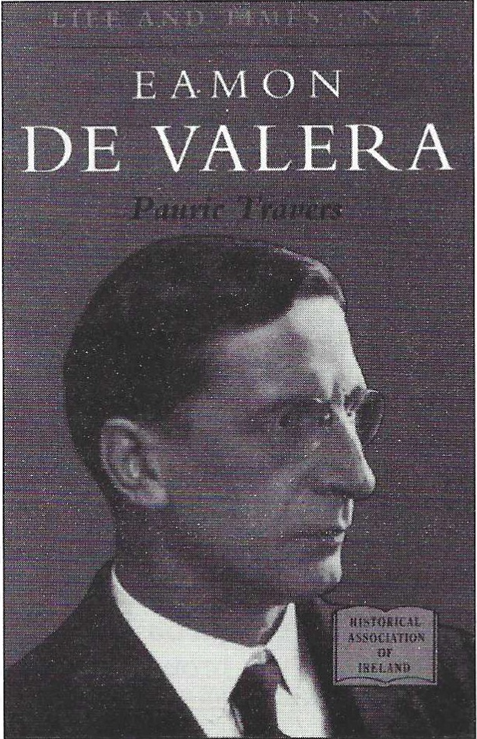
For A level and Leaving Certificate pupils, there have always been the old reliables by the major Irish historians—Lyons, Beckett and Moody, and that prolific producer of school texts, M.E. Collins. Recently a new generation of texts has appeared specifically aimed at the school-leaver and undergraduate. The Historical Association of Ireland is to be congratulated for its recent Life and Times series of biographies: Henry Grattan by James Kelly, Edward Carson by Alvin Jackson and Eamon de Valera by Pauric Travers. The stated aim is ‘to place the lives of leading historical figures against the background of new research on the problems and conditions of their times’ in a way that is helpful to students and at the same time appealing to the general public. They have succeeded admirably in all three. Not all students or general readers have the time to plough through the acknowledged biographers such as T.P. Coogan or T. Ryle Dwyer on de Valera, Stephen Gwynn on Grattan or Ian Colvin or Montgomery Hyde on Carson. This series provides a necessary abstract of these and the other general related histories. Each book also supplies a useful chronology as well as an essential bibliography for further study. They are written in an authoritative, accessible and enjoyable way. Remarkably each slim volume evokes a whole life and times in only fifty-four pages in the case of Kelly, fifty-six by Travers and seventy-four by Jackson. The Historical Association of Ireland have further volumes in the pipeline: Thomas Wentworth by Raymond Gillespie, Henry Joy McCracken by Tommy Graham, Daniel O’Connell by Gearóid Ó Tuathaigh, Justin McCarthy by Eugene J. Doyle and W.T. Cosgrave by Eunan O’Halpin. This can only make life easier for the harassed teaching profession and its students.
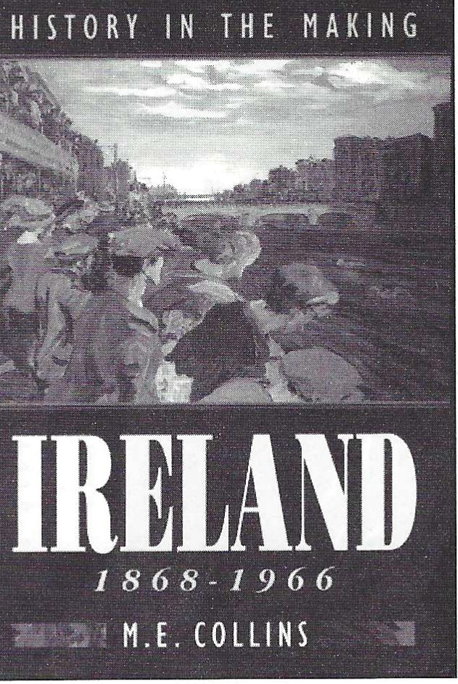
A welcome addition to the general texts has been M.E. Collins’s Ireland 1868-1966 in the History in the Making series, published by the Educational Company. This is more than just a reworking of her earlier Outline of Modern Irish History 1850-1966—it is a completely new work which has taken into account recent research and methodology. It is chock-full of excellent illustrations, photographs, document extracts and relevant exercises. Collins’s familiar precise style is here used to great effect. If a teacher had only £10 per school leaver for an Irish history course then it should be spent only on this book. I can also recommend the companion volume in this series, Europe 1870-1970 by Richard Fogarty.
Finally, two books have been warmly recommended in the chief examiner’s report for A level history in 1994. One is Eamon Phoenix’s Northern Nationalism: nationalist politics, partition and the Catholic minority in Northern Ireland 1890-1940 (reviewed in this issue) which has thrown new light on a surprisingly little researched topic. It has deservedly already become a best-seller. The other is my own Nationalism and Unionism: Conflict in Ireland 1885-21 (reviewed in HI Autumn 1994) which is based on lectures to sixth-formers by eminent Irish historians.
Peter Collins is a fellow of the Institute of Irish Studies, Belfast.