
Netflix, autumn 2025
By Sylvie Kleinman
‘The profits flowing from New York are being used to serve God’s purpose. The secret deal which you struck with our friends [Fenians] is therefore the disreputable means to a virtuous end. In this work I am supported by the women of the Guinness Housing Trust.’
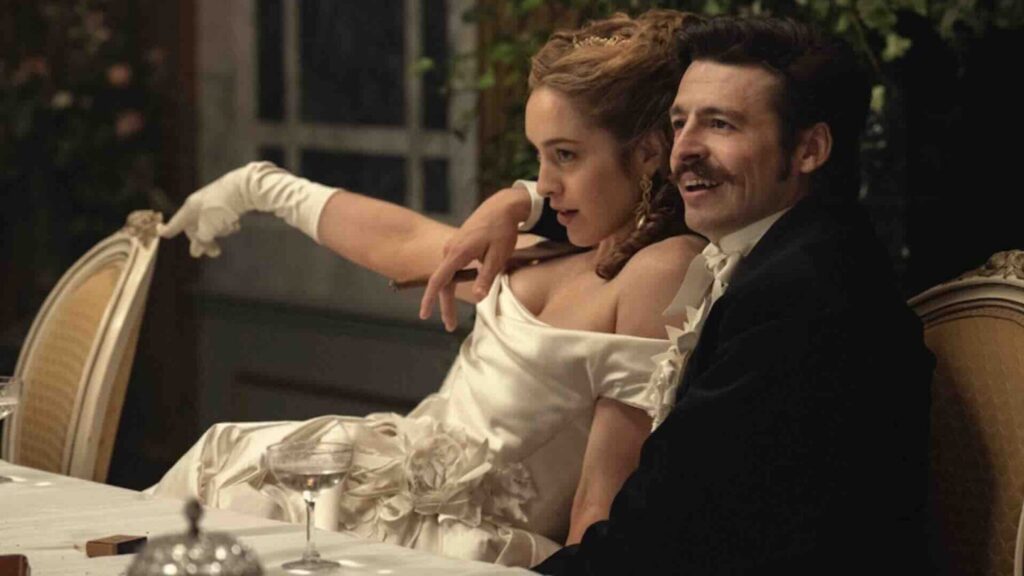
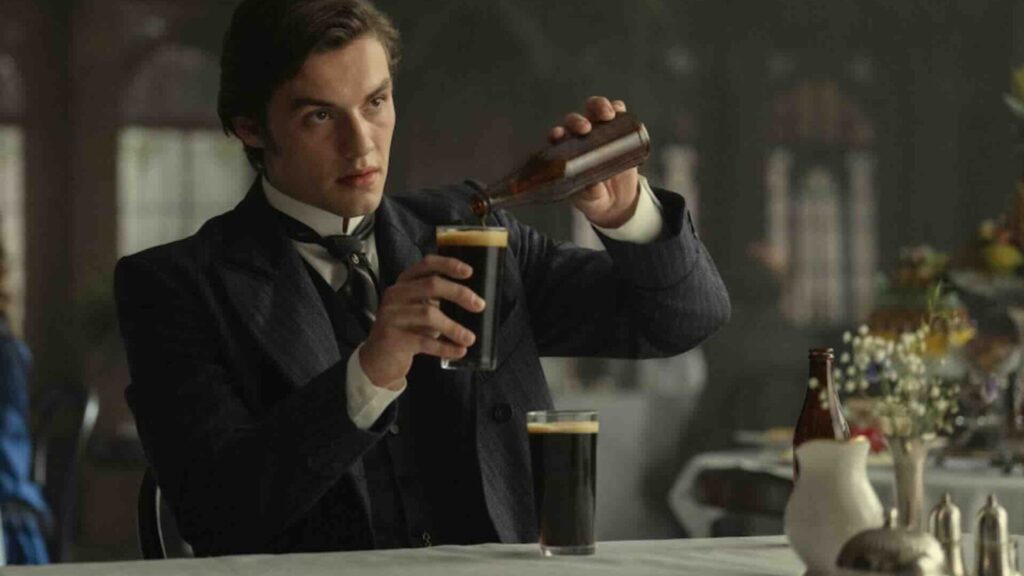
So wrote Edward Cecil Guinness (actual brewery manager at the age of twenty in 1868) to his fictitious illegitimate relative Byron Hedges in Netflix’s lavish and controversial hit series House of Guinness, set to a high-octane contemporary soundtrack that includes Irish post-punk and Kneecap. Hedges sells Edward a cunning plan: Guinness exports are smoothly offloaded on Manhattan docks by local Irish Republican Brothers in return for a monetary gesture supporting their cause. After colourful adventures in a very atmospherically recreated Hell’s Kitchen, Hedges will even manage the elder Arthur Guinness’s Conservative election campaign! Arthur, not wanting his [Netflix] ‘sodomy’ publicised, yields. Robust history is often lacking in such series, and House of Guinness self-identifies as ‘fiction … inspired by true stories’. Stories are people-driven, and the series bustles with complex characters, real and unreal, enmeshed in believable, plausible, preposterous, ridiculous or fictionalised scenarios. As House of Guinness stars the rich and famous, there are inevitable romantic/sexual intrigues, arguably here crossing an ethical line in creative licence. The cast (mostly Irish) is energetic and enthusiastic, and, beyond the audacious liberties and minor costume and accent glitches, the fast-paced plot and attentively designed sets make for escapist entertainment.
We rarely get Irish period drama, and local reactions were interesting, given that we haven’t exactly been overwhelmed with the public demanding true stories about our internationally renowned parvenu unionist/Protestant and (this generation) evangelical-leaning industrial dynasty. For example, for Pat Stacey (Evening Herald, 24 September 2025), whose parents and grandparents left dilapidated tenements for Iveagh Trust flats, this saga was ‘risible nonsense’, pouring history ‘down the drain’.
Siblings Arthur, Edward, Anne and Benjamin hint at rivalry after the death of their father Benjamin Lee in 1868, but warm to each other’s life issues. Buoyant Arthur must keep his father’s (Conservative) Dublin seat, while capable young Edward manages the brewery—all true. The action hinges around these two (who are not yet earls entertaining royalty), but females have great presence, if not always within the societal norms of the times. Here Arthur is gay, based on the supposed evidence that offspring were not mentioned in his marriage settlement with his actual bride, the Earl of Bantry’s daughter, Lady Olivia, and they had no children. On screen she arrives unchaperoned (probably at Iveagh House, sumptuously recreated), proposes a convivial deal spouting the F-word, demands a drink and asserts that she will be a publicly dutiful wife seeking her own pleasure elsewhere. This ambitious power couple very amiably breakfast or debrief, e.g. when Arthur loses his seat owing to electoral fraud, or after late nights and furtive trysts. We have never seen Irish mid-Victorian queer life re-created, and it is credible, though one wonders whether someone of Arthur’s status would have taken such risks, crossing class lines in back lanes and in the brewery. Online we learn from Dr Jack Egan, whose recent thesis examined the Guinness empire, that Olivia had ordered her diary to be destroyed at her death.
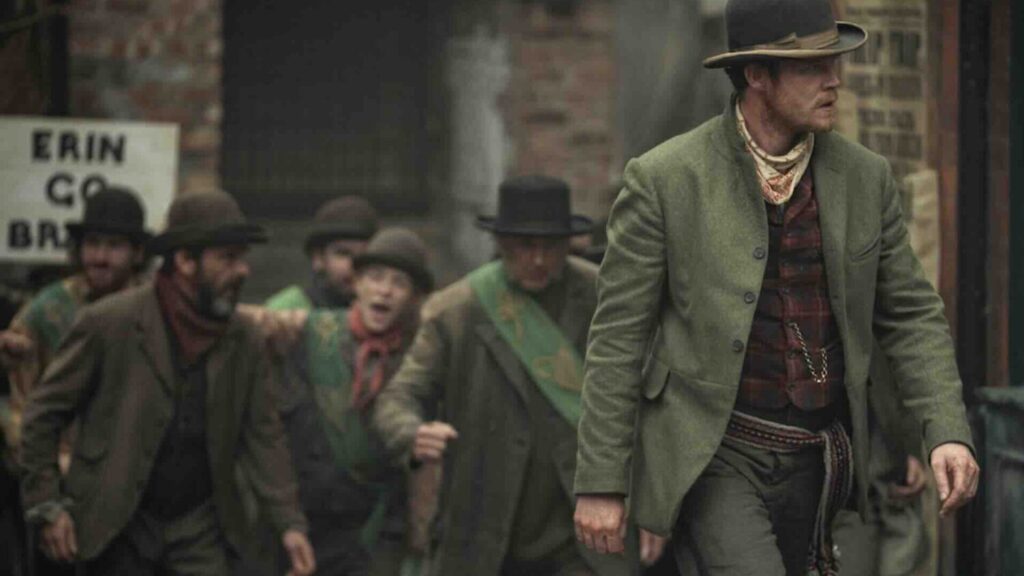
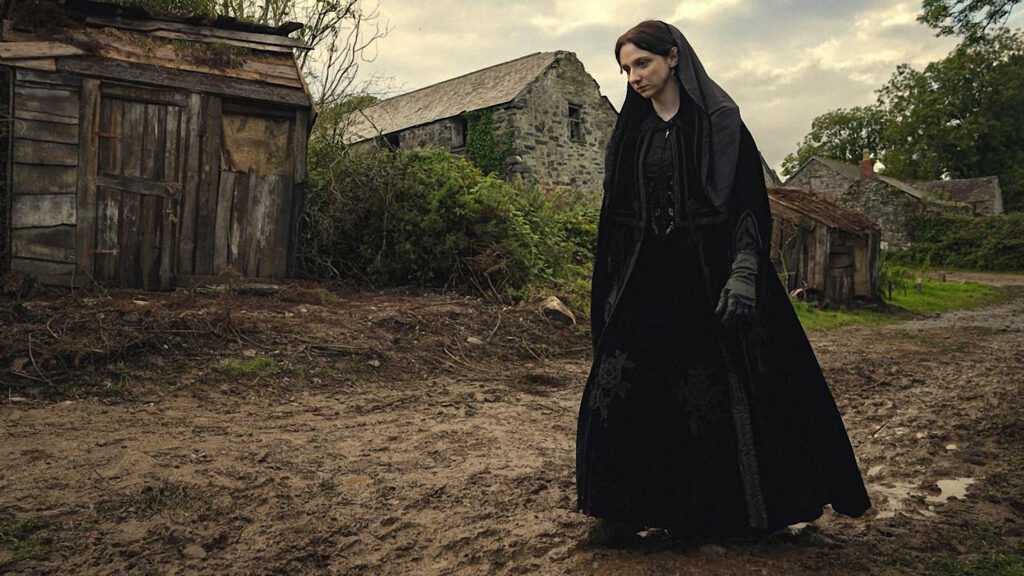
Another daft layer is an arrangement sanctioned by Arthur with the fictitious (Catholic) brewery foreman, the alluring, swaggering thug and fixer Rafferty. It goes wrong when Olivia’s corset gets tight and Cupid has struck them jointly. A Bantry House descendant commented that they had not been asked for historical details. Multi-tasking Rafferty had already connected—literally—in a dark, damp lane with the quiet but interesting Anne, in real life the wife of the Anglican clergyman William Conyngham, later 4th Baron Plunket and archbishop of Dublin, a lady more likely to organise Bible readings in fact and a philanthropist in her own right. We see her miscarrying the resulting pregnancy en route to Ashford Castle, travelling solo, which gives her greater agency but is improbable. A compassionate village woman assists, then brings her to the local (Catholic) church for spiritual healing, prompting Anne to learn more about conditions in the fictitious village of ‘Clonboo’ (actually in Wales). House of Guinness was not filmed here but, despite the foreign location, the recreation of bleak, forlorn rural graves is effective and moving. Edward and his real-life cousin and fiancée Adelaide also experience West of Ireland social consciousness-stirring, but his eyes had been opened during his romance with the committed, principled and fabricated Fenian babe activist Ellen. We are edified, given that this early republican revival is hardly remembered for its feminism.
Here, Adelaide is the instigator, with Anne, of the housing trust we began with, and we see the plans and bright new flats (sets) with running water, which all look late Victorian or Edwardian (as they were in real life), though the timeline here is early 1870s. This is just about forgiveable, whereas the colourful Fenian layer probably irritated specialist historians. All the sets, both indoor and outdoor, lavish and luxuriant, taverns or humble dwellings, and the steaming brewery and dockyards, are visually successful. The focus is more élitist upstairs than labouring downstairs, but when the iconic brewery pension is introduced, way earlier than in reality, we get some stirring ‘Guinness from below’. A worthy aged chap in the bustling yard at St James’s Gate waves his pension form, perplexed: he could stop working and still get paid—applause!
There was an ‘inevitable thrill’ in seeing it all on screen, but much of House of Guinness remains ‘wildly unfaithful’ (Irish Times, 25 September 2025). The Guinness story is embedded in Irish consciousness, and begrudgery was probably exacerbated by the bold gusto of the British creator, Steve Knight, in freely fictionalising in the signature style of his cult success Peaky Blinders. House of Guinness was produced by Irishman Cathal Bannon; Netflix introduced Irish subtitles; and—as it ends with cliffhangers—it will return.
Sylvie Kleinman is Visiting Research Fellow at the Department of History, Trinity College, Dublin.