
By Brian Casey
John Philpott Curran, a member of the Church of Ireland, a lawyer, MP, graduate of Trinity College, Dublin, and supporter of Catholic rights, was born in Cork in 1750. As a student, he attended debates in the House of Commons, College Green, and was inspired by Henry Flood. He was a defender of the United Irishmen in the 1790s, and of Robert Emmet until he learned that Emmet was secretly engaged to his daughter. He died in his London home in 1817 and was buried in Paddington graveyard. Daniel O’Connell had pledged to erect a monument in his memory, keeping the idea alive during the campaign for Catholic Emancipation.
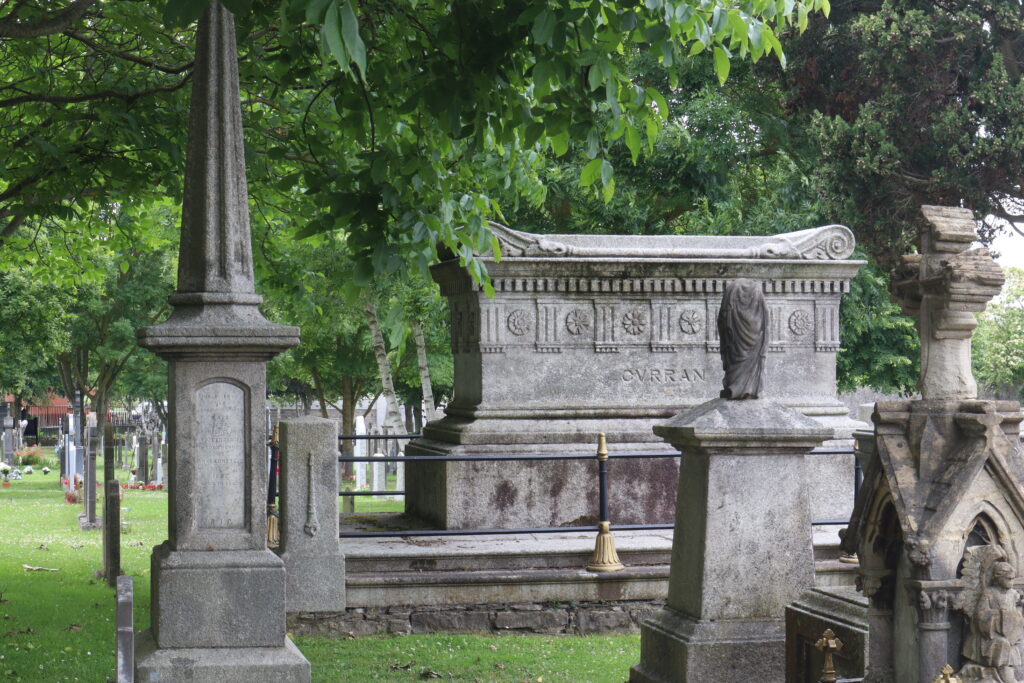
In October 1830 the Freeman’s Journal reported that there was a need for a national monument for the ‘late celebrated patriot, orator and wit’. It said that ‘they have a splendid pillar in Sackville Street to a Norfolkman [Nelson] whilst the eminent men of their own country are so comparatively forgotten’. A memorial was needed for Curran, ‘as he is buried in a strange land’. It would also ensure that his legacy and memory were captured, so that ‘the name of Curran must be known to posterity’.
The first discussions about the repatriation of Curran’s remains to Prospect (now Glasnevin) Cemetery are recorded in the minute-book of the Dublin Burials Committee in December 1834. Lawrence Finn, a member of the committee, stated that one of the purposes of such a funeral was to redeem the nation ‘from the reproach of insensibility towards the memory of a patriot who was a defender of Ireland during the Reign of Terror’. His son William supported this initiative, telling the committee in a letter that the ‘land of his birth should be his final resting place’. He was disappointed that ‘this feeling could not be indulged’ and expressed gratitude that new efforts were being made so that ‘what remained of him should be coming home’.
The minute-books note that Christopher Fitzsimons, MP for Dublin and son-in-law of Daniel O’Connell, assisted in the process of repatriation, which was not straightforward, since burial-grounds fell under the purview of the Church of England’s Consistorial Court. Nevertheless, Curran’s remains arrived back in Ireland from London in July 1835. Initially they were stored in the mausoleum of Lord Cloncurry at Lyons, Co. Kildare, until arrangements were made to build ‘a more suitable monument … in the cemetery at Prospect’. The loyalist Evening Packet was dismissive, stating that there was going to be an ‘infliction of a procession to reinter Curran’s ashes at the Prospect cemetery’.
In January 1836 a group met at the Royal Hotel to progress arrangements for the funeral and reinterment. They also solicited subscriptions for a monument over his grave. Lord Cloncurry opened the donations with £50 and the committee hoped that they would reach their target in a relatively short time. Curran’s funeral was held in February 1837 and was a show of support for the Repeal movement, with notable figures of Dublin’s political and commercial life attending in solidarity.
Curran’s funeral helped to raise the profile of Prospect Cemetery and he was the first of many significant political figures to be buried there. The fact that he was a member of the Church of Ireland reflected the mission of the Dublin Burials Committee and Daniel O’Connell to bury people of all faiths and none with dignity and respect. Over his grave there is a granite sarcophagus, modelled on the tomb of Scipio Barbatus in Rome. It is one of many striking memorials in Glasnevin, and where he is buried is now known as Curran Square.
Brian Casey is Archives Manager, Dublin Cemeteries Trust, Glasnevin.