
By James Chandler

Steve Bannon, one of the several Irish Americans who have helped put Donald Trump in power, is the former Goldman Sachs investment banker and Hollywood film producer who co-founded Breitbart News as ‘the platform for the alt-right’ in 2007. Bannon rose to prominence in American politics when he took over the management of Donald Trump’s presidential campaign in August 2016 and left his ideological mark on the election victory that November. He became Trump’s chief strategy officer in the White House and served in that post for a year before Trump dismissed him, partly because Bannon had begun to take too much public credit for Trump’s political success. But the story of Bannon’s recruitment of Trump to his ‘America First’ anti-intellectual crusade is still not widely known, and neither is the deeper history of anti-Irish Nativism that lies behind it.
Sixteen years ago Bannon teamed up with David Bossie, who had just spearheaded the successful effort to lift caps on campaign spending (the 2010 Citizens United decision), and as early as 2012 the two men met with Trump in Trump Tower to feel him out about a presidential run. Trump soon decided not to take on Barack Obama, the incumbent president, whose birthright he had been challenging, but Bannon had already concluded that the real-estate mogul turned reality-TV celebrity was the front man he needed. Bannon continued to cultivate Trump and then, about a year out from the November 2016 election, gave him major exposure with the MAGA base in a series of Breitbart interviews. Playing a wheedling ‘Steve’ to his guest’s ‘Mr Trump’, Bannon coached the presidential hopeful through a series of conversations on a range of subjects from China and Iran to oil and climate change.
At this point, in late 2015, Trump and Bannon seem not yet to have been on the same page when it comes to so-called ‘intellectual élites’. In their first interview, on 5 November, they quibble about Bannon’s sarcastic reference to ‘smart Republicans’—Trump, failing to hear Bannon’s sarcasm, retorts that they are not smart, but he (Trump) is. He later chides Bannon, ‘You have to stop using the word “the intellectuals”’, before going on to boast: ‘I went to an Ivy League school. I was a very good student. I’m more of an intellectual than I think anybody.’ Trump even volunteers that he is keen to find a way to hold on to foreign students who ‘do great’ at our best universities. One exchange in this broadcast stands out in Bannon’s later telling. As the talk turns, inevitably, to immigration, Bannon reports Trump as having said, ‘I still want people to come in. But I want them to go through the process.’ Implying that he himself did not want people to come in, Bannon quotes himself (accurately) as replying: ‘You got to remember, we’re Breitbart. We’re the know-nothing vulgarians. So, we’ve always got to be to the right of you on this.’
Bannon’s self-identifying reference is to the Know-Nothing movement of the early 1850s, which took official political shape in 1854 as the American Party. That 1850s movement, for all its brevity, is probably the most influential incarnation of American Nativism, marking a major pivot in antebellum American history. It helped both to end the old Whig Party in 1854 and to create the new Republican Party in 1856, for which Abraham Lincoln would be the presidential nominee in 1860. The growth of this organisation over its brief lifetime was nothing short of mind-boggling, from 43 members to over a million between 1852 and 1854. Know-Nothingism extended to both the North and South of 1850s America, but it took a slightly different shape in each region. Common to both parts of the movement was a fierce resistance to immigration, targeted chiefly at the Irish and the Germans, and above all at the Catholicism that many of these newcomers to America brought with them. The movement originated as secret, oath-bound societies whose members were instructed to say ‘I know nothing’ when asked about their political activities, but the term came to be embraced by the movement, which, for example, called its 1856 yearbook the Know Nothing Almanac.
In the decade from 1845 to 1855, more than a million people emigrated to America from Ireland and an even larger number from Germany—ten times the immigration levels from these countries twenty years earlier. The new post-Famine waves of Irish immigrants were objectionable to some Americans in ways that earlier generations had not been—not only because of their numbers but also because they were more likely than ever to be Catholic. Compared with earlier arrivals from Ireland, these immigrants were less skilled and poorer, and included Gaelic-speakers without English. In Northern cities they were seen as a cause of rising crime rates and a danger to employment opportunities for native-born Americans. ‘No Irish Need Apply’ first appeared in a New York Times advertisement in 1854. The Know-Nothings saw all this as an existential threat.
For Lincoln, the case was decisively otherwise. Writing to his friend Joshua Speed in 1855, he clearly expressed his rejection of the Know-Nothings with a reference back to the nation’s founding declaration:
‘I am not a Know-Nothing. That is certain. How could I be? How can anyone who abhors the oppression of negroes, be in favor of degrading classes of white people? Our progress in degeneracy appears to me to be pretty rapid. As a nation, we begin by declaring that “all men are created equal”. We now practically read it “all men are created equal, except negroes”. When the Know-Nothings get control, it will read “all men are created equal, except negroes, and foreigners, and catholics”.’
One glaring irony in Bannon’s invocation of the Know-Nothing movement as background for his and Trump’s crusade has to do with their respective ancestries. Trump is a descendant of German immigrants and Bannon a descendant of Irish Catholic immigrants. Trump’s grandfather, Friedrich, arrived in the United States from Bavaria in 1886 with just a suitcase. Bannon’s great-grandfather, Lawrence Bannon, came over from Ireland in 1850, squarely in the middle of the same post-Famine mass exodus that triggered the rise of the Know-Nothings. He would thus presumably have suffered some persecution in the 1855 heyday of the movement, when Know-Nothing candidates held 140 seats in the House and Know-Nothing mayors were elected in major cities from Boston to Chicago (including New York). Indeed, had the triumph of the Know-Nothing movement been even swifter and greater, Bannon’s great-grandfather might not have been able to enter the United States when he did—there would be no Steve Bannon from Richmond, Virginia, to recruit Trump as the political face of his plan to close American borders.
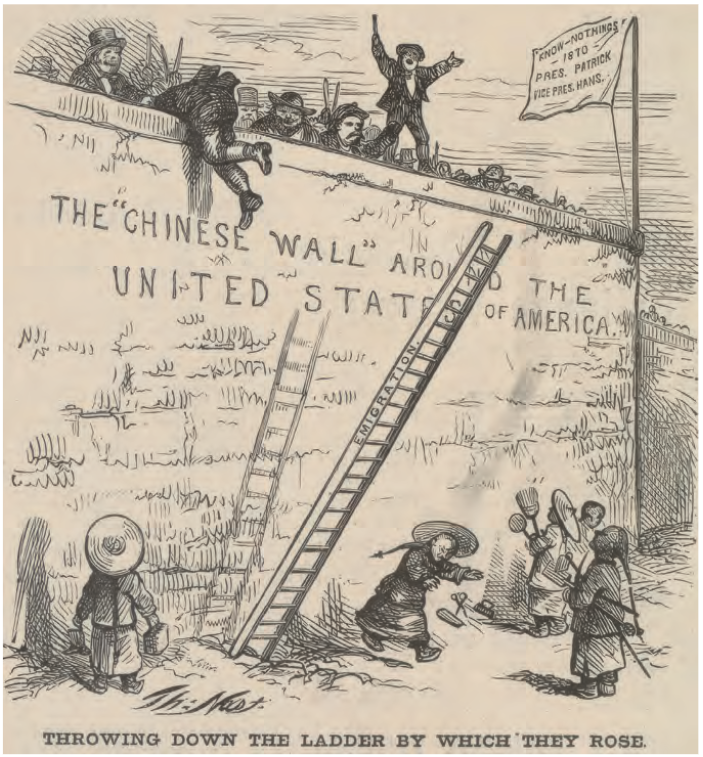
Another Catholic immigrant of this moment, Thomas Nast, who surely did attend New York City schools in the 1850s, would go on to become the greatest political cartoonist of his age. Nast was born in Bavaria in 1840 and came to the United States as part of the same Irish and German waves of immigration that the Know-Nothing movement was created to oppose. Nast’s career was well advanced by 1870, when he produced a cartoon about how American attitudes to immigration were evolving. Once the Germans and Irish Catholics assimilated, many of them in their turn struck a hard-line anti-immigration stance towards new Chinese arrivals. Recognising this irony led Nast to one of his most famous and prophetic satirical efforts: ‘Throwing Down the Ladder by Which They Rose’ (above/below). Atop the newly walled border around the United States, under an updated Know-Nothing flag, stand assimilated Irish and German Catholic immigrants. They are led by ‘President Patrick’ and ‘Vice President Hans’, presumably Irish and German leaders of the new Know-Nothings, a reincarnation of the very movement that had so relentlessly persecuted them, or their parents, a quarter of a century earlier.
It is hard to look at this 1870 cartoon without thinking of the Irish-American president of Breitbart News and the German-American president of the United States. More is involved here than mere policy. Beyond reviving the same kind of Know-Nothing immigration proposals that would have kept their own ancestors out of the country, Steve Bannon and Donald Trump have also supported their effort with the same kind of illiberal xenophobic rhetoric that the nineteenth-century Know-Nothing movement used to stoke that first campaign.
Back in the 1850s, a prominent member of the Know-Nothing party in the New York of the early 1850s was William ‘the Butcher’ Poole, whose violence against Irish Catholics was memorably restaged on screen by Daniel Day-Lewis in Martin Scorsese’s 2002 Gangs of New York. As the brutal leader of the Bowery Boys, Poole assumed the role of a gang lord hell-bent on blocking immigrants and extirpating Roman Catholic globalism. Though he left little by way of a written record, an 1853 notice in the Brooklyn Eagle notes a William Poole elected to serve a three-year term in the sixth ward of New York City’s Board of Education. If this was indeed the William Poole, as seems likely, he would have been responsible for shaping the educational experience of students in New York schools in the decade after the arrival of Lawrence Bannon from Ireland. I can find no information about whether Steve Bannon’s Irish great-grandfather came first to New York, as so many other Famine immigrants did, but the very idea of him under the tutelage of Daniel Day-Lewis’s William Poole character in Gangs of New York conjures an image to reckon with.
James Chandler is William B. Ogden Distinguished Service Professor of English and Cinema and Media Studies at the University of Chicago.
https://www.pricklyparadigm.com/the-know-nothing-campaign-against-higher-learning