
PATRICK GLEESON
Four Courts Press
€45
ISBN 9781801511650
Reviewed by
Simon Egan
Simon Egan is a lecturer in Medieval Irish History at Queen’s University, Belfast.
The study of medieval Irish kingship and society is undergoing something of a renaissance. The last few years alone have witnessed the production of some truly excellent work: Katharine Simms’s Gaelic Ulster in the Middle Ages: history, culture and society (Four Courts Press, 2020); Elizabeth FitzPatrick’s Landscapes of the learned: placing Gaelic literati in Irish lordships, 1300–1600 (Oxford University Press, 2023); Seán Ó Hoireabhárd’s The medieval Irish kings and the English invasion (Liverpool University Press, 2024); and Ronan Mulhaire’s Irish kingship in the eleventh and twelfth centuries (Routledge, 2025), to name but a handful of studies. Patrick Gleeson’s exciting monograph follows in this rich vein of scholarship.
A significant body of work has been completed on kingship in medieval Ireland, from the earliest recorded kings to Brian Ború (d. 1014) and all the way through to the decline of kingship in the later Middle Ages. However, most studies (whichever period is in question) have tended to focus on the textual sources, relying on often-unreliable annalistic material, dynastic propaganda (such as the late eleventh/early twelfth-century Cogadh Gaedhel re Gallaibh, ‘The war of the Irish against the foreigners’) or complex genealogical material. Historians and Celtic scholars alike have often paid scant attention to the archaeological evidence and the valuable insights that it can offer in understanding many aspects of pre-modern Irish society. Patrick Gleeson’s study offers the first in-depth examination of Irish kingship to combine traditional historical investigation with archaeological approaches and landscape study. This is no easy task for two key reasons. Firstly, the subject-matter is incredibly complex. Early and high medieval Ireland is perhaps best described as a fragmented polity and at one point there may have been up to 600 kings active across the island. Of course, the status of these men varied wildly. The least important grade of king, the rí tuatha, may have ruled a small plot of land that amounted to little more than a parish (if even that). Power was, in reality, concentrated in the hands of the more powerful over-kings, provincial kings and, ultimately, high-kings. Secondly, pre-modern Irish society has often been perceived to exist outside the European norm. Given that Ireland never formed part of the Roman Empire (unlike large areas of its nearest neighbour, Britain), the Irish kings, aristocrats and the people they ruled have long been regarded as something of an aberration when compared to other parts of Europe. These notions were put forth most acerbically by commentators such as Gerald of Wales (d. 1223) in the later twelfth and early thirteenth centuries and further engrained during the Tudor and Jacobean periods by English officials such as Edmund Spenser (d. 1599) and John Davies (d. 1626). This idea that Ireland was not only somewhat ‘odd’ but also ‘backward’ and socially regressive in a European context has proven very difficult to challenge. The notion gained considerable traction in the debates between Goddard Henry Orpen (d. 1932) and Eoin Mac Neill (d. 1945) and others during the early to mid-twentieth century, but even in the scholarship of the present day one will not have to look too far to find pre-modern Irish society described in such pejorative terms.
Patrick Gleeson’s very welcome book seeks to dispel the idea that Ireland was a politically underdeveloped backwater on the European periphery. It does so by drawing on a range of evidence (historical and archaeological) to demonstrate not only that Irish society was highly structured but also that its increasing stratification in the early and high medieval period was shaped primarily by the evolving institution of Irish kingship. The introduction provides a detailed overview of how scholarship on kingship has developed since the 1970s. This not only provides readers with a guide to the key debates but also highlights how and why certain scholars continue to regard medieval Ireland as an oddity. The first two chapters foreground the importance of landscape study in understanding the evolution of kingship in medieval Ireland. While textual sources can shed a great deal of light on how contemporaries conceived of royal power, kingship also needs to be understood within spatial contexts. Ritual and ceremony are particularly important in this regard, and the chapters discuss the role of the early medieval assembly, the oenach. As Gleeson demonstrates, assemblies were hugely important in the regulation of Irish society; they acted as a focal point for the local community, were key to organising and dispensing justice, and provided the forum in which a king could exercise his power.
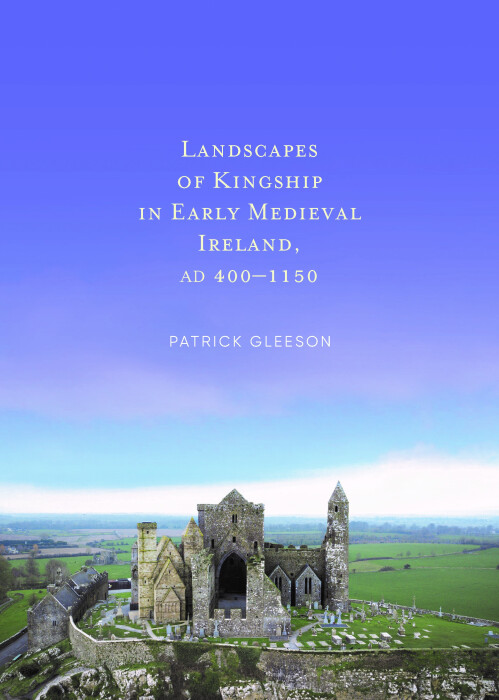
Medieval Irish kingship is a complex topic that involves quite literally hundreds of royal lineages. Gleeson takes two of the best-documented royal dynasties as his core case-studies: the Eóganacht confederation that ruled Munster and the Síl nÁedo Sláine of the Southern Uí Néill. The next four chapters deal with the evolution of kingship amongst the Eóganacht in Munster. In Chapters 3 and 4 Gleeson discusses the origins of the Eóganacht. The Eóganacht are an intriguing dynasty and produced a range of remarkable leaders, such as the infamous bishop-king, ascetic and monastery-burner Fedlimid mac Chrimthann (d. 846) and the scholar-king Cormac mac Cuilennáin (d. 908), who produced the well-known Sanas Chormac, ‘Cormac’s Glossary’. Nevertheless, aside from some local studies, the Eóganacht have not been studied with the same level of interest as other dynasties such as the Uí Néill. In these chapters Gleeson seeks to challenge current thinking on the origins of the Eóganacht; he argues that this famous grouping should be understood as a confederacy comprising two powerful regional polities (the Uí Maic Láire and the Corcu Loígde) rather than as a group of lineages descended from a single origin-figure (as they have typically been understood). He challenges the traditional line of interpretation and discusses how the Rock of Cashel gradually developed from being the important regional seat of the Uí Maic Láire to the major royal landscape of the kings of Munster. Chapter 5 offers a fascinating discussion on how ambitious Eóganacht kings such as Fedlimid mac Chrimthann (and later kings of Dál gCais such as Muircheartach Ó Briain) may have conceived of Cashel as the capital for a new monarchy of Ireland. Chapter 6, in turn, conducts a detailed investigation of Cashel’s changing royal landscape in the early and high medieval period, considering how the landscape was altered in line with the growing power of the region’s kings.
The next two chapters move north to explore the history of the Síl nÁedo Sláine of the Southern Uí Néill. This lineage ruled an area of Leinster that more or less approximated to the modern-day counties of Meath, Louth and Dublin. Furthermore, the Síl nÁedo Sláine themselves formed part of a much wider confederation, the Cenél nEogain or Uí Néill, which controlled most of Ulster. In many respects the Uí Néill and Eóganacht were counterpoints to one another; the Eóganacht ruled Munster and regarded Cashel as their seat while the Uí Néill were closely associated with the royal site of Tara. The Uí Néill, unlike the Eóganacht, have been studied in detail from both a historical and an archaeological perspective. The Hill of Tara, for instance, has been subject to significant archaeological excavation, whereas other important sites have yet to be considered. Chapter 7 examines the history of the Uí Néill dynasty more generally before tracing the fortunes of the Síl nÁedo Sláine. Understanding the history of this sub-branch provides context crucial for unpicking Tara’s emergence as a key royal site, a topic explored in detail in Chapter 8. While Tara has been the subject of significant scholarly interest, Gleeson makes the astute observation that medieval Irish propaganda (produced by the Uí Néill) has been very successful in overstating its national importance. The site is critical to understanding evolving attitudes towards kingship but, for much of its existence, Tara should be understood as being one among many such sites in Ireland.
In the final chapter, Gleeson takes a step back and considers the evolution of kingship in Ireland from a wider perspective. This is an ambitious section of the book in what is an already ambitious piece of scholarship and the chapter identifies a series of changes that continue across eight centuries, from the fifth century through to the events of the English invasions in the late 1160s. Gleeson’s core contention is that Irish society in this period was far from being static or politically underdeveloped. During this longue durée, Irish society became increasingly stratified as kings sought to consolidate their power. The codification of laws in the eighth and ninth centuries not only saw the legal system become more sophisticated but also lent weight to how contemporaries understood the organisation of Irish society and the territorial divisions of the island more generally. The growing complexity of Irish royal and political culture is borne out in the surviving built heritage and material culture, including the growing prominence of assembly sites, settlement patterns and ecclesiastical patronage. Irish kingship should therefore be seen as a dynamic force, capable of adapting to new challenges as well as innovating when the need arose. While Ireland was located on the geographic periphery of Europe, events there reflected developments on the Continent and the desire of kings in places like England and Francia to rule their subjects and realms more effectively.
Patrick Gleeson has provided a master-class in combining traditional historical (and text-based) approaches with up-to-date archaeological methods. The book draws on a vast range of primary source material from medieval Ireland, including annals, law codes and genealogies, as well as a rich meld of archaeological evidence, including excavations carried out by the author himself. Four Courts Press have produced a beautiful book, replete with a series of photographs in colour. There are also several helpfully illustrated genealogies and a number of maps depicting royal sites, territories and terrain models derived from LiDAR scans (which generate 3D representations).
This book should attract a wide readership. Naturally, it will be essential reading for anyone working on or interested in the history of kingship in medieval Ireland—specialists from a range of disciplines such as history, Celtic studies, archaeology and geography will no doubt discover a wealth of new material here. Equally, the book should dispel many of the attitudes present in mainstream European scholarship that continually portray medieval Ireland in terms of ‘backwardness’. It should also appeal to students approaching this topic for the first time. Gleeson has provided a specialised but also a very accessible account of medieval Irish kingship and it should be required reading on third-level medieval Irish history courses. Compared with many other academic publishers, Four Courts Press generally offer a more cost-effective option. Given the level and range of expertise on display here, €45 is an excellent bargain.