
BY AODHÁN CREALEY
SEPTEMBER
12/1814
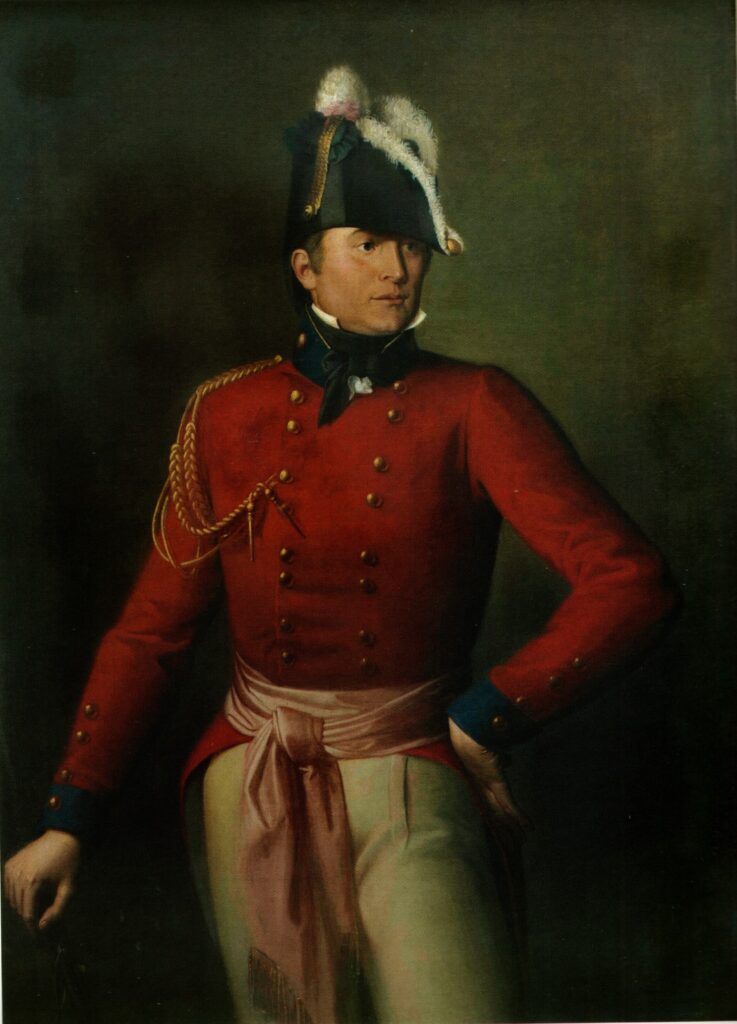
Major-General Robert Ross (c. 48), commander of British forces on the East Coast (Canada), was mortally wounded by American snipers near Baltimore during the war of 1812. Born in Dublin, with family connections to Rostrevor, Co. Down, Ross joined the British army in 1789 and fought with distinction in the Napoleonic and Peninsular Wars. He was then sent to British North America—now Canada—and given command of a 4,500-strong brigade of infantry. Crossing the border into Maryland, he followed the Patuxent River right down to Chesapeake Bay, where he attacked and routed a superior American army at the Battle of Bladensburg—the only battle in US history in which a sitting president, James Madison, took part. From there he marched some 50 miles to Washington DC, where he made his name in history by ordering that all buildings connected with government, including the White House—but not private property—be burned. Following his death, his body was preserved in a barrel of rum and taken to Halifax, Nova Scotia, where he was buried with full honours. Highly respected by his superiors and by his men for his courage in battle, he, like the aforementioned snipers, is widely commemorated in the US. Here he is remembered by a 30m granite obelisk on the shoreline near Rostrevor, erected by his former colleagues twelve years later, which was refurbished and reopened in 2008.
02/1976
The European Court of Human Rights found the British government guilty of torture of republican prisoners in Northern Ireland but not guilty of discrimination in the operation of internment during August 1971.
05/1926
Forty-eight people died, over half of whom were under 25, when a loft in Drumcollagher, Co. Limerick, being used as a temporary cinema to show Cecil B. DeMille’s The Ten Commandments, was engulfed in flames after one of the exposed film reels caught fire.
09/1976
Mao Tse-Tung (82), Chinese communist leader and founder of the People’s Republic of China (1949), died.
11/2001
9/11: some 3,000 lost their lives, including at least eighteen Irish citizens, in coordinated attacks by al-Qaeda on the Twin Towers in New York and the Pentagon in Washington DC.
15/1976
Anne Dickson became the first woman to lead an Irish political party when she was elected leader of the Unionist Party of Northern Ireland.
22/1576
Walter Devereux (37), 1st Earl of Essex, chiefly remembered for the Rathlin Island Massacre (1575) in which Sorley Boy MacDonnell’s garrison and the entire civilian population—over 600 Scots and Irish men, women and children—were killed, died.
26/1986
Brian Desmond Hurst, Belfast-born film director, including of Ourselves Alone (1936), a love story set during the War of Independence which was banned in Northern Ireland, died.
28/1966
The ‘Tricolour Riots’, the worst disturbances in Belfast for over 30 years, began when the RUC, under the terms of the Flags and Emblems Display Act (1954), forcibly removed a tricolour from a window at the election headquarters in Divis Street of Liam McMillan, Republican (Sinn Féin) candidate in the impending Westminster election.
29/1826
Charles Cornwallis Chesney (49), professor of military history at the Royal Military College, Sandhurst, who revolutionised the study of military theory, born near Kilkeel, Co. Down.
OCTOBER
25/1854
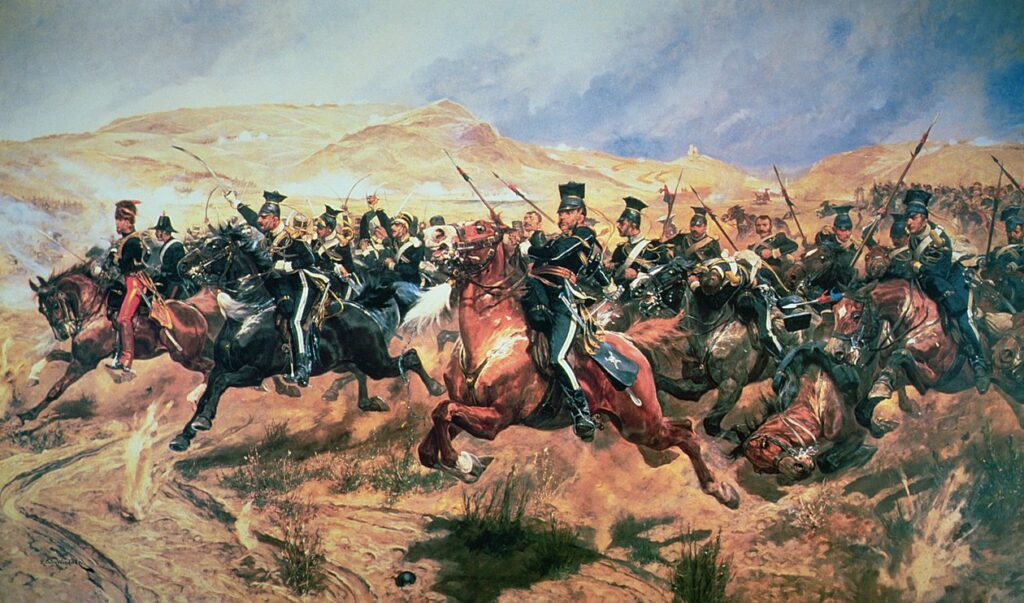
The charge of the Light Brigade at the Battle of Balaclava in the Crimean War—the biggest disaster in British military history—came about through incompetence and poor communication. When the British commander, Lord Raglan, observed that the Turkish positions on the heights above the battlefield had been overwhelmed and that the enemy were withdrawing with their 12-pounder naval guns, he issued a written order to cavalry commander Lord Lucan, an infamous landlord in Mayo during the Famine who had little cavalry experience, instructing him to ‘follow the enemy and try to prevent them from carrying away the guns’. This order was conveyed to Lucan by Captain Louis Nolan, a young, impetuous officer thirsting for action. Lucan was puzzled because he could see neither the enemy nor the guns. He remonstrated with Nolan, who, according to Lucan, gestured not at the heights but towards the further end of the valley, so Lucan ordered his deputy, Lord Cardigan, ‘to attack the Russians in the valley’. Though he pointed out that the order was suicidal, Cardigan complied—‘Theirs not to reason why, theirs but to do and die’, as Tennyson put it. As our own William Howard Russell of The Times described the half-hour of carnage, ‘Our Light Brigade rushed to the front. They swept proudly past, glittering in the morning sun. At a distance of 1,200 yards the whole line of the enemy belched forth, from 30 iron mouths, a flood of smoke and flame, through which hissed the deadly balls.’ Of the 671 men who charged, half were either killed (including Captain Nolan), injured or taken prisoner. Some 37,000 Irishmen fought in the Crimean War, of whom 7,000 died, mostly from disease and neglect.
03/1226
Giovanni di Pietro di Bernardone (c. 45), known as Francis of Assisi, mystic, friar and founder of the Franciscans (1210), died. The order arrived in Ireland c. 1231.
07/1996
The IRA detonated two massive car bombs without warning at Thiepval barracks, British army headquarters in Lisburn, Co. Antrim. One soldier was killed and over 30 others were injured.
13/2006
The St Andrew’s Agreement between the British and Irish governments and Northern Ireland’s political parties was signed, leading to the restoration of the Northern Ireland Assembly, the formation of a new Northern Ireland Executive and a decision by Sinn Féin to support the Police Service of Northern Ireland (PSNI).
15/1976
Garda Michael Clerkin (24) was killed and four other gardaí were injured—one blinded for life—in an IRA booby-trap bomb in a deserted cottage near Portlaoise.
15/1996
The Criminal Assets Bureau (CAB) was established with powers to identify the illegally acquired assets of criminals and, through the Proceeds of Crime Act (1996), take the appropriate action to deny such people these assets.
23/1956
The Hungarian uprising, a nationwide revolt against Soviet-imposed policies and communist rule, began. A new government, under Imre Nagy, that sought neutrality was installed.
25/1996
The last Magdalene Laundry in Ireland, located on Seán MacDermott Street, Dublin, and run by the Sisters of Our Lady of Charity, closed.
28/1726
Travels into Several Remote Nations of the World. In Four Parts. By Lemuel Gulliver, First a Surgeon, and then a Captain of Several Ships, better known as Gulliver’s Travels, by Jonathan Swift, was published in London by Benjamin Motte.
28/1976
Máire Drumm (57), former vice-president of Sinn Féin, was shot dead by the UDA/UFF in a ward of the Mater Hospital, Belfast, where she was waiting to undergo an eye operation.