
By Lar Joye
Traditionally, from 1922 to 1964 the Irish Defence Forces had relied mainly on Ireland’s old colonial master, Britain, for their armaments. While in the 1930s two Landsverk L60 light tanks and eight L180 armoured cars were purchased from Sweden, generally most equipment was still made in Britain. By 1964 the old Swedish armoured cars and the home-made ones of the Emergency had become obsolete, hard to maintain and, in the case of the home-made Ford armoured cars, embarrassing to bring on UN duty. (See HI 18.6, Nov./Dec. 2010, p. 47.) The Irish Army needed new armoured cars and this would lead to a break with British armaments companies.
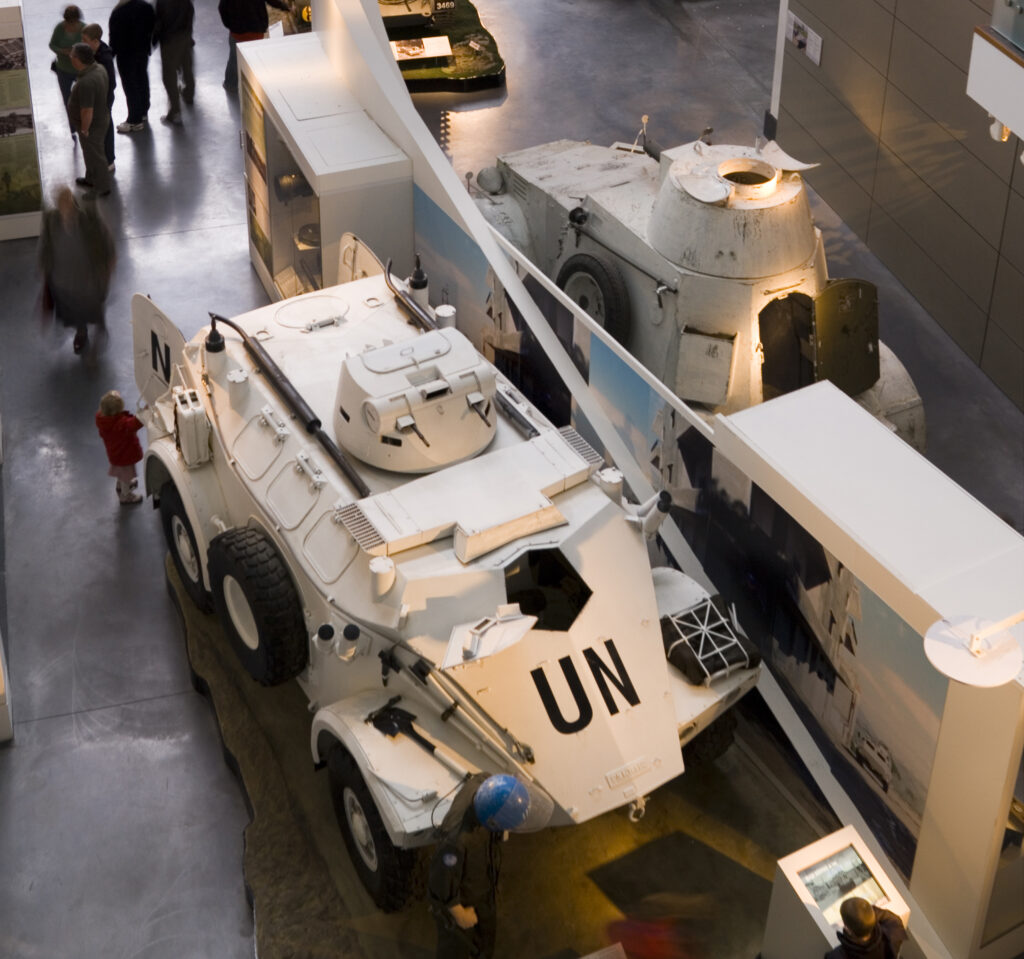
In 1961 Panhard, a subsidiary of Citroën, designed an armoured car for counter-insurgency operations for the French Army based on their experiences in Algeria. Called the Light Armoured Car 245 (Automitrailleuse Légère), it came in two formats: AML 60, equipped with a 60mm mortar, and AML 90, equipped with a 90mm gun. The secondary role was to provide light armoured cars to the French gendarmes and soldiers in the rearguard who would, in the event of invasion, have to protect vital installations against paratroopers. This suited the Irish government perfectly. As Prof. Eunan O’Halpin has written, ‘nothing was done to make the country a militarily credible neutral state’ after the Second World War. What was needed was not equipment to protect Ireland from invasion but a light armoured car for UN service and internal security—in the event of the IRA starting another border campaign. From 1964 to 2013 the Irish Defence Forces operated 32 AML 60 and 20 AML 90 Panhard armoured cars. In 1972, with the expansion of the Irish Defence Forces owing to the outbreak of the Troubles, 60 Panhard M3 armoured personnel carriers (APCs/véhicules blindés de transport de troupes) were purchased, one of which is pictured here on display in the Soldiers and Chiefs exhibition in the National Museum of Ireland, Collins Barracks.
The M3 APC had a crew of two and carried ten soldiers in the back, with a hand-operated turret equipped with two general-purpose machine-guns (GPMGs). It was fully amphibious and proved popular internationally, being sold to 25 countries. The M3 APC shared 95% of the AML armoured car components, which made maintenance easier, and thanks to its small size it was ideal for small country roads along the border. One weakness was its underpowered engine; another was the lack of power steering and consequent driver fatigue. Fourteen M3 APCs were sent to Lebanon in 1978, where they found the mountainous terrain challenging owing to the underpowered engines. They were replaced by the United Nations in 1989, when they gave the Irish Army ten Finnish-made SISU APCs. Meanwhile, the Panhard M3 APCs in Irish Army service soldiered on until 2001, and the armoured cars until 2013.
Lar Joye is Dublin Port Heritage Director and current chair of the Irish Museums Association.