
By Brian Trench
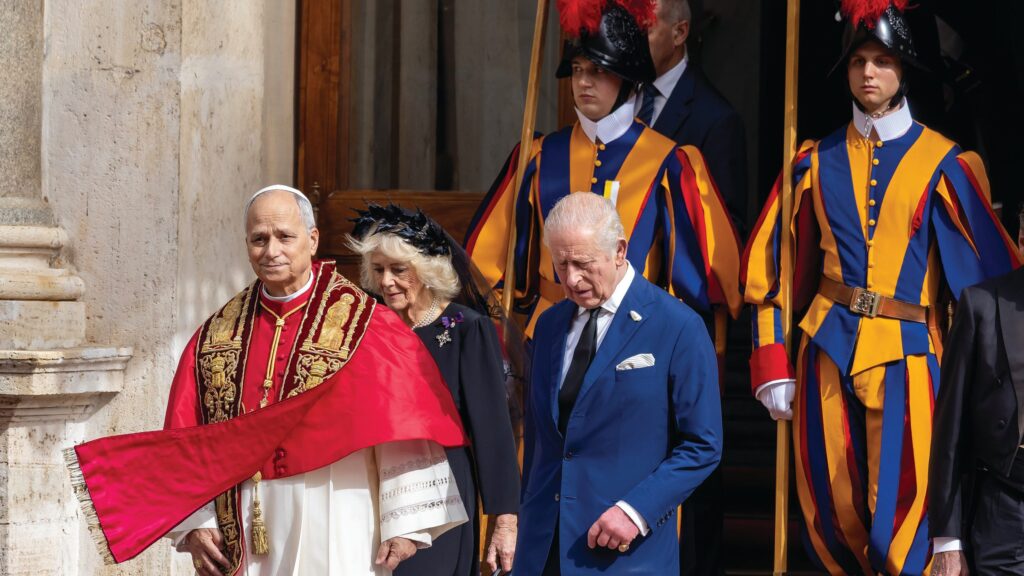
When King Charles III went to Rome as supreme governor of the Church of England in October 2025 to meet and pray with Pope Leo XIV, he was continuing the British monarchy’s gradual disentanglement from Reformation and post-Reformation cultural wars. In an earlier phase of that process, an Irish committee made a significant contribution when Charles’s great-grandfather became King George V.
For over two centuries British monarchs on ascending the throne had made a declaration of loyalty to the Protestant faith, repudiating certain aspects of Catholic doctrine. Kings and queens solemnly and sincerely professed that they did not believe in transubstantiation in communion and that the ‘adoration’ of the Virgin Mary and the ‘sacrifice of the mass as they are now used in the Church of Rome are superstitious and idolatrous’.
In the early twentieth century the wording of this declaration was publicly challenged, notably in the House of Lords, as representing an insult to Catholic subjects of the Crown. Irish peers, or English lords with Irish estates, were prominent in seeking the changes. Several attempts to have the offensive wording changed or removed were unsuccessful. The demand for amendment of the declaration intensified after the death in May 1910 of King Edward VII.
A committee of Irish Protestants was formed following a public meeting in Dublin on 20 June 1910, and they convened a further meeting on 19 July 1910 which adopted a resolution stating that repudiation of certain doctrines ‘is a just cause of offence to many of His Majesty’s subjects and repugnant to Christian courtesy’. The Royal Declaration Amendment Committee (Ireland), as it styled itself, launched a petition two days later to gather endorsements of this resolution. Over the following week, the signatures were collected of 2,370 Protestant men, mainly of the professional and landowning classes, among them 248 magistrates, 97 physicians and surgeons, 100 army officers, 120 bank officials and 290 clergymen from the Church of Ireland, along with some Presbyterians and Methodists. This collection of signatures was delivered to the Houses of Parliament in London on 29 July.
According to the committee’s later report on its short life,
‘… only men in a responsible position were invited to sign. To have asked women as well as men, or to have asked men generally instead of only those of a representative character, would alike have been too much for the Committee’s powers of organisation.’
The signatories included unionists and nationalists—notable among the latter were Douglas Hyde and Roger Casement. The landowners included the Lords Fitzgerald of Carton House and Kilkea Castle, Sir Josslyn Gore-Booth, brother of Constance, and Sir Horace Plunkett, founder of the agricultural co-operative movement. The academics and professionals included Sir Charles Cameron, pioneer in public health and a prominent freemason, UCD physicist Professor John McClelland, architect Richard Caulfeild Orpen and painter Dermod O’Brien.
The executive committee that drove this effort was chaired by Lord Shaftesbury, Earl of Belfast, later a long-serving vice-chancellor of Queen’s University, with Benjamin John Plunket, then vicar at St Ann’s Church in Dawson Street, Dublin, and later bishop of Tuam and of Meath, playing a prominent role. His entry in the Dictionary of Irish Biography credits this as ‘probably [Plunket’s] most notable stand’, though in 1917 he also signed an anti-partition manifesto as one of only three Church of Ireland bishops to do so. Other members of this committee included B.R. Balfour DL as joint honorary secretary and, as joint honorary treasurer, Wilbraham Fitzjohn Trench, then a professor of literature at Queen’s College Galway, and later at Trinity College, Dublin.
An Accession Declaration Bill, setting out a much shorter commitment by the incoming monarch to uphold the Protestant faith but not denouncing Catholicism, much less particular Catholic beliefs, proceeded quickly through the Houses of Parliament. Lord Killanin and Lord Meath were among those in the House of Lords to refer approvingly to the Irish petition. Killanin, a Catholic, acknowledged ‘the kindly support and sympathy shown towards [Irish Catholics] by a large body of their Protestant fellow-countrymen’. The Accession Declaration Act came into effect in time for George V to make the revised declaration in November 1910 at the first opening of parliament following his accession to the throne.
Three months after it was formed, the Royal Declaration Amendment Committee (Ireland) wound up, having received donations totalling £135, which went towards printing, postage and the collation and transcription of the collected signatures by staff at the Irish Central Bureau for the Employment of Women. These lists were deposited with the National Library in Dublin and a bound, largely typed copy was given to W.F. Trench in recognition of his ‘wise counsel and ungrudging personal toil’ and ‘as a memento of our movement’.
Brian Trench is a former senior lecturer at the School of Communications, Dublin City University, and grandson of W.F. Trench.