
National Gallery of Ireland, 18 July–6 December 2026
By Marie Bourke
The National Gallery of Ireland has mounted a spectacular exhibition of 50 of its finest works on paper to celebrate Ireland’s presidency of the Council of the European Union. Consequently, the exhibition looks at European artists from Italy, Spain, France, Germany, Holland, Ireland, Belgium, Finland, Britain and Czechia. Curator Niamh MacNally has combed the Gallery’s collection and hand-picked outstanding drawings, watercolours, prints, photographs and some rarely seen miniatures, ranging in date from the fifteenth century to the present day.
There are, for example, Italian Renaissance drawings by Raphael and Lorenzo di Credi and late Renaissance works by Pollaiuolo, Primaticcio and Jacopo Bassano. One of these is a Renaissance portrait of Francesco II Gonzaga, 4th Marquess of Mantua (1466–1519), c. 1490 by Andrea Mantegna (1431–1506). Francesco II succeeded his father, Ludovico II, in 1484 and he developed into a prominent military leader and statesman. Through his marriage to Isabella d’Este, a leading Renaissance figure, he made Mantua into a major cultural centre. The highly finished drawing of Francesco II by Mantegna is a work of art in its own right of a type popular in early Renaissance Italy. Francesco was a patron of Mantegna, who is generally accepted as the author.
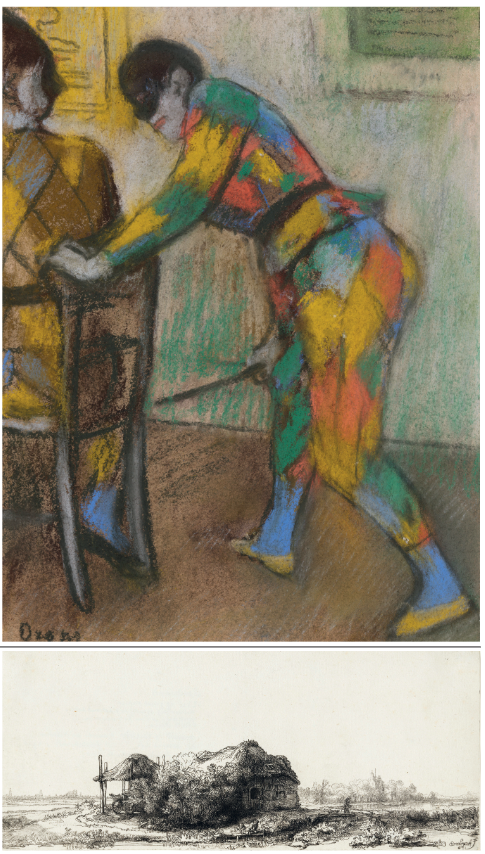
The strength of the collection is demonstrated across the various schools, from early German drawings by Albrecht Dürer to German Expressionist watercolours and prints by Emil Nolde, Käthe Kollwitz and Max Beckmann. Among the Gallery’s recent acquisitions is an exquisite etching by Rembrandt van Rijn (1606–69), who was one of the most famous printmakers of all time. The detail of Landscape with Cottages and a Hay Barn: Oblong (above/below) shows the city of Amsterdam on the left, a manor house on the right and the edge of a rural dwelling in the centre, probably from the Kostverloren estate, which Rembrandt drew several times. While realistic, it is a work of Rembrandt’s imagination created in the studio from observations taken in the countryside. This early impression reveals all of Rembrandt’s skill in conveying the delicate interplay between light and shadow. The print was created in 1641 during a period when, between 1627 and 1665, he made 314 etchings. Although c. 350 paintings and 314 prints are attributed to Rembrandt, he also created a remarkable 1,000 drawings.
The Gallery’s well-known highlights include works by Henri Matisse, Pablo Picasso, Armand Seguin, Paul Cézanne and Edgar Degas (1834–1917). Two works by Degas feature in the exhibition, both employing pastel: Two Dancers in a Dressing Room, c. 1880, and Two Harlequins, c. 1884 (above). Pastel was fundamental for Degas: he used the medium between 1888 and 1890 as part of his ongoing investigations into drawing and colour. The Two Harlequins wear the colourful diamond-patterned leotards, black masks and dark caps associated with their Italian commedia dell’arte characters. While usually portrayed as agile and active, here they are shown resting mid-rehearsal, a motif frequently used by Degas in depicting ballet dancers. Attention is drawn to the figures by his use of the softly textured pastel in vibrant yellows, blue, orange and green. The composition suggests ease of interaction between the theatrical performers, who are comfortable in each other’s company. Degas showed at all but one of the eight Impressionist exhibitions between 1874 and 1886, including the final one in 1886.
Included among the Irish artists drawn to Europe for training and inspiration are Roderic O’Conor, William Leech, Mary Swanzy and Nathaniel Hone the Younger (1831–1917). Hone was the first modern Irish painter to practise abroad. Having studied under Thomas Couture in Paris, he moved to Barbizon in the forest of Fontainebleau to do landscape painting, before returning to Ireland. At the age of 60 he toured the Mediterranean, where his sketches reflected the great monuments of antiquity. During a visit to Athens in 1891–2, his watercolours, painted in and around the Acropolis, included The Parthenon, Athens and Gorsey Hill above Sea. He was as fascinated by the Mediterranean light and colour as by its history and archaeology. European artists featured in the show were equally inspired by the Irish landscape.
Do not miss this outstanding exhibition of the Gallery’s European works on paper!
Marie Bourke is a cultural historian, formerly of the National Gallery of Ireland.