
JOHN CUNNINGHAM, BRIAN HANLEY, MARY MULDOWNEY and SONJA TIERNAN (eds)
Irish Labour History Society
€35
ISSN 03321169
Reviewed by
Conor McCabe
Dr Conor McCabe is a researcher at DCU School of Law and Government.
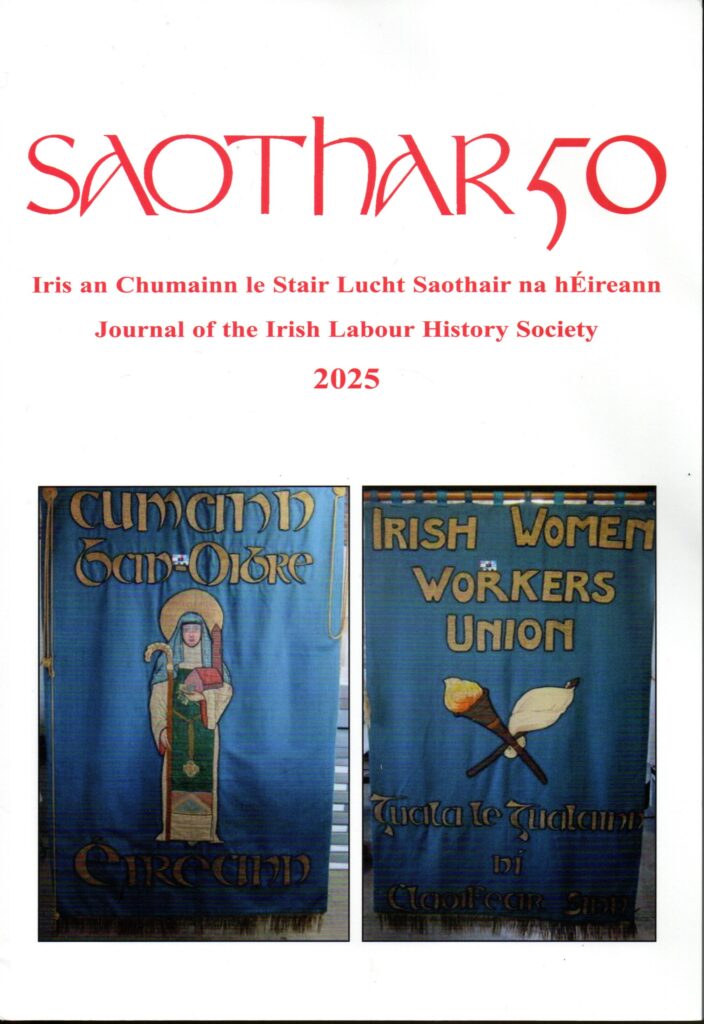
For the past 50 years the Irish Labour History Society (ILHS) has produced Saothar, an annual journal that reflects on the dynamics of Irish working-class and trade union life. Its latest edition is a celebration of that achievement, providing a series of essays covering women’s history, the Troubles, memory, housing and strikes. These detailed portraits of events and activities are situated alongside more systemic pieces that interrogate the journal’s position within historical studies in general. Together they provide an opportunity to reflect on the value and purpose of Saothar, and whether it still has relevance today.
It is probably fair to say that Irish historiography does not do class very well, particularly as regards the twentieth century. Its main theoretical debate in the past 50 years has been on revisionism, which provided a lot of heat but little by way of insight in terms of socio-economic dynamics, particularly with regard to working-class lives and experiences. From the start the ILHS sought to counter this bias. ‘Its bold ambition’, writes Joan Allen, was ‘to recalibrate Irish history itself’, with the excavation of working lives and experiences the primary consideration.
This saw a strong emphasis on documenting memory through oral records, a tradition continued today and reflected in Zoë Coleman’s article on Dublin’s rag trade. It draws upon four interviews conducted by Coleman which, taken together, capture the energy and independence that factory work offered young women in Dublin in the 1960s and 1970s, as well as the societal decline of the 1980s when the garment industry was offshored mainly to Asian states. ‘By gathering these stories’, says Coleman, ‘we are acknowledging and commemorating working women’s important contributions to Ireland’s economic, social and cultural identity.’
Indeed, stories of women’s working lives and struggle form a key part of the anniversary edition. Margaret de Courcey reflects on her time as an activist with the Post Office Workers’ Union and the campaign for equal pay in the 1970s. It led to the adoption of a new single-sex pay scale—a resounding labour and feminist victory that was won through the ‘dogged belief and sheer determination of the women and their union’. Caitríona Beaumont amplifies the everyday experience of two housewives in her piece, taking a micro-history approach to capture the ‘messy and complicated’ story of change that was promised and somewhat delivered by women’s groups in the ’70s and ’80s. The analysis is complemented by Lindsey Earner-Byrne’s look at the gendered economy and official myths that framed the imagined family of the 1930s and 1940s. ‘It was women who were relegated to the liminal spaces between paid and unpaid work’, she finds, ‘between caring and duty, between dependence and independence, and between affection and labour.’ The essay convincingly shows why the home, not just the factory, needs to be part of Saothar’s remit. ‘As the primary economic unit of society’, writes Earner-Bryne, ‘family life cannot be separated from the history of work, money and care, and the dynamic relationship between these factors had specific gendered consequences, which we are only beginning to unravel.’
Trade unions’ stories are not neglected, with first-hand accounts given of Ireland and the British miners’ strike, as well as the fight for LGBT rights. Francis Devine recalls fund-raising in Cork for the Welsh miners in 1984, as well as the often-fraught discussions and debates within the Irish trade union movement in the years and months leading up to the national agreements of the 1990s—a process undertaken in the shadow of Margaret Thatcher’s assault on organised labour and working-class communities across the Irish Sea. Orla Egan describes how ‘trade unions and trade union activists played an important role in campaigns for legislative changes and protections for LGBT workers’. She also reminds us that ‘progress is not always linear’ and that the disturbing attacks on LGBT rights in recent years show that there is no room for complacency. Des Derwin gives a rounded account of the Ranks Mill occupation in February 1983, while Deirdre Foley reflects on women workers in Jacob’s biscuit factory.
A similar concern for the relevance of past struggles is shown by Padraig Durnin in his account of the Dunnes Stores Anti-Apartheid strike. The ongoing genocide in Gaza and the current housing crisis hang over his essay. He notes that no comparable trade union actions have emerged in relation to Palestine and the occupied territories. Donal Nevin’s comment in 1985 that ‘issues of conscience’ such as a boycott of South African produce ‘were beyond the remit of the trade union movement’ seems to have been the lesson carried forward, with solidarity remaining performative, not interventionist.
The Troubles and Northern Ireland are also covered, with Brian Hanley providing an engaging account of the Socialist Workers’ Movement (SWM) and the Northern conflict. The 1970s saw a proliferation of left-wing groups and organisations who broadly fell into two camps: ‘those who saw the northern struggle as key to the Irish revolution and those who prioritized working-class unity in the North itself’. The SWM, Hanley reminds us, straddled both camps. In doing so its internal dynamics provide an insight into the ideological (and physical) disputes that were taking place at the time. Hanley also shines a light on figures such as Seamus Costello, who opposed, at the founding conference of the Irish Republican Socialist Party (IRSP), ‘a motion on a woman’s right to choose, claiming that the country was “under-populated” and that abortion was “immoral”’. Overall, he finds that partition played a strong role in working-class mentalities, and this made the North a difficult topic on which to mobilise, ‘especially after the early 1970s, when the conflict settled into what seemed to be a bloody, but also futile, routine’.
In a short piece, former general secretary of Fórsa Shay Cody writes that James Connolly served in the British army in India and Egypt. He cites a note by trade union leader William O’Brien to the effect that John Lyng, a former comrade of Connolly, told him so. It should be noted that Lyng did indeed say in a letter that Connolly served in India. He also said that Connolly was adopted; that he was born in Monaghan but then brought to Edinburgh, where he was surreptitiously passed off as Scottish; that he never had a Scottish accent; and that he bore no facial, physical or moral resemblance to his brother John. We know all of this to be false. Indeed, Lyng himself conceded this just over three weeks later in a follow-up letter to O’Brien, after he had seen the reproduction of Connolly’s birth certificate in the Irish Democrat. ‘It would be better to ignore any discussion of the matter in the future and burn my [previous] letter’, he wrote. ‘They have legal letters and ours are only memories of what was said by others dead and gone.’ Lyng’s confidence in his own memories lasted exactly 24 days. Such are the pitfalls of appeal to authority, as any jobbing researcher will tell you.
The final, and central, theme of the special edition is the history and future of Saothar itself. This is captured in the editorial and in a historical essay by Joan Allan, as well as a reflective piece by Emmet O’Connor. The editors, for their part, bemoan ‘the current popularity of decolonisation’ and comprador-class analysis, but it is not entirely clear whether they actually understand these terms. Their use of them is clumsy, to say the least. They also make—without evidence—the statement that ‘right-wing ideas have far more currency among a section of the working class than any concept of the labour movement’, which would be news to the tens of thousands of young, working-class trade union members and activists across the island. Why prioritise one and not the other? The far-right threat is real and does not need such hyperbole for the point to be made. By way of contrast, O’Connor offers a deep, genuinely reflective essay on a possible 21st-century agenda for the ILHS and Saothar, ending his piece on an upbeat note: ‘The outlook is bright for labour history. Never, in Ireland, has it had so many readers and researchers.’
There are nonetheless some aspects of Saothar that could be modified to make its presence stronger within that readership. Its adherence to the idea that history must be at least 30 years ago can lead to a self-limiting conceptual framework in terms of analysis and scholarly interrogation. While this serves other history journals quite well, ensuring that they do not descend into journalism or purely political studies, Seán Fenton’s piece on the Dublin Housing Action Committee, for example, would have benefited from a comparative look at the Community Action Tenants’ Union (CATU) today, and why, from a class perspective, housing remains a site of contestation, agitation and struggle. This would require seeing class not as a category but as a social relation—‘the heat, the thundering noise’, as E.P. Thompson calls it—that is observed over time. Indeed, history is the only discipline that provides a canvas wide enough to allow us to see class in motion. Saothar is ideally suited to serve as a forum for such interrogations of Irish history and society and yet does not seem fully interested in doing so, falling back on formulas of class as aggregations of occupations, income and identity that are observed either in the historical moment or through trade union activity.
Finally, there is access. There is no option for a digital subscription and the most recent articles available online are from 2019, as the journal has a five-year embargo in place. This makes publication in Saothar something of a hindrance to dissemination of one’s research. The 2025 special edition, for example, will not be available on JSTOR until 2031. Its review section is similarly disjointed, with some available on its website as download-only Word documents while others grace the pages of its print edition, under digital lock and key for the rest of the decade like an obscure vinyl reissue. Throughout its publication history, Saothar has provided a vital and necessary platform for Irish labour and working-class studies. It is utterly unique in having done so, but at the same time it is somewhat at an impasse today. Rather like the trade union movement itself, the ILHS has been content to live off its past dynamics, resisting new ideas and direction. Its current existence owes more to social partnership initiatives of the 1990s than to any membership-led or historiographical dynamic, with its museum and archive reliant on all-too-meagre state and trade union funds. Similarly, Saothar’s publishing model is frustratingly archaic and self-limiting in the 21st century. And yet we are more in need of Saothar today than ever before. The quality of research in this edition speaks to that. Whether it is willing to engage with analysis of economic class relations, of the very particular modes of production and exchange which route themselves through Irish working-class lives, remains, however, to be seen.
Dr Conor McCabe is a researcher at DCU School of Law and Government.