
By Damian Murphy
The ecclesiastical origins of Kildare date back to the late fifth or early sixth century and the foundation of a monastery by St Brigid, whose church was described by Cogitosus (fl. c. 650) as ‘very lofty, adorned with paintings [and] containing three oratories’. The original church survived sixteen assaults by the Vikings and repeated burnings thereafter, but not the ambitions of Ralph of Bristol (d. 1232), who, appointed as bishop of Kildare in 1223, replaced it with a large cruciform cathedral in the Early English Gothic style of architecture. The new cathedral resisted the almost continuous stream of conflict of succeeding centuries, sustaining limited damage during the Cromwellian conquest (1649–53), but the removal of its roof in 1588 and the subsequent collapse of its tower, north transept and chancel caused it to be described as ‘altogether in ruins’ in 1603. Although an attempt was made at rehabilitation by the reconstruction of the choir as a Romanesque parish church (1683–6), eighteenth-century illustrations published by Ware and Beranger, and early photography by Lawrence, all give the impression of a once-majestic cathedral in irreversible decline.
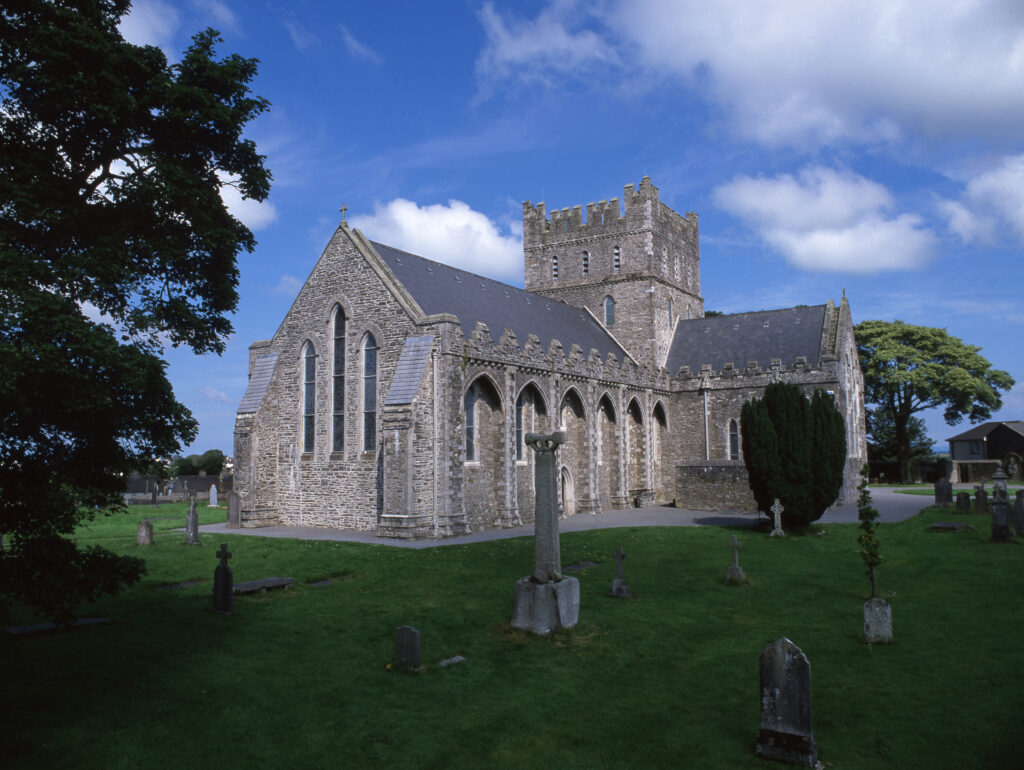
The proposed restoration of St Brigid’s Cathedral should have been a cause for universal celebration but proved surprisingly contentious in architectural circles. The appointed architect, Englishman George Edmund Street (1824–81), produced a report for the restoration committee in November 1871, describing the condition of the ruins and setting out a phased programme of restoration beginning with the nave, followed by the transepts and crossing tower and, if funding permitted, the removal of the ill-fitting choir and its reconstruction as a chancel in a compatible Gothic style. This elicited a lengthy riposte from the Cork architect and antiquarian Richard Rolt Brash (1817–76), who claimed that too little survived to restore and that the project would amount to little more than a conjectural reconstruction. The only matter on which both architects agreed was that the placement of the lancets of the nave between deep buttresses joined by battlemented arcades was unusual, if not unique. Brash called the arrangement the cathedral’s only feature of interest; Street suggested that it pointed to ‘a probable acquaintance on the part of its builders with military but not ecclesiastical architecture’.
An initial flurry of donations, including a commitment by the Duke of Leinster to make good one of the transepts at his own expense, allowed work, estimated at £5,000, to begin in 1875. Progress was slow, however, hampered by dwindling contributions and escalating costs. This prompted a frustrated dean to suggest in November 1890 that the committee appeal to the generosity of the people of Dublin, whose cathedrals, Christ Church and St Patrick’s, were restored at the sole expense of wealthy benefactors.
St Brigid’s was rededicated on 22 September 1896, a quarter-century after its restoration was first mooted, and the congregation entering under the shadow of an Early Christian round tower gathered in a space that was neo-medieval in both senses: an ancient cathedral reborn and a Gothic-style revival to cater to the tastes of the Victorians. The atmospheric interior is lit at each end by triple lancet stained-glass windows, including one that shows scenes from the life of the first abbess of Kildare and one dedicated to Revd R.S. Chaplin, who as a ten-year-old boy made the first contribution to the restoration of St Brigid’s Cathedral.
Damian Murphy is Architectural Heritage Officer, NIAH. Series based on the NIAH’s ‘building of the month’, www.buildingsofireland.ie.