
By Zoë Reid
On 18 April 2026 the National Archives will publish online the first census of the Irish Free State, an extraordinary corpus of more than 700,000 individual household returns which were to have been completed on the night of 18 April 1926. Fully searchable and free to access, the census reveals the early Free State not as an abstraction of statistics but as a lived landscape of families, farms, institutions and townlands recorded on a single night in April 1926.
Where the 1901 and 1911 censuses framed late imperial Ireland, the 1926 returns present a state stepping into sovereignty. The population in the 26 counties had fallen to 2,971,992, a decline of more than 5% since 1911, with Dublin the only county to grow. The returns depict a society still predominantly rural and agricultural, and overwhelmingly Catholic.
One of the most striking features of the 1926 census is the introduction of bilingual forms. For the first time, households were allowed to complete their returns in either English or Irish. The design of the 1926 household form also breaks with the Edwardian template that preceded it. The earlier forms allowed space for fifteen individuals; in 1926 there is room for ten. This change forces the largest families across multiple sheets and, in doing so, makes visible the extended, multi-generational households that characterised much of rural Ireland. These structural differences significantly alter how historians can now read domestic life, dependency and household economy.
Equally striking is the removal of specialised institutional forms. In 1901 and 1911, ships, barracks, prisons, hospitals, workhouses and boarding-schools all had bespoke forms. In 1926 everyone, from a family in a terraced house to a patient in a provincial infirmary, is captured on the same Form A. The census becomes a unified demographic instrument, folding institutions back into the broader population rather than isolating them as administrative outliers. It speaks to the Free State’s desire for uniformity and reflects the evolving governance structures of the new state.
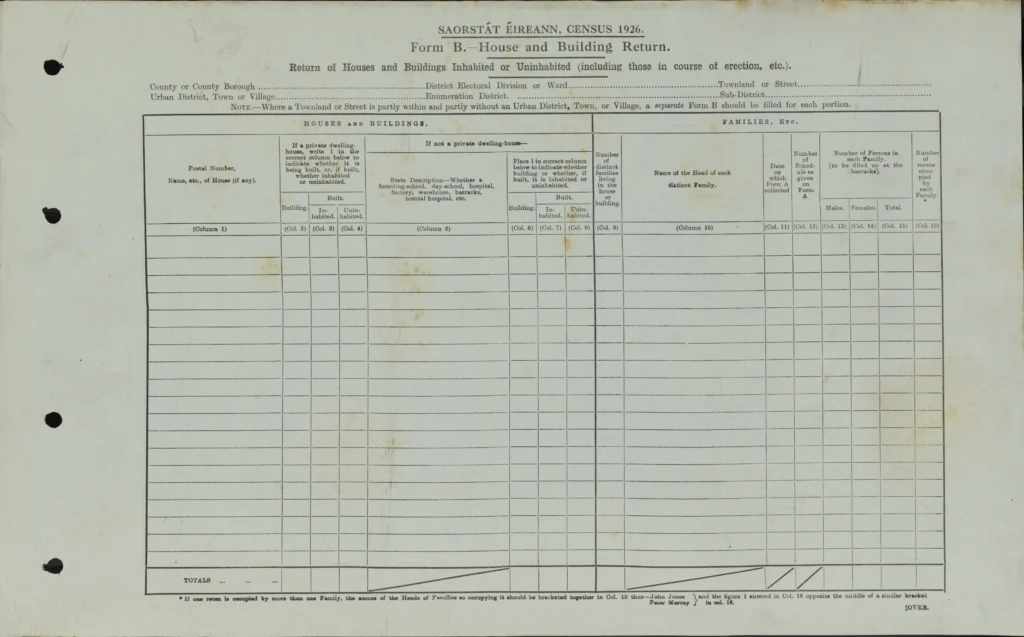
The 1926 return is rich in detail. Each person is recorded by name, relationship to the head of household, age, sex, marital status or orphanhood, birthplace down to the townland, religion, linguistic ability and occupation, with a new request to provide employer’s name or business. The form concludes by noting the acreage of agricultural holdings associated with the household, a revealing inclusion that aligns closely with the Free State’s focus on land ownership and agrarian reform. Context at the level of streets and townlands is provided by the enumerator’s abstract, Form B, which records each building’s status, the number of families within it, the number of males and females within each group and the number of rooms they occupied.
Preparing this census for release has been a monumental archival undertaking. A total of 2,496 volumes of forms, organised by district electoral division, were catalogued. After the careful removal of their bindings, the forms were cleaned and flattened; 70,708 forms (c. 10%) needed repair. More than 734,000 high-quality colour digital images were created, and approximately three million rows of data were transcribed and manually verified. It is the most ambitious census-digitisation project yet undertaken by the National Archives.
When the census goes live on 18 April, a searchable online platform at www.nationalarchives.ie will allow users to move seamlessly from national patterns to individual households. It is a resource built to serve scholars, communities and families alike. This complex, intimate and astonishingly human story of the early Irish Free State will be there to be read, one household at a time.
Zoë Reid is Keeper of Manuscripts, National Archives of Ireland.