
By Patrick Murphy
Late nineteenth- and early twentieth-century Cork had a reputation for political dissent and street protest. Elections were rumbunctious affairs, often descending into physical conflict. The by-election following the death of Charles Stewart Parnell (MP for Cork City) in 1891, for example, saw widespread rioting. The North and South Infirmaries were inundated with casualties, and there was even talk of setting up a temporary medical station in Blackpool, an anti-Parnellite working-class district in the north of the city.
JANUARY 1910 GENERAL ELECTION
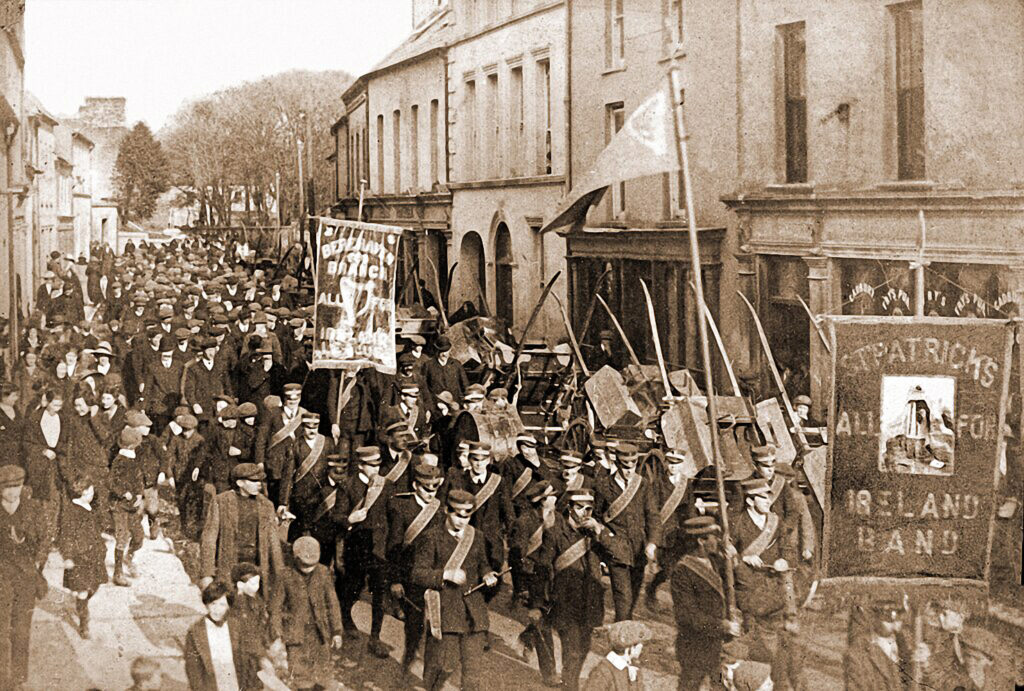
But far worse was the violence that erupted in January 1910, when the British prime minister, Herbert Asquith, frustrated by the House of Lords’ rejection of his government’s ‘People’s Budget’, called a general election. William O’Brien, MP for Cork City and an iconic figure in Irish nationalism, had launched the All-for-Ireland League (AFIL), a breakaway from Redmond’s Irish Parliamentary Party (IPP), the previous March. Serious and sustained rioting broke out when the AFIL contested seven of the Cork seats in addition to constituencies in Kerry and Limerick. In one incident police had to disperse rioters with rifle butts; the police report stated that the rioters were armed with sticks and revolvers and that ‘they were mostly half-mad with drink and excitement’. Rival groups led by brass bands and armed with cudgels clashed frequently. A sitting MP was set upon by supporters of the rival candidate and forced to withdraw his nomination. Two MPs had lime thrown in their faces, and another was pelted with turnips and driven out of town. The homes of one side were attacked by a large and violent mob. Priests were booed, jeered and roughed up.
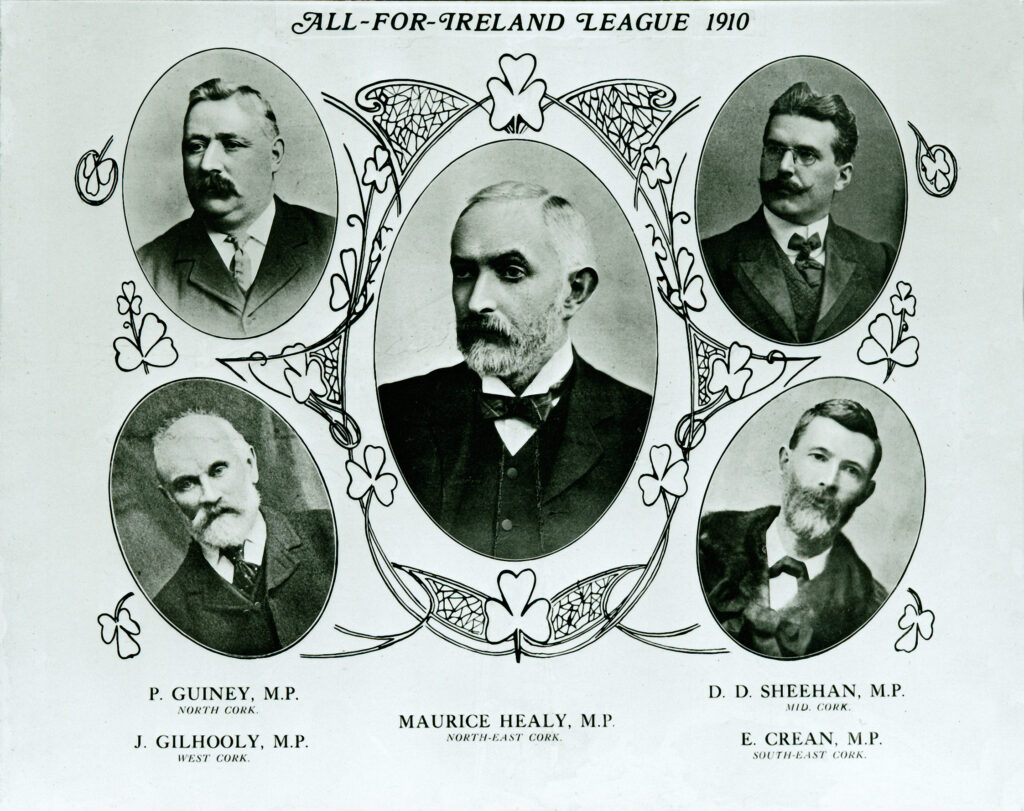
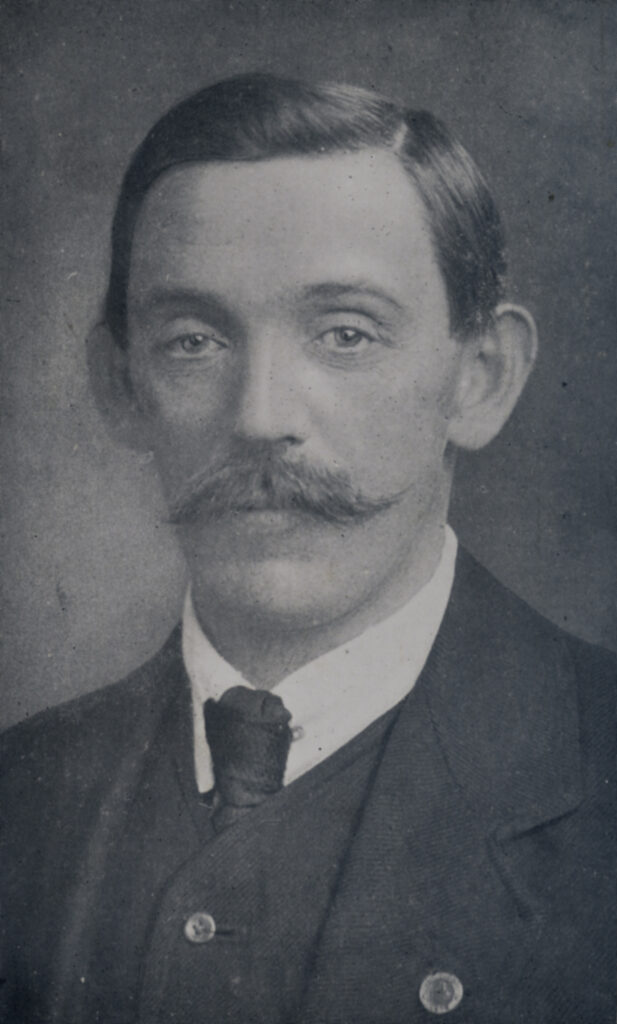
This was a conflict that the IPP MP Edward Barry claimed ‘set man against man, labourer against farmer, son against son, brother against brother, and father against son’. It was the only organised schism in the history of constitutional nationalism. The new party split politics in Cork and brought underlying divisions, particularly in the labour movement, to the surface; more importantly, it challenged the most fundamental weakness of Irish nationalism: its failure to build an inclusive vision of nationhood. The AFIL took six of the Cork parliamentary seats in January 1910, and in the second general election in December of that year it took eight of nine Cork seats. In 1911 the party took control of local government in Cork city and county.
WILLIAM O’BRIEN MP
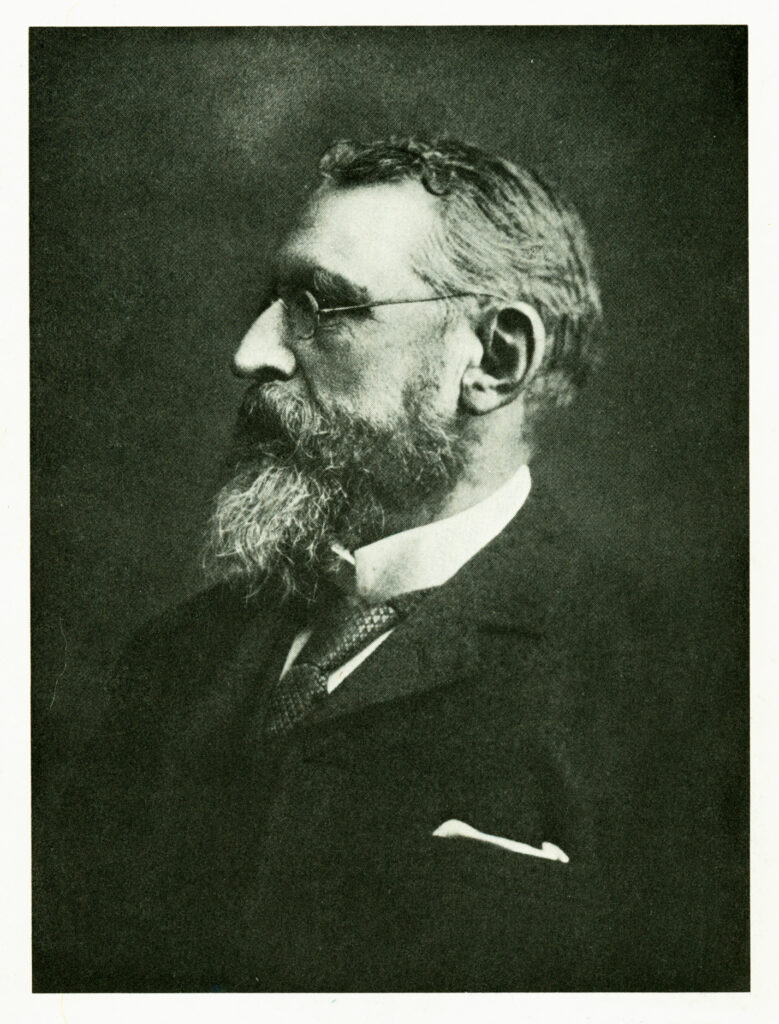
In the first decade of the twentieth century William O’Brien’s star was in the ascendant. He was given credit for launching the United Irish League in 1898 and reuniting the Irish Parliamentary Party and was seen as the architect of the Wyndham Land Act, one of the most important pieces of legislation in Ireland’s history. He was part of a generation of political figures from the Home Rule movement now largely forgotten, but he was one of the most extraordinary and consequential politicians of his day. He was a journalist, novelist, newspaper editor and publisher, Fenian, campaigner for land reform and an MP between 1882 and 1918 (with several breaks, as he was a serial resigner and stood down from parliament on no less than four occasions). In the first half of his political career the land question drove the obsessive single-mindedness that made him such an exceptional campaigner. That same restless energy sparked his metamorphosis from radical land agitator to apostle of reconciliation with unionists and Protestants in 1903. By then he was a nationalist icon whose dedication to the cause of land reform was legendary, and he was widely admired as a leader of adamantine determination and unimpeachable integrity. His physical resemblance to an Old Testament prophet spoke of his willingness to suffer for the greater good, a man of fierce integrity and unbending will.
However, O’Brien’s character also proved to be a significant impediment to the success of the AFIL, and the very attributes that many of his followers found admirable also contained the essence of a messianic and obsessive personality. One of the more notable paradoxes of his character was that, although he had developed an almost numinous belief in conciliation, his thin-skinned nature often drove him to behaviour and rhetoric which were far removed from the conciliatory ideal. He was, in the words of Liberal chief whip Alexander Murray, ‘An honest fanatic—a kind of Mad Mullah’.
LAND CONFERENCE 1902–3
At the end of 1902 O’Brien sat down at a Land Conference with Ascendancy landlords whom he had long considered his enemies and who considered him their bête noire. They reached an amicable agreement, which led to the Wyndham Land Act and facilitated the mass transfer of land from landlords to tenants, subsidised by the British exchequer. Following the Land Conference, O’Brien underwent a Damascene conversion and devoted the rest of his political career to the ill-starred cause of attempting to reconcile nationalists and unionists. In 1903 the Home Rule movement, at O’Brien’s behest, adopted a policy of conciliation with unionists, an initiative welcomed by Redmond and the Parnellite wing of the IPP, who believed that the resolution of the land struggle opened the way for a changed relationship with unionists and offered the hope of a more inclusive vision of nationhood. In an interview in the Freeman’s Journal Redmond argued, ‘The cry of “Don’t grant Home Rule or the landlords will be robbed” is no longer available to the Unionist cause’. There was, however, a significant faction of the Home Rule movement, led by John Dillon and Michael Davitt, with the support of the Freeman’s Journal, who rejected this approach. They presented the land struggle as a zero-sum game: a binary conflict between the indigenous Irish and alien landlords, an elemental struggle between good and evil. To decouple land from the struggle for Home Rule and offer the hand of friendship to unionists, Dillon argued, would be to shatter the legitimacy of the nationalist struggle and destroy the fragile edifice of the Home Rule movement, reunited only three years before after an acrimonious split—a dangerous predicament at a time when competing versions of nationalism were emerging. O’Brien resigned from both the IPP and parliament because of Redmond’s refusal to publicly distance himself from the Dillonite rejection of conciliation. Six years later, he launched a political insurgency against the IPP in Cork.
THE BANSHEE’S KISS
O’Brien rejected the nationalist interpretation of an independent nation based on territory (the island of Ireland), ethnicity and—implicitly though not explicitly—religion which from the 1880s came to identify itself with only one ethnic group and one religion: Irish Catholic. For him, it was incomprehensible that a stable society could be based on a concept that ignored or rejected the views and wishes of one quarter of the population. A narrow and exclusive nationalism, he argued, resulted in ‘the Banshee’s Kiss’, a seductive but lethal invitation to each new generation to carry on the struggle for Irish independence, which, although inspired by high ideals, ran the risk of descending into an ethnocentric campaign, wilfully ignoring those who did not share the same aspirations; this would result in an endless cycle of conflict and violence as ‘the torch of Irish nationality’ is passed down from generation to generation, ‘ending in the prison or the grave’ for many young nationalists. O’Brien’s alternative was that nationalists needed to take any and every opportunity to work with unionists to build a bond of trust, and to attempt to mitigate unionist and Protestant fears that a Catholic democracy would ride roughshod over their rights and traditions. The task, he wrote, is to bring about ‘a combination of all the elements of the Irish population in a spirit of mutual tolerance and patriotic good-will, such as will guarantee to the Protestant minority of our fellow-countrymen inviolable security for all their rights and liberties and win the friendship of the entire people of Great Britain’. Given the political maelstrom in which the AFIL existed from the Home Rule crisis onwards, this seemed to many a naïve and fanciful aspiration.
The AFIL was a fissile coalition of Parnellites, working-class nationalists and liberal unionists and O’Brien found it almost impossible to satisfy their competing demands. His proposals to amend the Home Rule bill by mitigating unionist objections were rejected by Redmond, and the AFIL MPs were the only nationalists not to support the bill on its third reading in May 1914, when they abstained. The coup de grâce for the AFIL came with O’Brien’s support for the war and nationalist recruitment, which satisfied his unionist supporters but alienated young nationalists, who noted that most of the politicians of military age (which did not include O’Brien) who urged them to risk life and limb in Flanders and the Balkans showed little inclination to do so themselves. As Tadhg Barry, the republican activist, trade unionist and one-time sports columnist on O’Brien’s newspaper the Cork Free Press, drily observed, ‘They’d shed all others’ blood but not their own’. Following the Easter Rising, which drove O’Brien almost to despair, he was booed and jeered by young nationalists at an anti-partition meeting in Cork. The AFIL was now seen as part of a political tradition that had failed and whose time had passed. All the AFIL MPs stood down in favour of Sinn Féin at the 1918 general election.
O’Brien blamed John Redmond, John Dillon and Joseph Devlin, the leading triumvirate of the IPP, for the displacement of constitutional nationalism by Sinn Féin after 1916. He castigated Redmond for his failure to stand up for his Parnellite principles and face down the Dillonite wing of the party in 1903. By 1909, when the AFIL was launched, the space for a cross-confessional centre party had significantly narrowed, as nationalist hopes of Home Rule increased with Redmond’s balance-of-power advantage. In a grudging encomium during the Home Rule debates in 1913, Sir Edward Carson pointed out:
‘When the honourable gentleman [William O’Brien] and some others proceeded to what they called trying to reconcile Ulster and the Protestants from Ulster and Ireland generally, they made speeches, which if they had been made by the majority of them for the last twenty years might, I admit, possibly might have had some effect on some of the Unionists in Ireland.’
CENTRIST TRADITION
The AFIL was unable to compete with the great primordial passions, both nationalist and unionist, stirred by the Home Rule crisis, the outbreak of war and the Easter Rising. At a time of great upheaval there was a communal need for solidarity and cohesion, with little room for compromise and conciliation. William O’Brien looked on, incredulous and embittered, in 1918 and 1919 as some southern unionists, including their leader, Lord Middleton, terrified by the rise of revolutionary nationalism, accepted Home Rule and embraced two new parties, the Irish Centre Party and the Irish Dominion League, both modelled on the cross-confessional AFIL. Many of the same unionists had failed to support the AFIL just a few years before.
Like many figures from the Victorian and Edwardian Home Rule movement, William O’Brien has largely been forgotten by contemporary Ireland, and even in his own time dismissed as a naïve fool or a unionist dupe and, after 1916, as representing a discredited political tradition that had failed nationalists. However, apart from Sinn Féin, which took a robust anti-partitionist line, O’Brien was one of the few nationalist politicians to warn in 1914 that a temporary Ulster opt-out was a convenient illusion grasped by a desperate IPP and that partition would prove to be a permanent parody of Home Rule. ‘Instead of “Ireland a nation” they would have only two miserable English provinces, one Redmondia and one Carsonia.’ He also predicted that the border would introduce a destructive dynamic and instability into Irish life and politics, leading to an endless cycle of conflict.
The settlement that was reached, or imposed, over a century ago resulted in a continuation of the Banshee’s Kiss until the Good Friday Agreement brought peace and at least the possibility of reconciliation. But Ireland now finds itself facing new political problems: Brexit, demographic changes in the North, the ascendancy of Sinn Féin and the possibility of a border poll with a small majority. (The United Kingdom, and especially Northern Ireland, are still living with the consequences of the 2016 narrow Brexit referendum result, which has poisoned political discourse in the UK and led to an outcome that has satisfied very few.) In addition, there is now the possibility of a right-wing English nationalist party taking power in the UK by the end of this decade, and once again the border and Northern Ireland could be used as a populist gambit. These are new dilemmas, but the questions raised by William O’Brien on reconciliation, consent and coercion remain the same.
If there is one politician to whom the golden thread of reconciliation can be traced from the legacy of William O’Brien and the All-for-Ireland League it is John Hume. He was a more emollient character than O’Brien and a much more gifted politician, but his political vision for a united peaceful nation and his rejection of violence and coercion closely align with O’Brien’s views after his metamorphosis in 1903. Like O’Brien, Hume was always clear that his aim was Irish unity, but he argued that this could only be achieved with the mutual agreement of nationalists and unionists:
‘The Border is not a line on the map. It is a mental border built on fear, prejudice and misunderstanding and which can only be eradicated by developing understanding and friendship. This is the only real task which faces those who genuinely want to solve the Irish problem.’
This was the central message in the story of the AFIL, a piece of forgotten history with a resonance for contemporary Ireland
Patrick Murphy’s The All for Ireland League: conflict, conciliation and the Banshee’s Kiss has recently been published by Peter Lang as part of its ‘Reimagining Ireland’ series.
Further reading
P. Bew, Conflict and conciliation in Ireland 1890–1910: Parnellites and radical agrarians (Oxford, 2002).
J.V. O’Brien, William O’Brien and the course of Irish politics 1881–1918 (Berkeley, 1976).
B. O’Leary, Making sense of a united Ireland (Dublin, 2022).
M. Wheatley, Nationalism and the Irish Party: provincial Ireland 1910–16 (Oxford, 2005).