
By Sergio Fernández Redondo
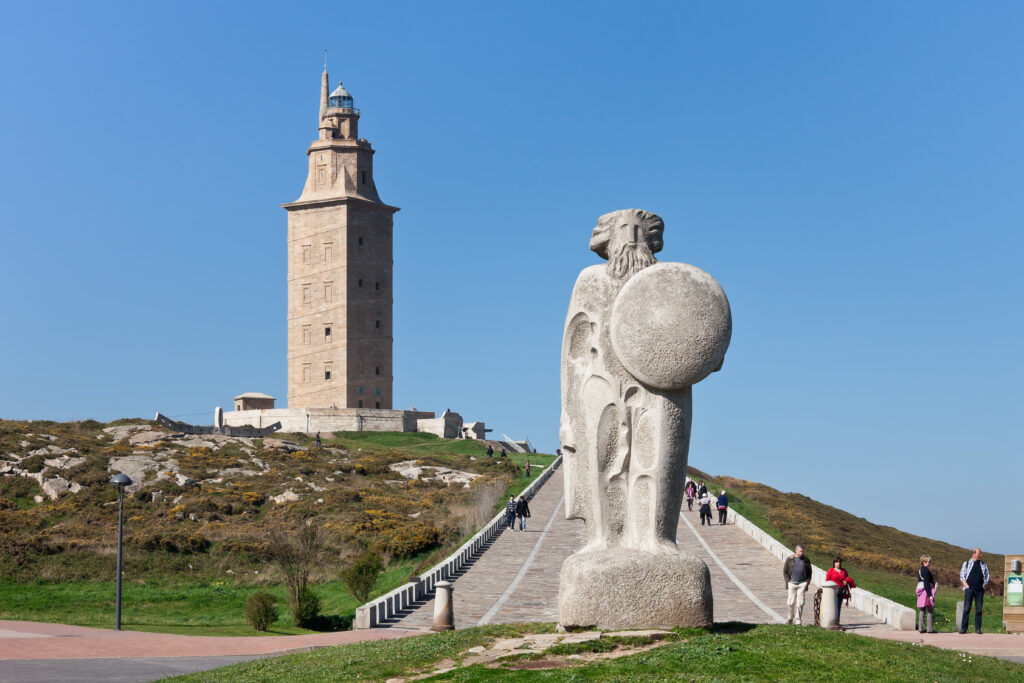
Íth mac Bregoin athchonnairc hÉrinn ar tús, fescor gaimrid, a mulluch Túir Bregoin; dáig is amlaid is ferr radharc duine, glan-fescor gaimrith.
(‘It was Íth, Breogán’s son, who first saw Ireland from the top of Breogán’s tower on a winter afternoon; as this is the best way to see it, on a clear winter afternoon.’)
So states the Lebor Gabála Érenn or Book of the Invasions of Ireland, the Irish mythical story that relates the arrival of the Gaelic people on the island from the north of Spain.
SIX INVASIONS BEFORE THE GAELS
What we know as Lebor Gabála Érenn is a collection of tales present in multiple Irish medieval manuscripts. According to this narrative, Ireland received six progressive invasions until the Gaels settled definitively on the island.
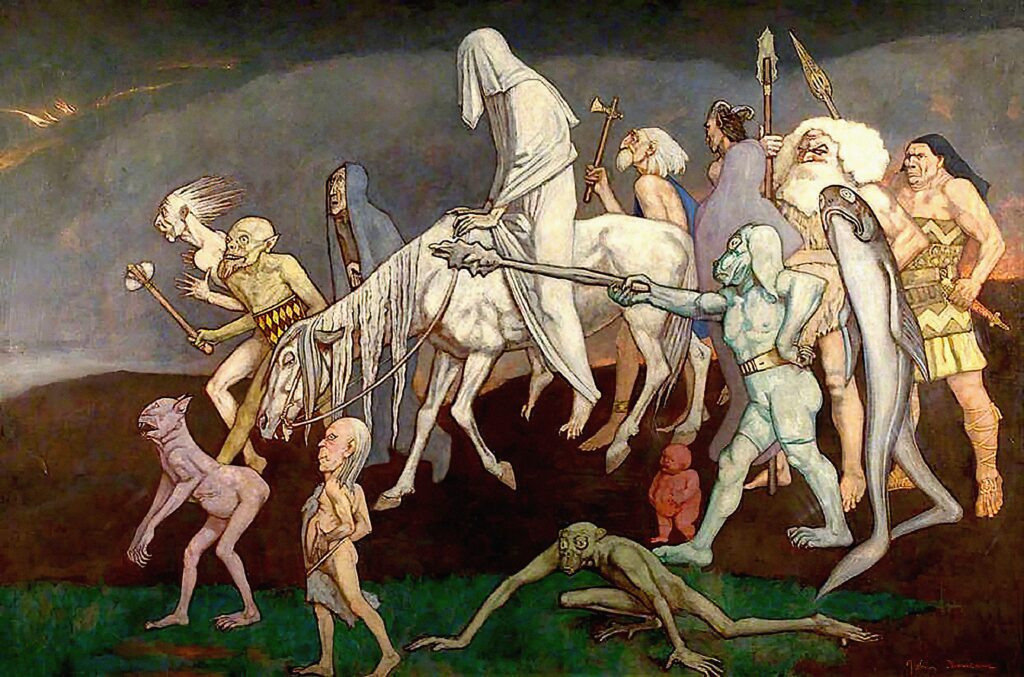
After the genesis and diaspora of the nations, the people of Cessair, grandson of Noah, are the first to set foot on the island, until they are annihilated by a flood. They are followed 300 years later by the people of Partholón, also from Noah’s lineage through Magog. These people perish owing to a plague and, after 30 years, there arrive the people of Nemed, also descendants of Magog. As an aside, we ought to mention the Fomorians, a supernatural race that already inhabited the island prior to the arrival of Partholón; they symbolise nature’s chaotic and destructive forces—and are therefore comparable to the Nordic Jötnar or the Greek Titans—and were confronted on the battlefield by both Partholón’s and Nemed’s people. It is, in fact, after one of these fierce battles that the surviving Nemedians abandon the island, splitting into three groups. The first group settle in Britain and become the ancestors of the Britons, the second group venture north and the third head for Greece.
This last group are enslaved in Greece and, after 230 years, they return to Ireland, bearing the name Fir Bolg. Their five chieftains divide the island into the traditional five provinces. And it is now that the second group of descendants of Nemed return to Ireland as the supernatural Tuatha Dé Danann, having learnt magic and druidic arts in the north. After the Battle of Magh Tuireadh, the Tuatha Dé Danann expel the Fir Bolg to the remote western islands and become rulers of Ireland.
The last and definitive invasion—that of the Gaels—takes place after another 150 years. The Book of Invasions relates how these people also descend from Magog and from a Scythian prince who took part in the construction of the Tower of Babel. The son of this prince marries Scota, daughter of an Egyptian pharaoh, and they have a son, Goídel Glas, who synthesises the Gaelic tongue from the linguistic confusion following the collapse of the Tower of Babel. After that, they embark on a voyage from Egypt which will take them to Scythia (present-day Ukraine/southern Russia), Crete, Sicily and, finally, Iberia. It is here where Íth, Breogán’s son, sees Ireland on the horizon and decides to launch an expedition. Once in Ireland, he is murdered in strange circumstances and his men return the corpse to Iberia, provoking the indignation of the Gaels and the preparation of a punitive expedition under the command of the brothers of Íth and the sons of Míl Espáine. This last character, a Gaelicisation of the Latin Miles Hispaniæ (soldier of Hispania), is of great relevance, as the Gaels start to be called Milesians after him.
This last expedition finally pits the Milesians against the Tuatha Dé Danann, resulting in a victory for the Gaelic faction, who proclaim themselves kings of the island. The Tuatha Dé Danann are then exiled into the underworld, becoming the aes sídhe of the faerie legends and giving birth to the rich Irish mythological culture that we all know well. The narration concludes with a chronicle of subsequent kings, first pagan and then Christian, at which point it starts to blend into reliable historical chronicles.
We can see how biblical references interweave harmoniously with pre-Christian legends, something common amongst European peoples who escaped direct Romanisation and who try thereby to justify their civilised nature. The Middle Eastern origin of the Irish and their journeys through Egypt or Greece are therefore to be expected in this type of narrative, but their stopover in Spain raises new questions. Subsequent instances of Spain in medieval tales add yet more interest to this conundrum. Among them we can find ‘The Tragedy of the Sons of Tuireann’, in which the protagonists reside in the court of a Spanish king to steal his magic chariot; ‘The Courtship of Momera’, which narrates the sojourn of the king of Munster, Éogan Mór, in Spain and his marriage to a Castilian princess with whom he would then return to Ireland; and the story of Princess Tailtiu, daughter of the king of Spain, Móg Mór, and adoptive mother of Lug, a god worshipped all over the Celtic world and of notable presence on the Iberian peninsula.
SPANISH BOND
The Book of Invasions had an enormous relevance throughout Irish history. The Irish always held in high regard the myth that justified their civilised essence despite the absence of Romanisation, especially in the face of English domination and its justification as a ‘civilising’ mission. Not surprisingly, the Spanish section of the narrative reached the zenith of its popularity during the apogee of the Spanish Empire. This purported bond with the greatest world power at the time, and an ally in the struggle against the English invader to boot, was welcomed with much enthusiasm by Irish people.
We have multiple accounts of how important the Spanish bond was at the time. Fynes Moryson, the English secretary of Lord Mountjoy, wrote extensively on his experience in Ireland in the early seventeenth century in his book Itinerary. Among many other subjects, he touches on the linguistic mores of the locals:
‘… when the itinerant iudges went theire Circutes through the kingdome each alfe yeare to keepe assises, fewe of the people no not the very iurymen could speake English, and at like sessions in Vlster, all the gentlemen and common people (excepting only the iudges trayne) and the very iurimen putt vpon life and death and all tryalls in lawe, commonly spake Irish, many Spanish, and fewe or none could or would speake English’.
Most remarkably, it appears that one would sooner hear Spanish than English in certain parts. This seems to be backed up by the report of a Spanish spy in Ireland during the Nine Years War in the 1590s. In a letter sent back to Spain with strategic information for a future Spanish intervention, he recommended Baltimore, Co. Cork, as a landing port on account of Spanish being spoken by a large percentage of the local population. The historian Florián de Ocampo reiterates again the myth in his Crónica General de España (1553), where he speaks of a Spanish King Brigo (Breogán?) who placed dwellers on the island of Ireland. Interestingly, Florián also relates the following anecdote from his personal experience in Ireland:
Acuerdome yo que siendo llegado con fortuna de la mar en una villa de la tal isla nombrada Catafurda, los moradores della con otros que de fuera venian, mostrauan mucho placer con los españoles que por allí nos juntamos, y nos tomaban por las manos en señal de buen conocimiento, diziendonos deçender ellos de linage español …
(‘I recall how, having arrived by fortune of the sea in a village of that island named Catafurda [possibly a phonetic approximation of Waterford], the dwellers thereof, with others who came from outside, showed great pleasure with the Spaniards there gathered, and they took our hands in sign of good knowing, telling us that they descended from Spanish lineage …’)
Spain was an ally of Hugh O’Neill during the Nine Years War, the most serious challenge to date to the English conquest of Ireland. Donal Cam O’Sullivan Beare, one of the last Gaelic chieftains to capitulate, wrote a letter to Philip II of Spain offering submission to his authority in a last desperate attempt to save the Gaelic cause:
‘We, the true Irish, long since deriving our root and original from the most famous and most noble race of Spaniards, and from Milesius, … as the testimonies of our most venerable antiquities, our histories, and our chronicles declare …’
The war ended in a resounding victory for the English, who established definitively their dominion over the island and forced the rebel chieftains to abandon Ireland forever in what has come to be known as ‘the Flight of the Earls’.
IRISH EXILES IN SPAIN
Many of the exiles settled in Spain, and would continue doing so over the following centuries. The Count of Caracena, at the time governor of Galicia—the region where most ships from Ireland would arrive—wrote to King Philip III extolling the character of the Irish, referring to them as nuestros hermanos españoles del norte (‘our Spanish brethren from the north’). The Irish were always warmly welcomed in Spain and enjoyed more privileges than other immigrants because they were seen not as foreigners but as fellow Spaniards. These Irishmen, many of noble birth, enjoyed great prestige in Spain and occupied high-ranking positions, producing an array of important historical characters, including prominent soldiers, politicians and even a prime minister and a Latin American liberator.
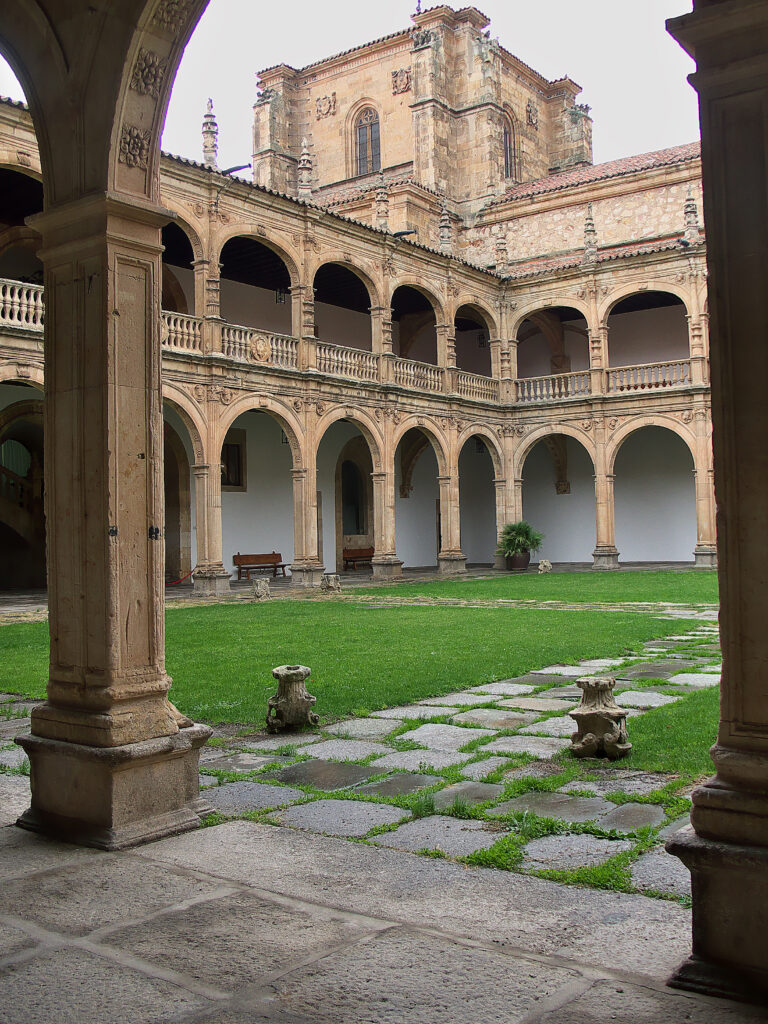
The exile prompted the foundation of numerous Irish colleges across Spain, under the patronage of the Spanish Crown. These institutions would provide education for Irish Catholic priests over the following centuries, making them invaluable for the preservation of Irish culture during the challenging years of the Penal Laws. It is symbolically significant that the first of these Irish colleges, at Salamanca, was founded in 1592, the same year as Trinity College in Dublin. Whilst the impending Anglicisation and Protestantisation of Ireland was initiated on the island, Gaelic culture found a haven across the Celtic Sea in Spain. Michael Doheny, in his memoir of Geoffrey Keating, makes the following revealing claim:
‘Spain was, in fact, the principal refuge for the exiled Irish, and his opportunities for preserving his practical knowledge of his native tongue, were far greater there than elsewhere out of Ireland’.
It was also around that time that Keating wrote his renowned Foras Feasa ar Éirinn, a history of Ireland of higher literary than academic value. In addition to the stories of the Book of Invasions, the Bordeaux-educated priest also recalls the theory of the classical name ‘Hibernia’ deriving ultimately from the Spanish river Ibērus (Ebro), and also the origin of the term Iberia.
As a last example of the general prevailing sentiment in those times, the exiled archbishop of Tuam, Florence Conry, wrote to King Philip III:
‘And the Ancient Irish, as these are descended from the Spanish, desire always to be governed by the Kings of Spain and their successors, and bear affection and love to the Spanish nation. Likewise great hate and enmity to their enemies and are sharp of wit and valiant in war, altogether like the Spaniard.’
THE ENLIGHTENMENT AND LATER
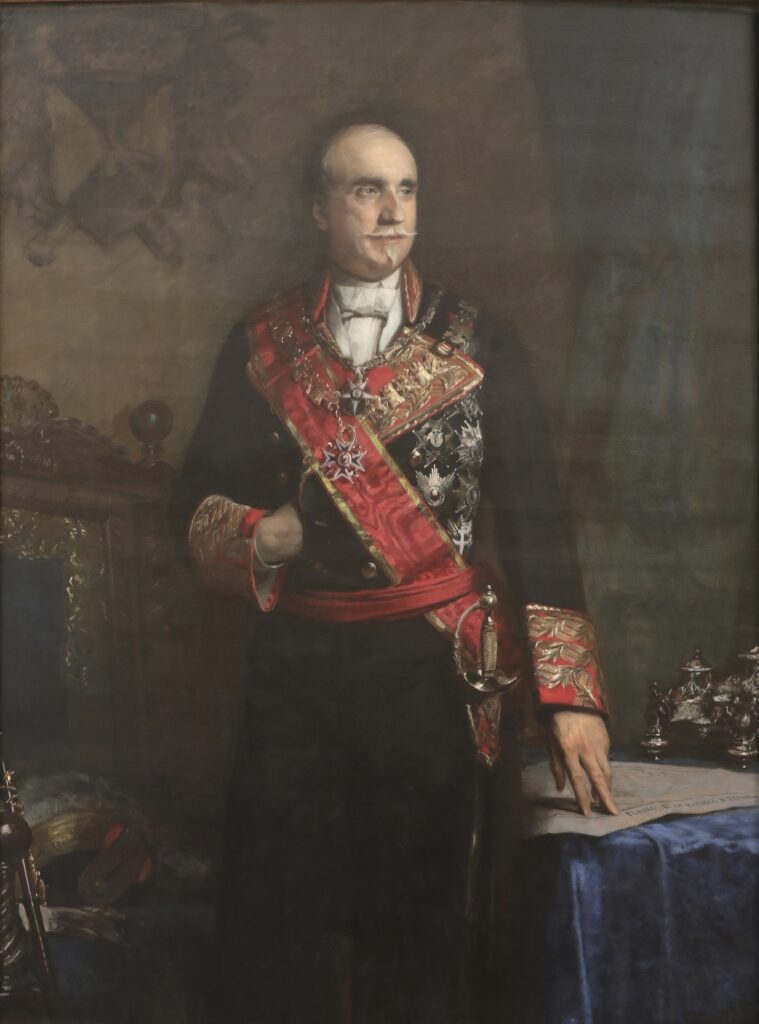
Moving forward in time to the eighteenth century, the Enlightenment witnessed another increment in the popularity of these legends. This period fostered an incipient patriotic movement that began to question the morality of the Penal Laws. Irish antiquarians of the calibre of Charles O’Conor and Sylvester O’Halloran started to investigate the island’s remotest past to demonstrate the existence of a rich literary culture in pre-Norman Ireland, and the Book of Invasions returned to the fore as proof of the civilised nature of the Irish.
In more recent times, some see a reference to the Milesians in Amhrán na bhFiann—Buíon dár slua thar toinn do ráinig chugainn (‘A band of our people who came from across the sea’)—although it is usually taken to refer to the Irish-Americans who supported the independence movement. It has even been suggested that Éamon de Valera, born in New York to an Irish mother and, supposedly, a Spanish father, is an incarnation of the Milesian myth.
Recent research by scholars like John Koch and Barry Cunliffe, who posit the origin of Celtic culture on the Iberian peninsula in Celts from the West, seems to confer a certain veracity on this myth. Their conclusions would explain the arrival of the Celts in Ireland from Spain through a process linked to the expansion of the Atlantic megalithic phenomenon.
Finally, let us not forget that we are dealing with one of the many foundational myths that populate European folklore and, as such, it is merely a legend. Nevertheless, are not legends often but fanciful and exaggerated representations of actual events perpetuated through oral tradition?
Sergio Fernández Redondo is a history aficionado from Asturias in northern Spain, currently based in the Gaeltacht of County Waterford.
Further reading
D.M. Downey & J. Crespo MacLennan (eds), Spanish–Irish relations through the ages (Dublin, 2008).
A. Gregory, Gods and fighting men (Dublin, 1905).
J.T. Koch & B. Cunliffe (eds), Celtic from the West: alternative perspectives from archaeology, genetics, language and literature (Oxford, 2010).
R.A.S. Macalister (ed.), Lebor Gabála Érenn. The Book of the Taking of Ireland (Dublin, 1935).