
RTÉ1, 29 December 2025, and RTÉ Player
By Sylvie Kleinman
‘Daniel O’Connell almost single-handedly raised a nation from its knees, and forced Britain, the most powerful empire in the world … to grant the Irish people their democratic rights’ (our emphasis, as are all italics in quotations below). An arty map shows this empire—in 1886. Clear concepts underlie ‘democratic rights’. When the voiceover announced that ‘Catholic Emancipation’ had been achieved in 1829, we saw a photograph (1880s?) of Irish peasants before a miserable dwelling. Their harsh existence obvious, one wondered what ‘emancipation’ had done for them. The Emancipator self-validates by pushing its narrator, the highly talented Irish actor Domhnall Gleeson. Telling Irish history continues to be a man’s game (though O’Connell’s political sphere was exclusively male). Gleeson’s delivery fluidly engaged the viewer, but only those steeped in the subject would detect the script’s factual errors. Overall, The Emancipator tends to eulogise O’Connell through subtle spins and strategic silences. Some visuals are anachronistic. Beyond oversimplification, some interviewees brought depth and nuance when evaluating this genuinely extraordinary person, also addressing uncomfortable truths. He invented the ‘methods of mass democracy’ and peaceful agitation. But the ‘people’ portrayed in contemporary footage were of both sexes and all classes, in today’s world of universal suffrage: nothing was said of the élitist/sexist access to ‘democracy’ in his lifetime. O’Connell’s long-neglected and game-changing anti-slavery agitation was covered (see my ‘Ireland and the £20 million swindle’, HI 29.3, May/June 2021). Typical of retrofitting was the claim that Frederick Douglass came here in 1845 to ‘meet O’Connell and study his methods’. Obscure Irish abolitionists had planned the tour of this un-manumitted slave, whose brief encounter with the Liberator was incidental. Nor did O’Connell (single-handedly) found Prospect (Glasnevin) Cemetery or the National Bank; and he only laid the foundation stone for the North Richmond Street Christian Brothers’ model school, established by Edmund Rice.
Spectacular drone footage swept over Kerry, and the O’Connell family seat at Derrynane that he would inherit: the O’Connells were rare as Catholic landlords. On a schoolroomish map, the ‘lands planted and confiscated by Britain’ end with Cromwell in 1652. Though ‘rich in culture, the Irish poor of O’Connell’s day live in primitive conditions’ as documented by ‘later photographs’. The above-mentioned one is shown. Is this honest? The Enlightenment projects optimism, but then in sensationalist images the French Revolution ends the old régime in 1789. Reduced to mobs, regicide and Terror, we heard nothing of the transformative processes of politicisation, agitation and radicalisation which would empower Irish Catholics. In Dublin, weeks before Louis XVI was guillotined, the ground-breaking Catholic Convention had convened. A Tralee delegate, Dominick Rice, may be the barrister of that name who signed O’Connell’s own King’s Inns memorial in 1798, and he knew that prominent family. Revolution ‘strikes Ireland’ that year, but through arms (and not two decades of popular politics voicing democratic visions). As ‘Theobald Wolfe Tone leads the Irish in a rebellion to overthrow British rule’ (while in France!), we drone over Vinegar Hill: ‘30,000 rebels are killed’; cautious estimates include countless civilians. We heard nothing of Tone’s initial moral-force argument on behalf of Irish Catholics, nor of the pre-revolutionary campaigning for civil and political liberties of the United Irishmen, whom O’Connell claimed he had later joined. We jumped to the 1820s, and it was asserted that he wished to ‘implant new ideas, that all men are born equal’: these supposed words of his were overlaid on a shot of the Liffey. But that foundational principle had been irreversibly projected to the world from America when Dan was in his infancy in 1776. Planted in Europe, it transformed Irish Protestant reformers by denouncing the archaic Penal Laws oppressing Catholics and preventing nationhood. And he referenced that iconic principle of the Declaration of Independence when addressing the shame that Irish-American slavery apologists should feel. This was not discussed in The Emancipator, created during the concurrent anniversary of American independence.
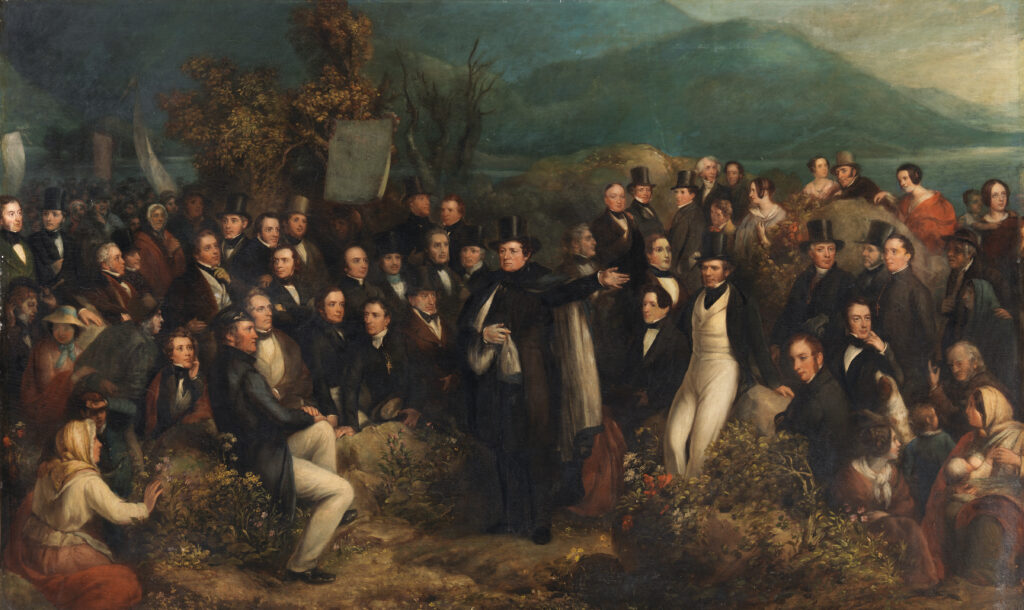
The pace intensified as O’Connell campaigned to repeal the Act of Union after 1801, to ‘restore a democratically elected parliament for Ireland’. We’re confused: moderates condemned its incestuous corruption, and radicals its unrepresentative nature. Catholic emancipation had been promised but had to be seized. His early involvement (c. 1807–14) in obscure lobbying is skipped, until ‘he’ organised meetings (with others) and artfully grasped the badly needed leadership role. His oratorial and performative skills drove the Catholic Association (1824), as he traversed the land urging the people to mobilise. Even a poor widow could afford its penny monthly membership, which the clergy helped collect (more photos!). That liberalism had grown out of earlier radicalism, and that prominent others in Anglo-Irish politics had indefatigably championed emancipation for years was missing. Here, O’Connell’s agency alone challenged the stubborn, self-serving British. The ‘Prince Regent’ in 1825 quashed a bill (though King George IV since 1821, and the Lords had rejected it), but mind-sets were rapidly changing. In 1828 O’Connell was finally elected MP for Clare, becoming the first Irish Catholic to enter the House of Commons. Recognised as a demagogue, ‘he’ self-branded, exploiting Gaelic signifiers like green, wolfhounds and round towers (though cultural nationalism was surging). His internationalised reputation motivated Catholics deprived of rights throughout Europe, namely in the Rhineland (discussed by Eda Sagarra in this issue, pp 36–9). The most visualised Irishman of his times, O’Connell was merchandised and caricatured in biting or proto-racist cartoons.
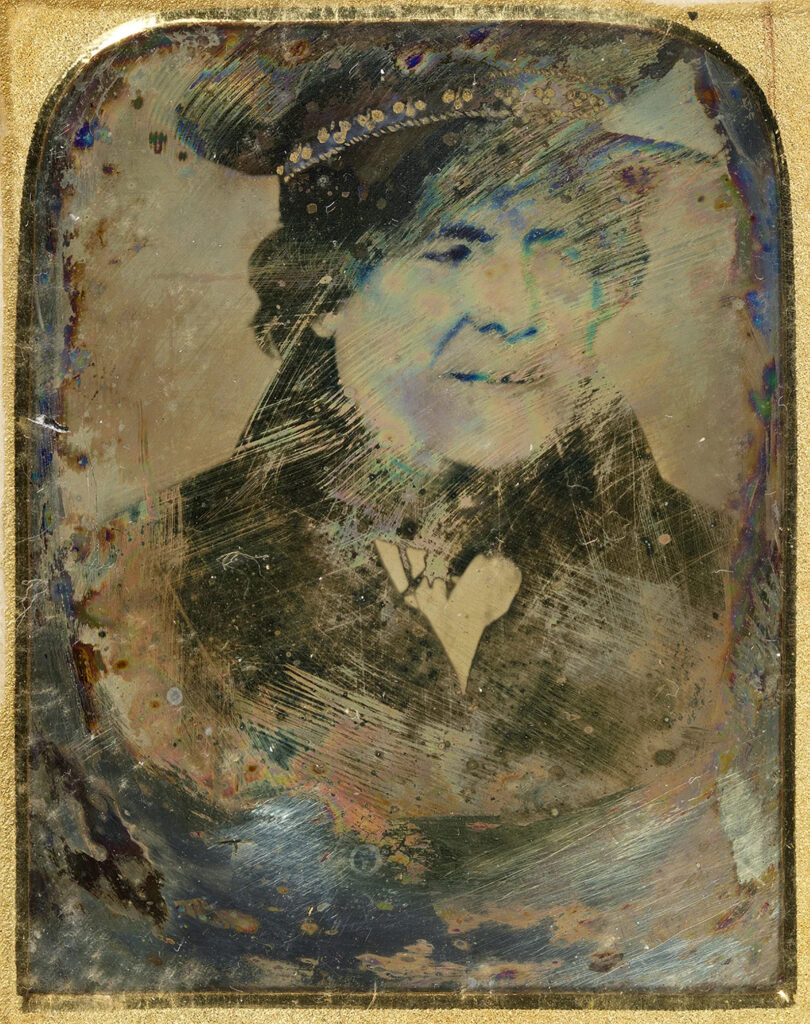
Losing his wife Mary was devastating, but he threw himself into Repeal agitation as monster meetings spread formidably across the land. Having ably maintained order, he was walking a fine line in 1843, stirring the crowds with rhetorical questions about rising. This led to the famously cancelled meeting at Clontarf and his incarceration (with others) in 1844. Freed, O’Connell processed through Dublin in a curated triumphal car (now on display in Derrynane). In a nanosecond, Old and Young Ireland sparred as nationalism surged, and he died in 1847, powerless and shattered at the Famine’s devastation (when only ‘Irish Catholics’ died, apparently). Promised ‘newly uncovered archival material’, we only saw the original of the known and fascinating 1844 daguerreotype (NGI). Excessive images overwhelmed, and his journal and correspondence (all online) were overlooked, apart from some tender words to Mary. Marking the 250th anniversary of his birth in 1775, The Emancipator was long overdue, as after 1916–22 ‘O’Connell and his pacifist instincts were eclipsed’ (if not in the emerging theocracy). Beyond dubious assertions and promoting a quasi-childish monomyth, it’s densely packed and enthusiastically portrays an undeniably exceptional character in history.
Sylvie Kleinman lectured on ‘Ireland in the Age of O’Connell 1775–1847’ at Trinity College, Dublin, 2011–14.