
St Comgall’s School, Falls Road, Belfast
www.wherethetroublesbegan.com
By Donal Fallon
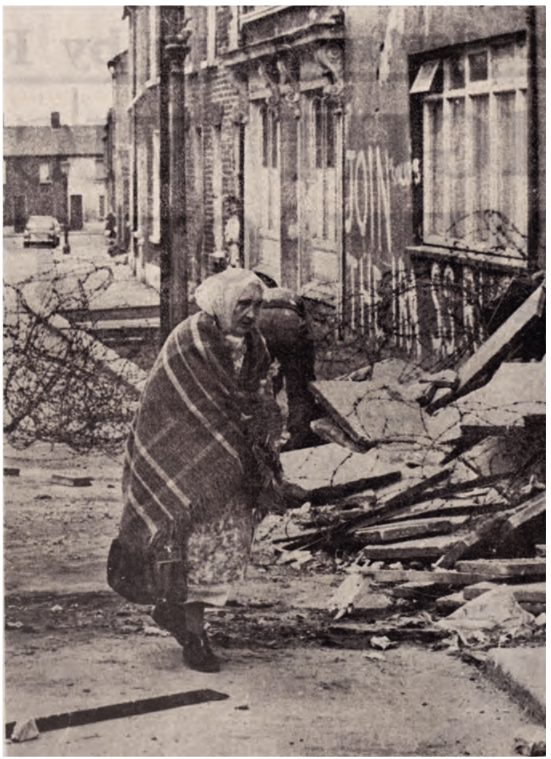
In August 1969, the Falls Road was described to readers of the New York Times:
‘At best, this is a dim Victorian district of redbrick row houses, second-class stores, cheap cafes and dowdy pubs. Today, the streets were littered with glass, stones and bricks. Shops, homes and pubs were either boarded up or burned and pillaged. Buildings smoldered, and a damp stench hung over the area.’
Even by then photographers and journalists were a familiar sight on the road and its intersections.
Most tourists to the Falls today make first for the ‘International Wall’, currently displaying a series of murals in support of Palestinian rights. Without realising it, the short walk from the city centre brings them past St Comgall’s School, a defining building in the story of the Troubles. It still carries some of the scars of 1969 on its façade. From its grounds, IRA men attempted to stop the advance into the area of a loyalist mob, hell-bent on burning homes and businesses. Brendan Hughes, present on that dramatic night, recalled that this was his old school: ‘one of the IRA men who was there at the time had a Thompson submachinegun and asked if anybody knew the layout of the school … There was a man on the roof of the school and people were shouting at him to fire into the crowd, and he shouted back that he was under orders to fire over their heads.’
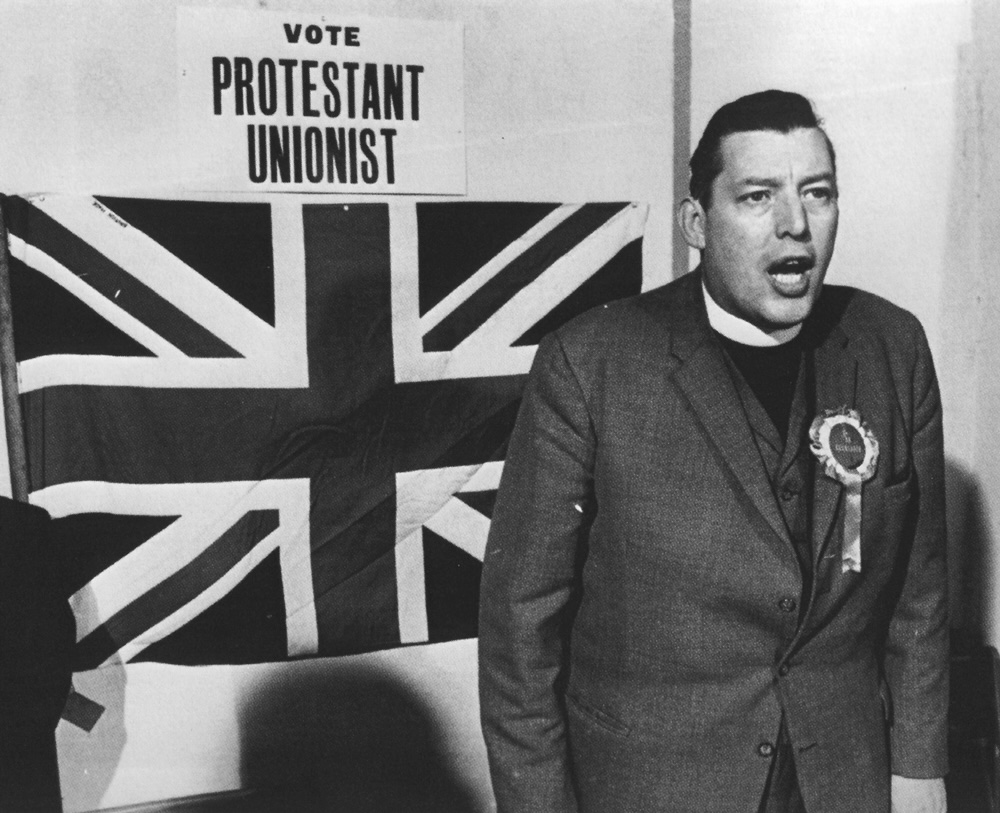
Some will perhaps initially question the title of this fascinating exhibition, The Falls: Where the Troubles Began. The worsening situation in Derry in the months before the Falls was besieged had significantly raised political tensions. Even earlier, 28-year-old John Scullion was the victim of a sectarian murder in June 1966 and is now considered to be the first victim of the Troubles. Nonetheless, this exhibition does a fine job of documenting the broader story leading up to the siege of the Falls Road and takes as its starting-point the 1964 Westminster election, when Billy McMillen stood as a Republican candidate, provoking the ire of Ian Paisley. As McMillen recounted, ‘On display in the window of the HQ was a photograph of a very handsome candidate, flanked on one side by the Starry Plough, and on the other by the Tricolour’. The removal of the Irish national flag by force, and the rioting that followed, propelled the Falls Road into international news. To many local people, it retrospectively marked the beginning of the Troubles.
Drawing primarily from the Dúchas Oral History Project, this exhibition consists of 22 large-scale visual panels, each with a corresponding number. On audio headsets the visitor hears historical context and recollections taken from the interviews conducted over many years. The exhibition stresses that it does not seek to ‘tell the story of the Troubles or the wider conflict’ but rather to focus on the events that played out in the immediate vicinity of St Comgall’s itself. As such, this is a localised approach that succeeds in bringing the visitor to the heart of the community around the school. Some recollections early on capture the fears of that community, who recounted boarding up windows and awaiting what increasingly felt like the inevitable confrontation that came in August 1969.
Early panels explain the rise of both the Civil Rights movement and the Paisleyites. Much has changed in how Paisley is now viewed since Peter Taylor’s study of loyalism in the late 1990s, in which Paisley was described as being ‘the heir of Carson, the sworn enemy of Rome, the opponent of ecumenism, the scourge of the IRA, the denouncer of Lundys and the thorn in the side of countless British governments whom he is convinced are determined to sell out Ulster and hand it over to Dublin’. Oral histories capture not only the fear of Paisley’s followers felt in the 1960s but also the confusing attitudes held towards Taoiseach Jack Lynch and others. That we hear different voices across the panels helps hold the visitors’ attention, and the sound quality is broadcast-level.
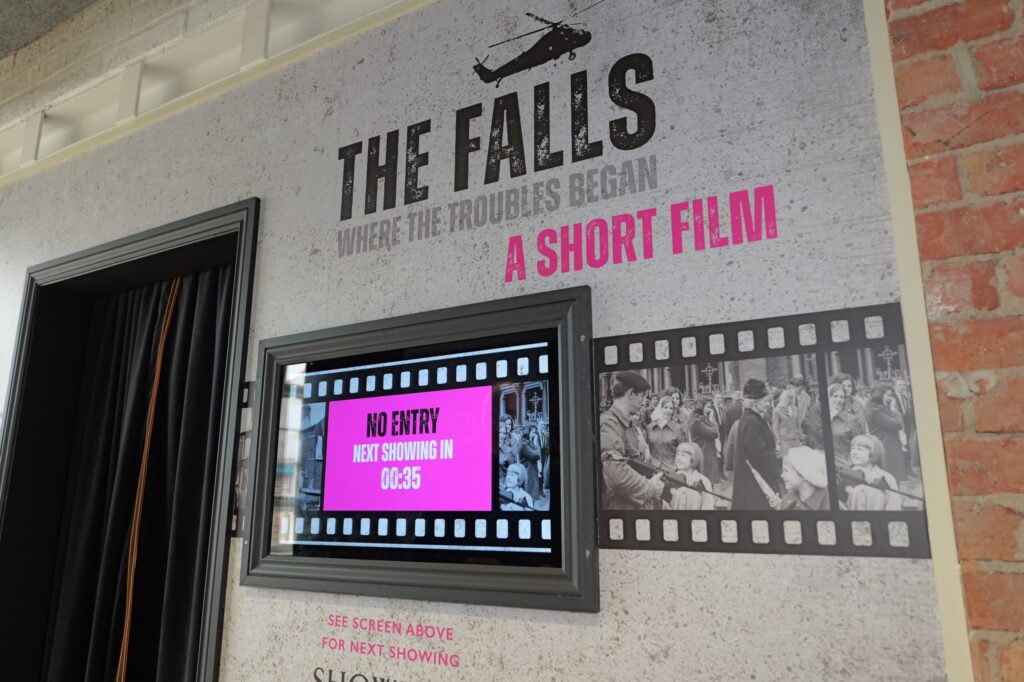
In the second room, archival footage is soundscaped and presented on a full-length wall, creating an almost cinematic experience. Showing the confrontations surrounding the 1964 Westminster election and the 1969 siege, much of the footage comes from the collections of RTÉ and the BBC, but some is nonetheless far less familiar to the public. There is a curious dance playing out between the nationalist community and British soldiers on the ground in early footage, before the political atmosphere dramatically changes.
In its latter rooms, the exhibition panels are joined by photographs from the Belfast Archive Project, a not-for-profit association seeking to preserve a photographic record of the city. There are striking images from photographers like Gerry Collins, who bravely photographed the burning Bombay Street. The exhibition also makes great use of archival maps, which give a sense of the topography of the area—and its proximity to the Shankill Road.
If there is a context largely missing in the exhibition, it is around republicanism itself. Tensions between the Official and Provisional republican movements are not explored in any great detail, nor is the role of the Official IRA in resisting the Falls Curfew a year later. The Falls, as Paddy Devlin noted in his autobiography, was ‘an acknowledged stronghold of the Official IRA’. As detailed in both Hanley and Millar’s The Lost Revolution and Seán Swan’s Official Irish Republicanism, 1962 to 1972, all of these events are vital to understanding both organisations and the paths they took.
Still, this exhibition is a shining example of how oral history and local history are vital to our understanding of the past. Great credit is due to the Falls Community Council for mounting something so ambitious in its use of technology. While the Troubles Gallery at the Ulster Museum holds many artefacts vital for understanding the conflict, this exhibition reminds us of the importance of preserving recollection.
Donal Fallon is a historian and the presenter of the ‘Three Castles Burning’ podcast.