
By Stephen McGarry
The ‘Wild Geese’ was the name given to the 14,000-strong Irish army that withdrew to France following the Jacobite War in 1691. These Irish regiments formed an Irish brigade that served France for around 100 years. It was disbanded after the French Revolution, leading to a split between those officers who supported the revolution and those who supported the monarchy. Many royalist officers entered the service of the émigré ‘Army of the Princes’ to fight for the Bourbon king against revolutionary forces.
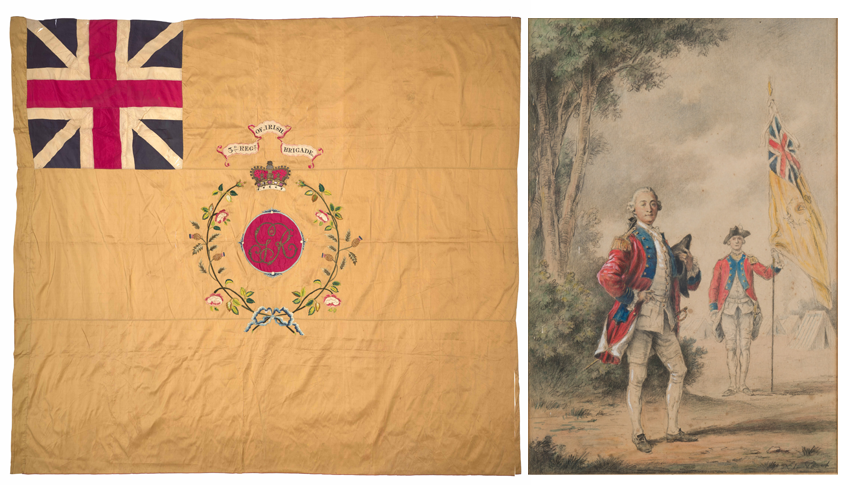
In 1794 these Irish officers were recruited by the British to continue the fight against revolutionary France. The plan was to raise six regiments under the Duke of Fitz James, Count O’Connell (uncle of the Liberator), Henry Dillon, Viscount Walsh, Count Walsh de Serrant and Count Thomas Conway. The regiments were fitted out in red tunics, evoking the Irish Brigade under the ancien régime. O’Connell’s were faced in light blue, Dillon’s in buff yellow and Walsh’s in blue (as in the watercolour below/right). There is no surviving evidence of the facings of the remaining regiments.
The newly raised unit was given licence to drum up Catholic recruits in Ireland but was unable to muster the requisite numbers, as it had to compete with other British units. Moreover, in the 1790s most Irish Catholics were sympathetic to the revolutionary cause and were trying to remove the shackles of a British monarch; they were not keen on a pro-royalist Franco-Irish unit that wished to see the return of a French one. Irish Protestants also resented its formation. The Irish Brigade of France had always been the bête noire of the Irish Protestant Ascendancy and now they were to fight for the British!
This ‘Irish Catholic Brigade’ was expected to be deployed in the European theatre to fight against revolutionary France. Instead, they were deployed to Nova Scotia and the Caribbean, where they suffered heavy losses—and came to an inglorious end, mostly owing to disease. These losses led to the unit’s disbandment in 1798, its remaining rank and file being transferred to other British regiments.
The flag displayed here is of Dillon’s 3rd Regiment of Foot. It came from the estate of the Walsh de Serrant family, a prominent Franco-Irish lineage whose members served as colonel-proprietors of the Regiment of Walsh. To my knowledge, this is the only surviving flag of the Irish Brigades or Napoleon’s Irish Legion in existence, apart from the Dillon fragment in the National Museum, Collins Barracks, and the Regiment of Berwick’s drapeau d’ordonnance on display at Les Invalides in Paris.
In the accompanying watercolour, Count Walsh de Serrant is shown imperiously. The flag-bearer carries the Colour of Dillon’s 3rd Regiment, adorned with a silken white cravat (at the top of the pole) denoting loyalty to the Bourbons, albeit now in British service. The white cravat had always been carried by the Irish Brigade of old, symbolising that they were never mercenaries but royalist troops.
Stephen McGarry is the author of Irish brigades abroad: from the Wild Geese to the Napoleonic Wars (Dublin, 2013).