
RONAN McGREEVY and EMER PURCELL (eds)
Four Courts Press
€30
ISBN 9780901510990
REVIEWED BY
Thomas O’Loughlin
Thomas O’Loughlin is Professor Emeritus of Historical Theology at the University of Nottingham.
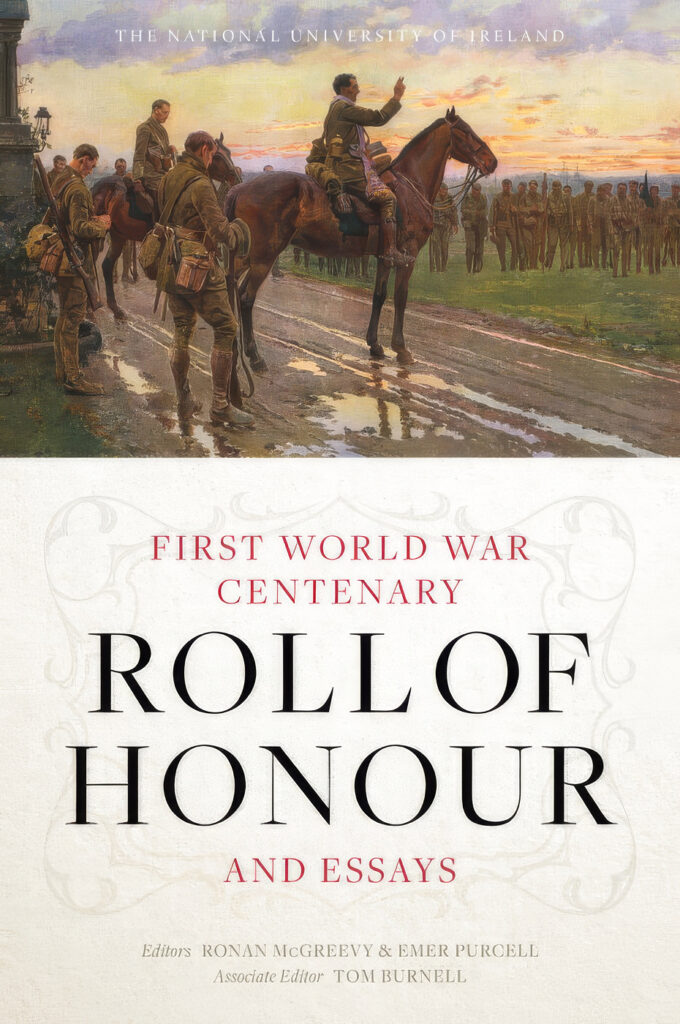
This book owes its publication to the Decade of Centenaries and needs to be understood in that context: it is both a commemoration today, which is part of that decade, and an archival work of acts of commemoration that occurred over a century ago, when two academic bodies (the National University of Ireland (NUI) and the Royal College of Surgeons in Ireland (RCSI)) published ‘rolls of honour’, books listing their alumni who served as part of Britain’s forces in the Great War. It is a very strange volume, for it is full of fascinating and diverse items that make it a pleasure to read and dip into but also make it almost impossible to review in the normal sense. The first step, therefore, is to give a detailed list of its contents.
In 1919 the NUI produced a 42-page book naming the staff and students who were killed or served with distinction in the war. This Roll of Honour is reproduced here on pp 27–68. It is preceded by an introductory essay by McGreevy, setting out with admirable clarity the complexity of remembering the Great War in relation to a university that was established to cater to nationalist desires, did not (unlike other universities) have an officer training corps and did not establish one when suggested in 1915, and where the split of the Irish Volunteers/National Volunteers in late 1914 was played out in detail: both Tom Kettle and Eoin MacNeill were UCD professors. This has also affected how the NUI has remembered its links with the war: walking into UCC or UCG, one could imagine that the First World War never occurred. Yet the NUI does have that war as part of its past, and another part of that memory is its difficulty with that memory. This is brought out in the story of Kettle and how he was both commemorated and not commemorated. At this point it is worth noting that a feature of all the essays is their biographical focus. This ‘up-close and personal’ character makes for fascinating reading; while one cannot draw wide conclusions from these anecdotes, one is struck by the variety of responses to war and amazed, to use Redmond’s phrase, at to just where ‘the firing line’ extended. Because of this biographical dimension, the index is crucial to follow people from list to list—and it is a research tool in itself (pp 381–422).
The third item is yet another roll of honour, this time from the RCSI, also in facsimile (pp 169–255). This was a book that emphasised ‘honour’ when it was published: it gave a list of those killed but also cited how its alumni were ‘mentioned in dispatches’. The fourth item is yet another list, this time newly compiled by Barbara McCormack, of 60 priests from Maynooth who served as chaplains in the British Army (pp 274–82), and 22 biographical sketches. The fifth item is material from the NUI archives relating to the war, and the sixth is a collection of essays. McGreevy presents a set of snapshots of NUI men. This is balanced by Fionnuala Walsh’s study of how NUI women were affected by the war. She concludes by noting that the war expanded the number of women in higher education, so that by 1925 women accounted for 30% of all Irish university students, higher than in Germany, Italy or France. Then there are studies of medics and chaplains.
One wonders why, in a book published by the NUI, the roll of the RCSI has such prominence, while the book is not a centenary volume for Irish universities (Trinity College is only mentioned incidentally). There is no real explanation given by the editors, but I suspect that the book’s origin lies in its interest in medicine (the subject of a special essay). The largest proportion of those listed in the NUI roll, both as participants and as casualties, is not, as one should expect, infantry officers but medics. This becomes clear by looking at their degrees and the units with which they served. Therefore it could be said that this is largely the NUI’s roll of medical officers (e.g. the UCD list is mainly graduates from the Cecilia Street Medical School) and this, naturally, makes the link with the roll of the RCSI understandable. Once this specialist dimension of the war—medical services—had been noted, then another anomaly, clergy who were NUI graduates, came into view and this led to their inclusion.
Let me end with two notes pointing to the need for a lot more work. First, this is not really a study of the NUI and the First World War but of a high proportion of Irish medics and the war. Second, it does not cover ‘Irish Catholic clergy and the war’ but only those from Maynooth—there were many other Irish chaplains, both diocesan and from religious orders. To conclude: this book has broken the surface, but there is a vast amount of archive work still to be done, and only then will new historical vistas come into view.