
Following on from Trinity College Dublin’s Legacies of Slavery Project, Rachael Scally investigates the Royal Dublin Society (RDS) and its links to slavery and empire. The project is co-funded by the RDS, which is a partner in the Research Ireland Enterprise Scheme.
By Rachael Scally
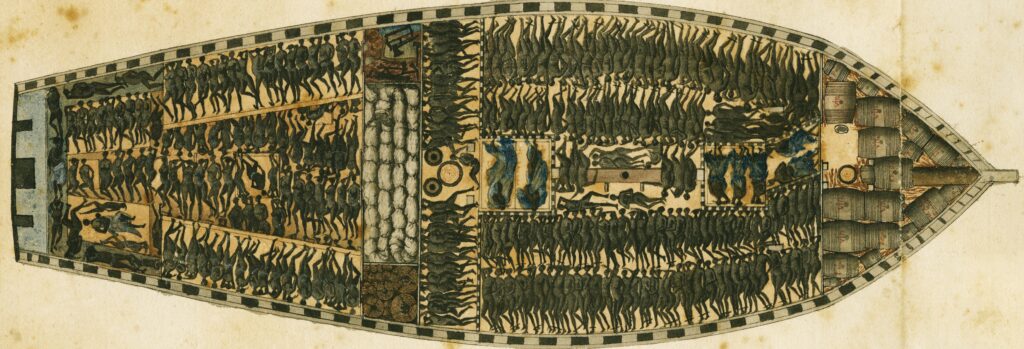
Work is ongoing but, to date, research has established that 23 of the Royal Dublin Society’s members and alumni had owned between them 2,260 enslaved people—approximately the number of members of the RDS from its foundation in 1731 to 1834. Jamaica was the most common source, but other locations included Barbados, Tortola, British Guiana, Trinidad, St Kitts, and North and South Carolina. This figure is a considerable underestimation, as the number of enslaved people held in captivity by several individuals is not known. The vast majority of these enslavers were absentees who had accumulated great wealth and received between them over £46,000 in compensation following the abolition of slavery. According to the Measuring Worth Calendar, an online tool used by academics, in terms of relative income this would be the equivalent of over a whopping £77.2 million today.
NOTABLE RDS SLAVE-OWNERS
The single most significant slave-owner was Thomas Wilson (d. 1857), a Dublin-based West India merchant who was the sole owner of no less than nine plantations in Trinidad. Wilson made his fortune by importing the produce from his plantations on his own ships. He was so ridiculously wealthy that he became known as the ‘Croesus of Dublin’.
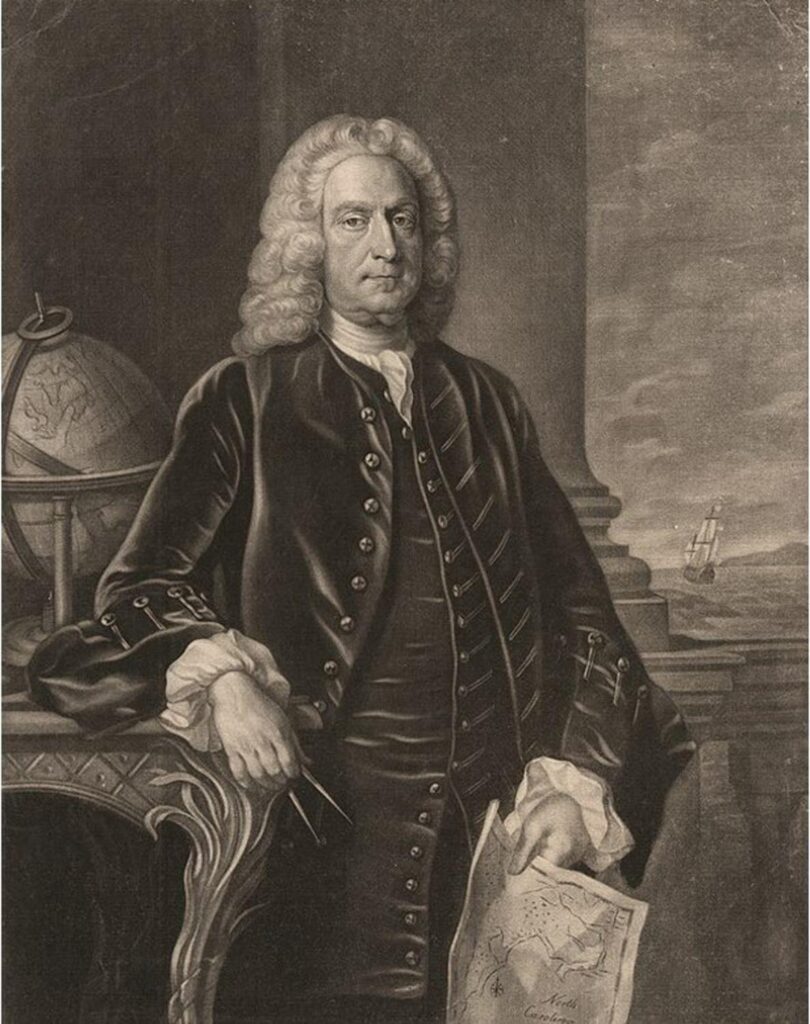
Another of the report’s most significant findings was that Arthur Dobbs, a founding member of the Society and a major figure in eighteenth-century Ireland, had owned enslaved people. According to Dobbs’s biographers, he was an ‘indefatigable’, ‘multi-talented’ man and a leading light of the Society who rarely missed a meeting. What his biographers have previously failed to mention, however, is that Dobbs, who by 1753 had been elected governor of North Carolina, was also a resident slave-owner.
Other notable members and alumni found to have owned slaves were James Hoban (1755–1831), celebrated for being the architect of the White House; the writer and reformer Joshua Steele (c. 1700–96), who established the Society for the Encouragement of Arts, Manufactures and Commerce in Bridgetown, Barbados; and several members of the famous Latouche banking family. One lesser-known individual who was found to be an enslaver was Revd Thomas Brownrigg (1755–1826), chancellor of Dublin’s Christ Church Cathedral, who owned ‘Phoenix Park Pen’ in St Ann, Jamaica.
The project discovered that a further fifteen members and one affiliate had profited financially from enslavement via family wealth, family connections or other means, such as being a mortgagee. They include Conway Richard Dobbs (1727–1811), the eldest son of Arthur Dobbs, to whom his father awarded a moiety of 12,500 acres in Meclenburgh County in North Carolina upon his marriage; Sir Humphry Davy (1778–1829), the British chemist and inventor of the miner’s safety lamp, who used his wife’s wealth, which had been acquired from enslavement in Antigua, to pursue his career; and John George Adair (1823–85). Adair’s family had made their fortune in the sugar trade between Ireland and Trinidad. Like Thomas Wilson, the Adairs had used their own ships to transport sugar from their plantations. John George Adair went on to inherit the family fortune and to build Glenveagh Castle in Donegal. He is remembered for being the landlord who instigated the notorious Derryveagh evictions, yet the fact that he owed his fortune to slavery is little known.
ATLANTIC ECONOMY
The project also found that members of the Dublin Society were linked to the Atlantic economy through Dublin’s commerce. Thirty-one members worked in industries that profited from the import of slave-produced goods such as sugar and tobacco, and from the export of goods such as linen to the colonies. These individuals were not just members of the Protestant Ascendency but also included Catholics, Presbyterians and Quakers.
Edward Byrne (1740–1804), for example, was a Catholic and the largest sugar baker in Dublin. He was reputed to be the wealthiest Catholic merchant in Ireland, paying a £100,000 tax bill each year. He owned a house in North Great George’s Street and a £40,000 estate in County Down. According to RDS records, Byrne had direct links with plantations in the Danish West Indies. When he died in 1804, his will was proved for £69,000.
The Presbyterian Adam Seaton Findlater (1855–1911) was another very wealthy member who had profited through the trade in goods connected to the enslavement economy. Findlater had travelled to Brazil at the age of just sixteen and established himself in Bahia, operating as a shipping agent and merchant. He exported cotton to Liverpool, Falmouth and Hamburg, and fabrics such as osnaburg and gingham were sent in return to Bahia, where trafficked Africans worked on sugar plantations. Findlater later went into partnership with his brother, Alexander, in Dublin as Findlater & Co., selling spirits, wines, teas, coffees and groceries. He donated around £3,000 per annum to charity and left effects under £250,000 when he died.
COARSE LINEN
While no evidence was found to suggest that the Society ever owned enslaved people, what research did reveal was that the Society awarded generous premiums to the linen and fishing industries, both of which profited from enslavement. Dublin never had ports like Bristol or Liverpool that traded enslaved people, but it did have a niche in the supply of cheap, low-grade cloth to the British colonies. It was the low-priced, coarse linen that suited the needs of the British West Indies and the American plantations. The Linen Bounty Act of 1743 provided financial incentives for the export of linens from British and Irish ports to destinations including America and the West Indies, and British America became Ireland’s second-largest market for linen and its most important destination for coarse, cheap linen. By 1771 Irish linen exports to British America totalled well over four million yards and accounted for 21% of Ireland’s total linen exports. The bounty made it possible for Irish linens to compete on better terms than the popular German fabric: in 1784 Lord Sheffield commented that, before the bounty, ‘the planters used almost entirely the German Osnaburghs for their slaves’. The historian Takeda argues that coarse Irish linens were imitations of popular fabrics used to clothe enslaved people and, in particular, imitated the popular coarse German fabric osnaburg. In 1762 the Society awarded seventeen premiums alone to support the manufacture of linen, including at least five to companies producing coarse, low-grade cloth. The largest sum of £2,000 was awarded to Coates, Crump & Co. for the manufacture of dowlas, a cheap, coarse Irish linen.
FISHING
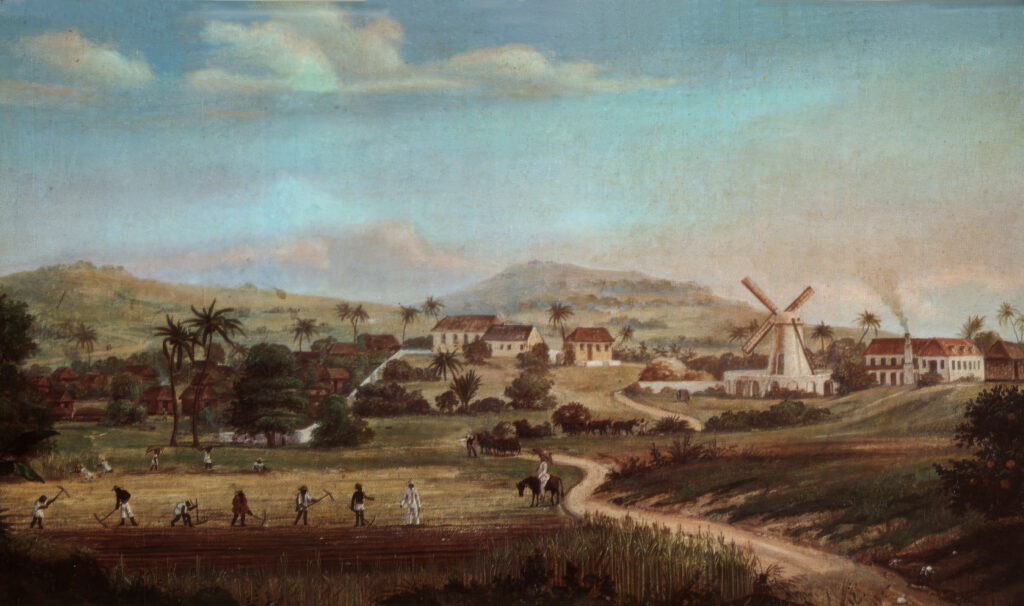
The Society also played a crucial role in promoting the Irish fishing industry. Fish, inexpensive compared to pork and beef, was in demand in the colonies, and Ireland exported large quantities of herring, and re-exported Swedish and Scottish herring, as well as smaller quantities of ling, mackerel, cod, and spiced and pickled salmon. Ireland’s export and re-export of herring became crucial for feeding the enslaved population in the West Indies, and between 1768 and 1776 Ireland shipped around 7,000 barrels of Irish-landed herrings per year, with the largest amount earmarked for Jamaica.
Throughout the eighteenth century the Society used its funds to promote the opening of new fisheries, and prizes were given for the curing and export of fish. Between 1745 and 1783 the Dublin Society awarded a total of 40 premiums for curing fish and another 107 for their export. For example, Andrew Moore was awarded a premium for exporting 178 barrels of herring to Jamaica, Gardiner Boggs received premiums for 860 barrels of herring that he sold in Antigua, and Thomas Gregg was awarded a prize for exporting 210 barrels of herring to St Kitts.
RDS AND EMPIRE
As Jane Ohlmeyer notes, while Ireland was England’s first colony, it was both colonial and imperial. Throughout the eighteenth and nineteenth centuries, Irish people from a variety of social backgrounds served in the British Empire, and the members of the Dublin Society were no exception. During this period its members actively participated in the business of empire, helping to uphold and expand British rule, working as administrators, officials, soldiers and colonisers.
Many Irish individuals travelled to India primarily for military and civilian service within the East India Company (EIC). The EIC had begun as a tiny London trading company with just 35 employees; it evolved into the largest corporation in the world, eventually ruling large swathes of India. The Irish could be found working as writers, soldiers, merchants, engineers and medics in the Company. These were highly coveted posts, but conditions for the recruits were tough, with many succumbing to sickness and disease. Just two monsoons were said to be the average lifespan of a Company writer, but great fortunes could be made by those who survived, with several returning home as nabobs. Notable members of the Society who were nabobs include William George Digges La Touche (1747–1803), Richard Griffith (1752–1820), Sir George Shee (1758–1825), Sir Thomas Lighton (d. 1805), John Armstrong Purefoy Colles (1834–73) and James Alexander, 1st Earl of Caledon (1730–1802). The latter travelled to India in 1752, working as a factor in Madras. His rise within the Company was meteoric. By 1760 he had been promoted to senior merchant and third in council at Masulipatam. He continued to work his way up through the ranks, accumulating wealth, for the next twenty years. By the time he left India in 1772, he was chief of the council of revenue at Murshidabad, which was the seat of power of the Nawabs of Bengal and the city from which all of Bengal was once governed before the Battle of Plassey. On his return to Ireland, he used his fortune to buy around £600,000 worth of land at Caledon, Co. Tyrone, and was created the 1st Earl of Caledon in 1800. He was elected a member of the Dublin Society in 1778.
Future research will investigate the impact of colonialism and empire on the Society’s collections. It will examine the large number of natural history specimens and artefacts from around the world that were donated to the Society by both members and non-members before its collections were transferred to state ownership in 1877.
Rachael Scally is a Research Ireland Enterprise postdoctoral fellow at Trinity College, Dublin.
Further reading
H. Fitzpatrick Berry, A history of the Royal Dublin Society (London, 1915).
C. O’Neill & F. O’Kane (eds), Ireland, slavery and the Caribbean: interdisciplinary perspectives (Manchester, 2023).
J. Ohlmeyer, Making Empire: Ireland, imperialism, and the early modern world (Oxford, 2023).
N. Rodgers, Ireland, slavery and anti-slavery, 1612–1865 (London, 2007).