
ORLAITH McBRIDE and JOHN GIBNEY (eds)
Irish Academic Press
€24.99
ISBN 9781788551816
REVIEWED BY
Fiona Fitzsimons
Fiona Fitzsimons teaches an evening course in Irish Family and Social History at Trinity College, Dublin.
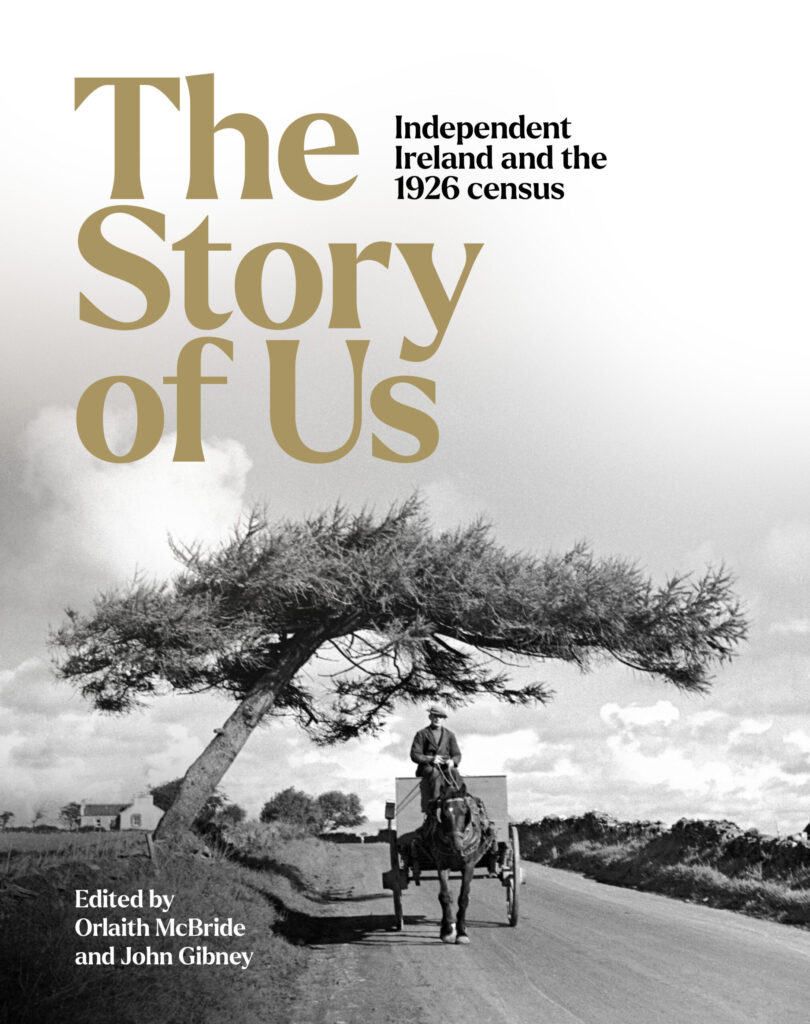
The story of us, published by Irish Academic Press in partnership with the National Archives of Ireland to mark the public release of the 1926 census, brings together a distinguished group of contributors to explore the first census of the Irish Free State, taken after the turbulent decade of the First World War, the Irish revolution, a global pandemic and Partition.
The editors are Orlaith McBride, Director of the National Archives, and John Gibney, Assistant Editor of the RIA’s Documents on Irish Foreign Policy series. The latter and Gregory Walls, an emerging scholar, are the workhorses who bring the book together. They introduce each section, provide context and link the individual essays into a coherent whole. The essays are organised into four thematic sections: ‘The World of the Census’ sets the scene; ‘People and Places’ moves from how the census was enumerated to the lives it recorded; ‘Identities’ explores these through the lens of Irish-language and minority faith communities, as well as through the intersections of gender and class; and ‘Economic Life, Housing and Infrastructure’ explores the material conditions of everyday life. A final chapter, ‘Census 1926’, describes how the census was prepared for publication.
It’s almost unfair to single out any one essay, so I’ll compound the offence by choosing two. Ida Milne’s ‘34 Marlborough Street’ vividly reconstructs the physical reality of tenement life: ‘… no running water or lavatory, … only a rudimentary privy in the yard; water had to be hauled inside and household waste back outside in buckets. Cooking was done over an open fire.’ These conditions led to ‘syndemics’, where disease and poverty combined to increase death rates among an already vulnerable population. The Dublin City Coroners’ records point to a further consequence: deaths from burns and scalds were disproportionately common in the tenements. Cormac Ó Gráda’s essay ‘Barely Alive: A Ghost Gaeltacht in Muskerry in 1926’ traces the decline of the Irish language in Derryfineen (Doire Fhínín) in West Cork. He neatly unpicks the complexities of personal and place-names in a bilingual society and concludes by breaking the fourth wall to explain his title.
The delight is in the detail: a love-song scribbled on the back of a census form ‘revealing a palpable moment of joy’; OPW architects repairing the Four Courts dome adding skimmed milk to tint the concrete to match the shade of the original masonry; the unfortunate Charters family who between 1911 and 1926 lost a son on the Titanic, a mother in the ’flu epidemic and a sibling shot dead by the IRA; Hugh McBride of Gola Island who played Gaelic football for Donegal but was dead three years later from tuberculosis; Anna Moore, the only child in a family of ten to survive childhood in a Dublin tenement; Susan Dempsey (1892–1964), born in Cavan Workhouse, died in Cavan County Home.
I have two reservations. The first is how the question of identity is framed: ‘Partition … corralled most of Ireland’s Protestants into the north-east and removed the heartlands of heavy industry … The Irish Free State remained an overwhelmingly rural, Catholic, Anglophone society …’. Partition didn’t create that society from scratch; rather it created the context in which political and church leaders were able to foreground one version of Irish identity—a rural Catholic people—while obscuring another tradition represented by the Irish Protestant community, ‘othering’ those who remained. What should have been an important strand of our national story became peripheral, reinforcing a narrowly Catholic conception of Irish identity that shaped the Free State and public memory for decades.
Bilenberg’s argument that Protestant decline owed more to ‘year-on-year economic emigration’ is correct, but in the early years of the Irish Free State ‘Protestant flight’ was real, though often downplayed. I recall a conversation with historian D.B. Quinn, who described his family moving from Offaly after Partition to settle in Northern Ireland, ‘not for political reasons but for work’. In this context, Mo Moulton’s suggestion that a careful comparison of Irish and English census data may allow a fuller picture of Irish Protestant migration to emerge is especially welcome. Unfortunately, the comparison cannot be made for Northern Ireland, where the returns of the 1926 census, taken on the same night, were later pulped.
The second reservation is the only discernible gap: the absence of Irish Travellers. They are mentioned three times, but there is no case-study of a Traveller family. In 1926 the Irish Traveller community was conservatively estimated at over 30,000 people, significantly larger than the Anglo-Irish community, which has a dedicated essay (Terence Dooley, ‘The Anglo-Irish aristocracy’). Irish Travellers are documented in church and civil records, in other complementary sources and now in three Irish censuses. The sources exist to begin to write their history.
Crucially, the work to publish the census was completed in-house, so the skills are now within the National Archives. By publishing it online, the National Archives has made the 1926 census accessible to the widest possible audience, building on the vision of archivists David Craig and Caitriona Crowe to democratise access to the sources we use to write Irish history.