
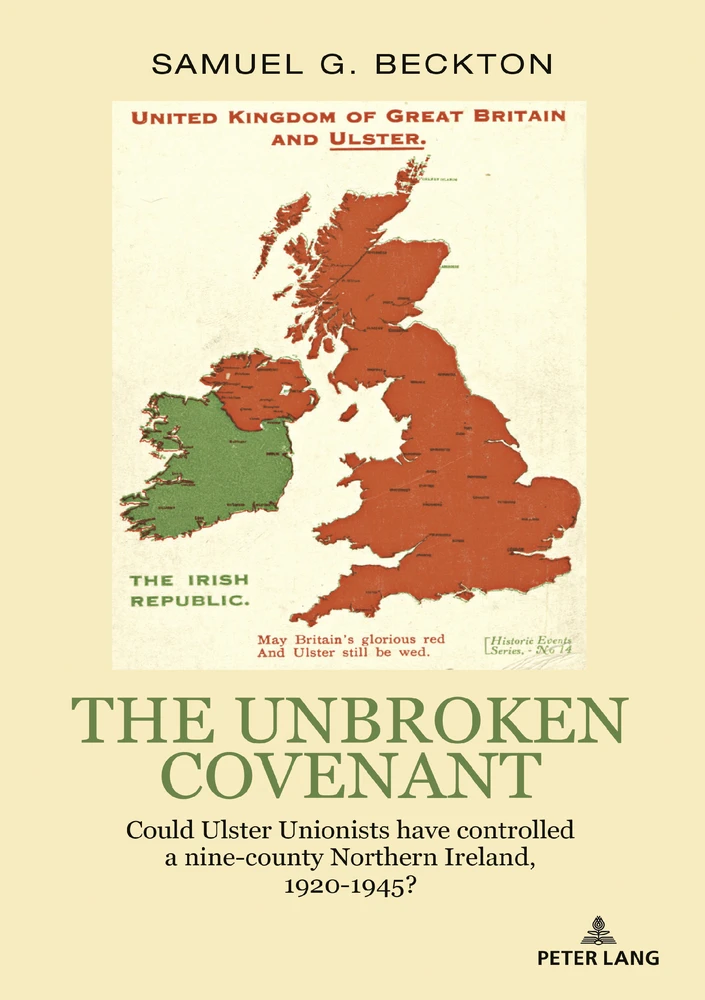
SAMUEL G. BECKTON
Peter Lang
£30
ISBN 9781803749891
REVIEWED BY
Ivan Gibbons
Ivan Gibbons is a former Director of Irish Studies at St Mary’s University, Twickenham.
This book is a fantastic read—in the original sense of the word. In the tradition of counterfactual or alternative history, it is a fantasy asking a fundamental conjectural question. If the 1920 Government of Ireland Act had established a nine-county Northern Ireland along the historic provincial boundary rather than the controversial truncated six counties, could it have survived politically?
Beckton’s thesis is highly speculative, but it is based on sound research. Basically, the author has drilled down into the religious demographics of the smallest electoral units in pre-partition Ireland, district electoral divisions (DEDs), according to the 1911 census (the last census before partition). This involved uncovering the religious breakdown in over 6,500 townlands (a number of which constituted each DED) in the three ‘lost’ counties of Donegal, Cavan and Monaghan. Using the statistics unearthed, Beckton asks fundamental questions—could unionists have controlled a nine-county Ulster and specifically these three counties? Would border county unionists in these areas have been able to return electoral representatives to Stormont and, finally, what role would a nine-county Northern Ireland have played in the Second World War?
The most interesting chapter is on the establishment of Northern Ireland between 1920 and 1924, where Beckton quite clearly utilises the same strategy used by the six-county Northern Ireland government to gerrymander local authority boundaries in, for example, Fermanagh and Tyrone during this period. Beckton extends this process and applies the same electoral manipulation to Donegal, Cavan and Monaghan, which, according to this alternative history, would now have been within Northern Ireland. His conclusion is that, although only four of the six counties were controlled by unionists in 1921, by 1925, utilising the same deft electoral manipulation, six of the revised nine counties would be under unionist control. To achieve this the author speculates that the Northern government would have participated in the Boundary Commission deliberations of 1924–5. Unionist objections to the real Boundary Commission delineating the borders of a six-county Northern Ireland were based on fear of losing territory. In this alternative scenario, the unionist government would see the Boundary Commission as an opportunity to lose Catholic nationalist areas such as south-west Donegal and south Monaghan while even gaining territory outside the provincial border, such as 33 townlands in south Leitrim adjoining the Cavan border where Protestants were in the majority. The attraction of this prospect, Beckton argues, would have been enough for the Belfast government to participate, to appoint its own representative (probably a cabinet minister) and to remove Derry/Londonderry as a controversial issue, as it would have been as far from the border in a nine-county state as Ballymena was.
According to Beckton, such measures as electoral manipulation would have been justified by the Northern Ireland government as only reversing the continuous gerrymandering on behalf of nationalists ever since the implementation of the 1898 Act, which had democratised local government in Ireland. Through judicious use of electoral engineering, a favourable outcome of the Boundary Commission and enhanced security, Beckton argues that a nine-county Northern Ireland could have survived in the short to medium term. The transfer of nationalist west Donegal and south Monaghan to the Free State by the Boundary Commission would have led to a combined and unionist-dominated Cavan–Monaghan County Council, as well as the division of Donegal, using South and North Tipperary as a precedent, into a nationalist-controlled South and West County Council and a unionist-controlled North and East Donegal County Council. There would also have been more public service jobs available for Protestants, as the more unionists controlled local government along the border the more a viable Protestant population could be maintained in these areas.
This is all heady stuff and Beckton admits that much of it is highly speculative. He also agrees that this situation would ultimately have become unsustainable. The high point in this alternative scenario would have been the Second World War, where the use of Lough Swilly and the construction of airfields in west and north Donegal would have provided sea and air cover in the ‘mid-Atlantic gap’, the area most dangerous to allied convoys. This would have symbolised the strategic importance of a nine-county Northern Ireland to Britain and the wider Commonwealth.
Beckton concludes that, if his electoral data are used as a predictor for a border poll, it is highly unlikely that a nine-county Northern Ireland, despite its electoral manipulation, would have commemorated its centenary. Unionists would have effectively controlled the parliament of Northern Ireland and most local councils. In order to achieve this, however, they would have needed a favourable outcome of the Boundary Commission and continued nationalist abstention in politics. Once the latter began to disappear and the Catholic birthrate continued to rise, the writing was on the wall. Beckton believes that a nine-county state could have lasted for decades but it ultimately would have brought about a united Ireland, only about 80–90 years later than Ulster unionists had feared and predicted.
This is a good read. If you want to indulge in a little conjecture and supposition about the fate of a nine-county Northern Ireland, Beckton is your man. My only concern is that there are quite a few typos in the text, so that it could have done with a good proofreading. This shouldn’t detract, however, from what is a novel though controversial interpretation of the partition of Ireland.