
By Andrew Totten
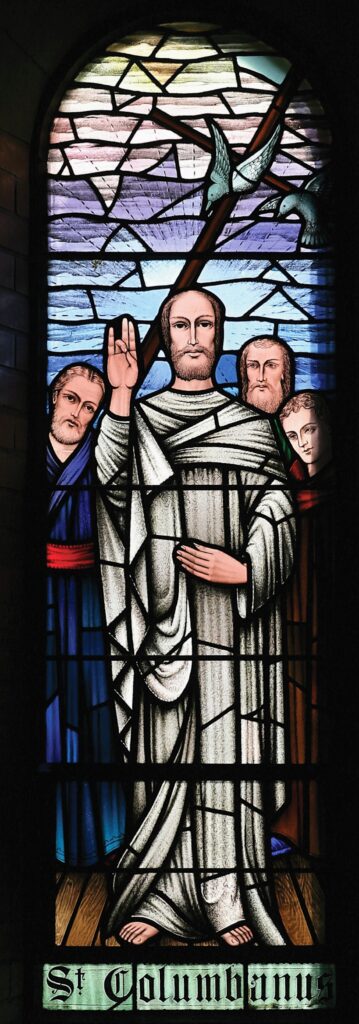
Around AD 590, somewhere along the east coast of Ireland, St Columbanus was waiting to go into exile. On reaching Burgundy—one of the kingdoms of Merovingian Gaul—he would found a series of monasteries to which people would flock. Eventually falling foul of the king, he travelled through France and Germany to Switzerland, where the hermitage of one of his fellow monks gave rise to the city of St Gallen. In 2025, Irish-related manuscripts from that city’s Abbey Library were displayed at the National Museum of Ireland’s Words on the Wave exhibition, which surveyed the cultural contribution of the generations of Irish monks who followed in Columbanus’s wake.
Columbanus himself eventually crossed the Alps into Italy. He died in 615 at Bobbio, where another great monastic library emerged. Further north, the numerous monasteries inspired by his foundations became spiritual powerhouses of Charlemagne’s empire (albeit under Benedictine rule). Columbanus’s approach to penance influenced how Christians across Europe atoned for their sins until the Reformation. The scriptorium at Corbie Abbey in France, a daughter house of his monastery at Luxeuil, developed the Carolingian minuscule script that shaped the look of the lower-case letters you are reading right now. But what was the embarkation point for the sea voyage with which it all began?
SEAFARING MONKS
Jonas of Bobbio, who wrote an influential Life of Columbanus, became a monk at the saint’s final foundation in 618. It seems reasonable to assume that he knew people who had travelled with Columbanus on the boat from Ireland. His brief account of the voyage, vividly conveyed in the historic present tense, has been translated as follows:
‘Columbanus … sets out on his journey and under the guidance of Christ makes for the seashore with twelve companions. There they wait on the mercies of the Almighty, to see if the intended plan, if it is in accordance with His wishes, might succeed. Knowing that the spirit of the all-merciful Judge was with them, they embark in a boat and set out through the straits into the uncertain sea-lanes and the calm high seas. With fair winds blowing, they quickly reach inlets on the coast of Brittany.’
Columbanus probably lacked a map (for which there was no word in Old Irish), but conceivably he had read about Ireland’s geographical setting in a history of the world by Orosius. Written in North Africa in the early fifth century, that work was known to the clerical scholar Gildas in sixth-century Britain. Copies (or quotations) could easily have reached Ireland by the time Columbanus embarked. Jonas almost certainly had access to the text: a copy which is now in Milan was created at Bobbio in the early seventh century. According to Orosius, Ireland was an island in the ocean that encircled the world, situated ‘opposite the Gauls’. It belonged to, but was on the boundary of, ‘all of Europe’ (totius Europae), a phrase employed by Columbanus in letters to Pope Gregory I and Pope Boniface IV.
On modern maps, Columbanus is invariably depicted as departing by sea from Bangor, Co. Down, where he had belonged to St Comgall’s austere monastery for perhaps twenty years. As popularly imagined, Columbanus and his companions rowed out of Belfast Lough aboard a currach. That image owes much to stories of Brendan the Navigator venturing out into the Atlantic. Despite hailing from Munster, Brendan even has a church named after him on the shore of Belfast Lough. St Brendan’s at Sydenham was the childhood church of playwright Stewart Parker, whose play Pratt’s Fall recalls Brendan in his currach. ‘No map, no compass, in a shell of stretched cowhide’, says a character. ‘The boat you can maybe reconstruct … but not the state of being. Not the unconditional surrender to God’s will. Not the wild surge of faith. Or the rapture of it, the blind leap into the dark. That class of a voyage is no longer in the sea’s gift.’
LETTERS AND POTTERY
Columbanus saw the sea in a different light from Brendan, though. In a letter he described himself as a fearful sailor. Another letter makes clear his sense of affinity with the Old Testament prophet Jonah, not just because their names both meant ‘dove’ but also because Jonah had been cast into the sea. ‘Pray that someone may take the place of the whale to bring me back’, he wrote. In short, Columbanus never captained a currach. That the monks were waiting to see how their plan might unfold suggests that they did not even possess a boat.
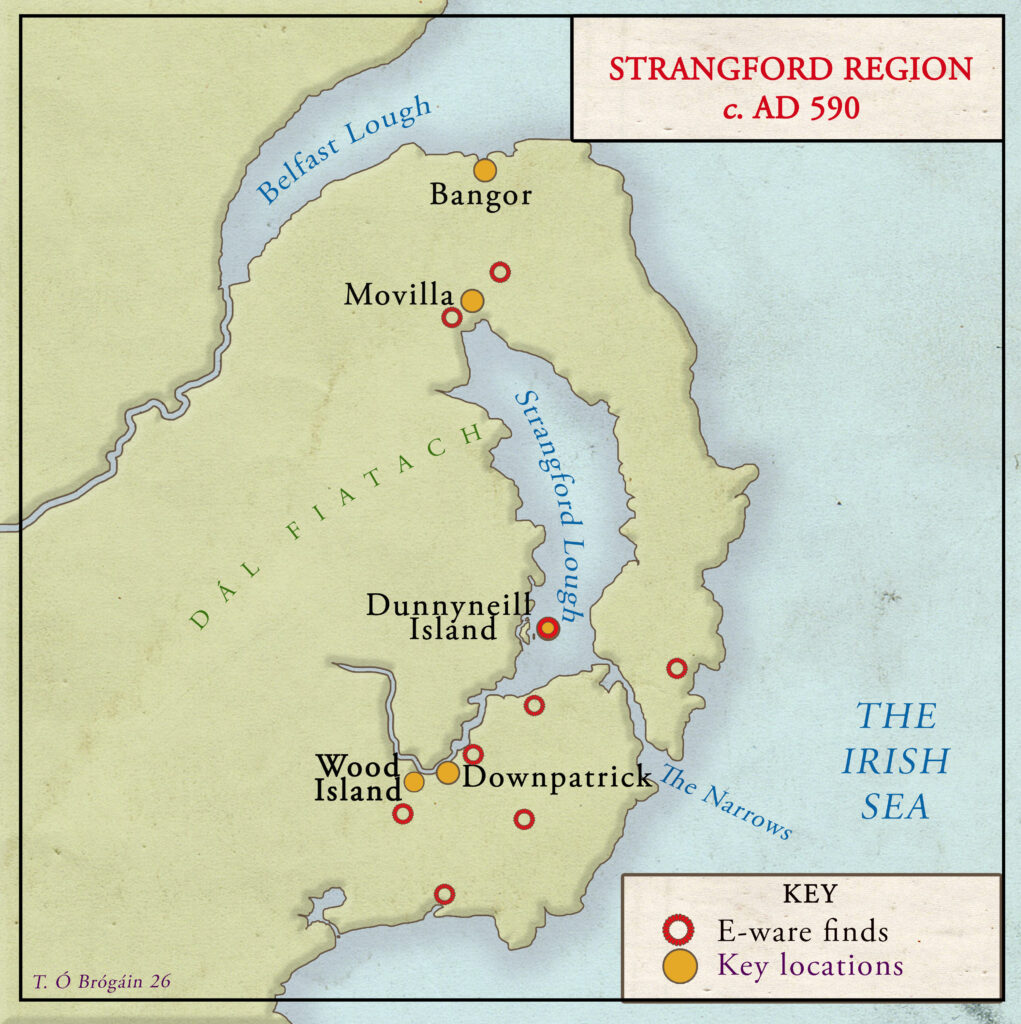
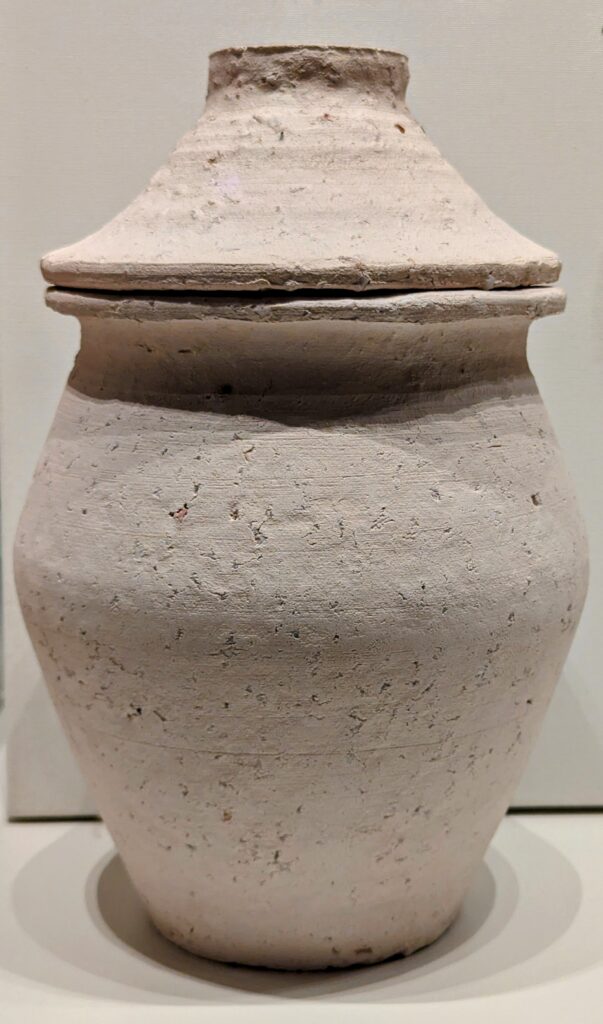
A rendezvous with merchant sailors seems much more likely. Twenty years later, when Columbanus was expelled from Burgundy, the vessel that was supposed to ferry him back to Ireland from Nantes was operating as a trade ship on that route. Maritime trade between Gaul and Ireland in this period is also evidenced by sherds which archaeologists have unearthed of a coarse kitchenware known as ‘E-ware’. Its point of origin has long proved elusive, but recent research points to the Bordeaux region. However, those same finds of E-ware challenge the idea that Columbanus sailed from Bangor. The distribution of the sherds is clustered around Downpatrick, revealing that Gaulish merchants were accessing the north-east of Ireland via Strangford Lough, not Belfast Lough.
THE DÁL FIATACH
Traders were drawn to Strangford Lough by the relative wealth of the Dál Fiatach, the rulers of the Ulaid or Ulster people, whose royal capital was at Dún Lethglaisse (Downpatrick). A narrow strait, 8km long, allowed the traders to sail from the Irish Sea into the lough. Now known as the Narrows, that strait was named Strangford by the Vikings on account of its strong currents. The name was extended to the lough as a whole from the seventeenth century, but the lough’s earlier Irish name of Loch Cuan—‘lough of the harbours’—indicates its attractiveness to early medieval sailors.
The Gaulish vessels have left no archaeological remains, but they must have had a shallow draught in order to be beached at locations such as Dunnyneill Island, which has no natural harbour. This island seems to have served as a summertime emporium for foreigners who wished to trade with the Dál Fiatach, whose own ships dominated the northern Irish Sea. Other landing-places at monasteries and churches around the lough enabled the delivery of commodities such as communion wine. Until the mid-eighteenth century the lough stretched to the west of Downpatrick, forming additional islands from the drumlins. Wood Island, now part of Hollymount Forest, may correspond to the island called ‘Crannach Dúin Lethglaisse’, with which Mo-Sinu, the likely teacher of Columbanus, was connected. If he was educated here (rather than on Cleenish Island in Fermanagh, as usually claimed), then Columbanus was familiar with Gaulish traders from his youth.
FINNIAN OF MOVILLA
Situated on high ground at the head of Strangford Lough, the monastery of Movilla was founded by St Finnian in the mid-sixth century, a decade or two before Comgall founded Bangor. With his appetite for books, Columbanus would have been no stranger to Movilla’s library, which can be pictured as a collection of manuscripts in leather satchels hanging from pegs. Columbanus was of the firm opinion that libraries should lend to each other. The two-hour walk from Bangor to Movilla would have involved crossing from the principal church of the Dál nAraidi to the principal church of the Dál Fiatach, but ecclesiastics (like poets) were able to roam beyond the bounds of any one kingdom.
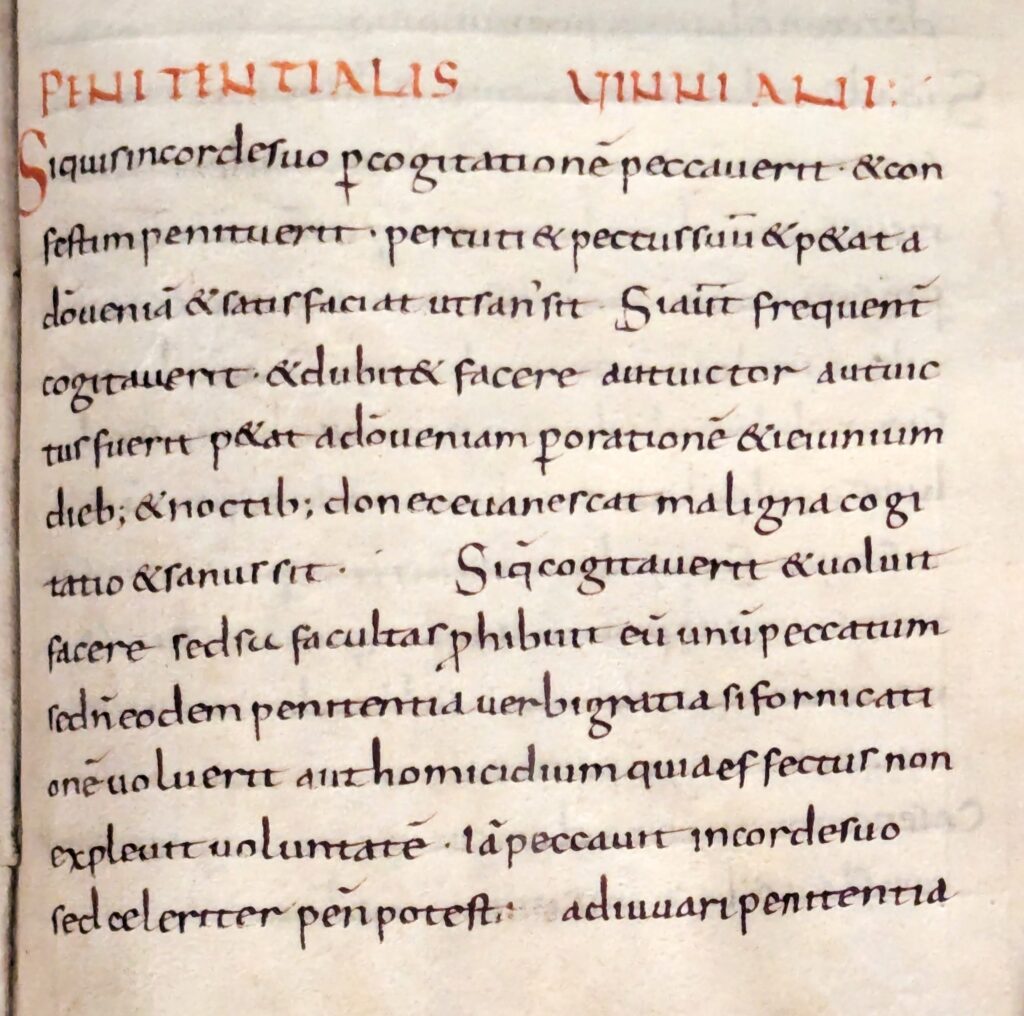
Columbanus had already left the kingdom of his birth in Leinster. Permanently leaving home was a spiritual exercise, and those peregrini who went into exile beyond Ireland itself were considered particularly ascetic. St Columba, for example, who was reputedly a pupil of Finnian at Movilla, left Ireland for Iona in 563. That island was still part of the Irish kingdom of Dál Riata, though. The voyage of Columbanus launched a farther-reaching pilgrimage. It also constitutes the earliest known export of books from the ‘island of saints and scholars’. Among the manuscripts on board the boat was a copy of the Penitential of Finnian, the oldest book in the Latin West to codify detailed tariffs (such as periods of fasting) to atone for specific sins. Finnian had died in 579 but it was probably at Movilla that Columbanus copied his work. Movilla is also where Columbanus could have gained access to correspondence (which he later quoted) between Finnian and the aforementioned Gildas.
LATIN TERMS
On the basis that Columbanus embarked at Movilla rather than Bangor, odd details in Jonas’s account of the voyage begin to make sense. Jonas evokes a setting that did not open directly onto the sea: the monks ‘set out through the straits [freta] into the uncertain [dubias] sea-lanes [vias] and the calm high seas’. Belfast Lough does open east of Bangor onto the North Channel, which is technically a strait joining the Irish Sea to the North Atlantic, but it is nearly 40km across at that point and the monks would have had no sense of proceeding through a strait.
The strait connecting Strangford to the Irish Sea, on the other hand, is less than 1km wide. Muirchú’s seventh-century Life of St Patrick, preserved in the Book of Armagh (as well as in several Continental manuscripts), similarly refers to that stretch of water as a fretum when describing Patrick entering the territory of the Ulaid. Jonas’s Latin also points to a sharp contrast between an early stage of the voyage—dubias can mean dangerous—and the calmness of the high seas beyond. Navigating the ways of the Narrows, where the tide runs at up to 4m per second, has troubled Vikings and modern sailors alike. As one skipper told the author, they ‘can be hellish in a southerly, and the transition into the Irish Sea can be a blessed relief. I have had solid water over the decks going through the overfalls as you exit the Narrows … and that was only twelve knots of southerly!’
A NEW BEGINNING
The monks apparently got off to a precarious start that seared itself into their memories. This was not a blind leap into the dark, though. His ‘intended plan’, which may have entailed negotiations with the Dál Fiatach hierarchy, had brought Columbanus to the nearest place to Bangor that afforded direct passage to continental Europe. The notion that the monks boarded a currach and rowed out to sea from Bangor can be discarded. Instead, on the shore below Movilla, where a tidal creek served as the monastery’s landing-place, Columbanus and his companions were awaiting the arrival of the Gauls on the incoming tide.
Andrew Totten is an Honorary Research Fellow of Durham University and a canon of St Patrick’s Cathedral, Armagh.
Further reading
T.M. Charles-Edwards, Early Christian Ireland (Cambridge, 2000).
R. Flechner & S. Meeder (eds), The Irish in medieval Europe: identity, culture and religion (London, 2016).
T. McErlean, R. McConkey & W. Forsythe (eds), Strangford Lough: an archaeological survey of the maritime cultural landscape (Belfast, 2002).
A. O’Hara (ed.), Columbanus and the peoples of post-Roman Europe (New York, 2018).