
By Brian Casey
Drinking at the wake of a dead person is a long-standing custom at Irish funerals. This is often about sharing memories of the deceased person and to help with the grieving process. Occasionally, however, extreme drunkenness at funerals in Glasnevin led to violence and assaults on cemetery staff. Two in particular were covered in the pages of the Freeman’s Journal and the minute-books of the Dublin Cemeteries Committee.
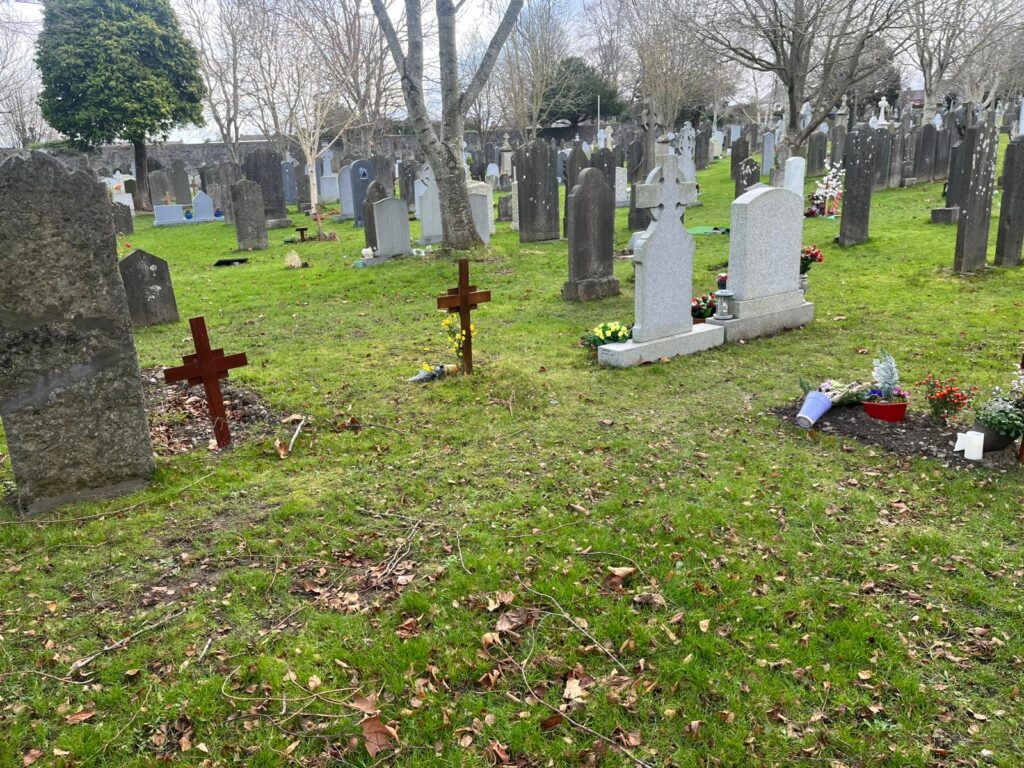
On 30 October 1835 the Freeman’s Journal reported that a man was charged with ‘riotously assembling in the company of others’ on Sunday 20 September 1835 at Prospect Cemetery. He was charged with assault and endangering the life of the cemetery sexton, William Walker. Walker said that he had been at the gate of the cemetery lodge at six o’clock in the evening when ‘a man came to light his pipe inside and stood behind me; I was suddenly attacked by several from the outside; they knocked me down and beat me till someone cried out: “Don’t murder him in consecrated ground”.’ They continued beating him until the priest conducting the funeral of William Adams of Constitution Hill, Fr Kelly, intervened. A witness, William Cole Harte, testified that he knew Walker as a friend and witnessed him being beaten by a large number of men: ‘I saw the prisoner strike him several times with his hand’. Harte managed, with great difficulty, to eventually drag Walker to safety. He stated that he had never seen the prisoner previously and that there were 200 people assembled when the riot kicked off. When further pressed as to his certainty regarding the identity of the assailant, Harte said that he was wearing a blue body coat when he attacked Walker. One witness saw him in a pub on Constitution Hill and another saw him walking along the North Circular Road at 4.30pm carrying a child on his back, which was verified by another witness.
Records for the cemetery show that eighteen people were buried that day in the cemetery. One, James Davies, was buried in the same area as William Adams. While it is unclear whether these funerals overlapped, Margaret Drake, a witness, said: ‘I think there was another funeral before us; a riot had begun before we arrived there’. After several minutes’ deliberation by the jury, the prisoner was found guilty of riot and assault.
In May 1836 the Freeman’s Journal carried another report of a riot in the cemetery, involving six people attending the funeral of Thomas Maguire from Stillorgan. Walker stated that ‘the prisoners had accompanied a funeral to Glasnevin from the neighbourhood of Stillorgan and that while within the walls of the cemetery, a desperate row had arisen amongst themselves, which they proceeded to settle in a very tumultuous and riotous manner’. Concerned that they would damage various monuments, he sent for the constabulary to have them removed. The constable who arrived twice tried to arrest the ringleaders, who managed to break free. With the assistance of reinforcements, he eventually took them into custody. A stone thrown hit a constable’s pistol, causing it to go off, though no one was injured.
In the aftermath of the first case, the minutes of the Dublin Cemeteries Committee stated that interments would no longer take place after 3pm, and instructions were issued that the gates at Prospect Square (beside the ‘Gravediggers’ pub) were to be locked at that time. These two incidents are examples of how the drunken behaviour of mourners in Glasnevin Cemetery occasionally ended in violence and they are part of the wider historical tapestry of the cemetery.
Brian Casey is Archives Manager, Dublin Cemeteries Trust, Glasnevin.