
By Brian Casey
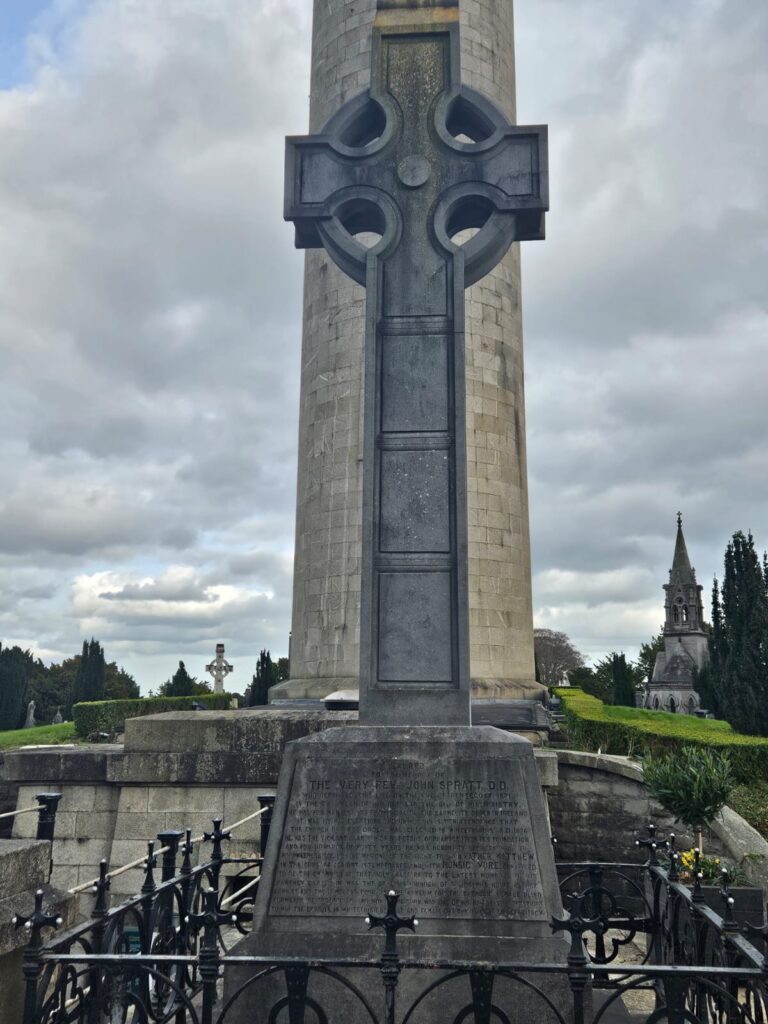
The Dublin Cemeteries Committee had been concerned about the rowdy behaviour of mourners at Glasnevin Cemetery since its first opening in 1832. In January 1852 it decided to close the cemetery gates daily at noon to reduce the risk of violence. This led to the establishment of the short-lived but vocal ‘Anti-Early Burials Committee’, whose members came from the Amalgamated Tontine, Friendly, Benevolent and Temperance Society.
This group was led by a Carmelite priest, Revd Dr John Spratt, known for a variety of charitable endeavours across Dublin, including in the temperance movement. Spratt said that the decision to shut the gates of the cemetery at noon every day was an arbitrary decision. He argued that the working classes ‘could not entertain the proposition of abandoning the cemetery of which they are so justly proud and where lies deposited the remains of 120,000 of our ancestors, wives and children, as also our dearest patriots and revered Liberator’. He argued that funerals held in the morning were detrimental to the financial well-being of Dublin’s working classes, who tended to hold their funerals between 2pm and 4pm. He was concerned that certain employers would not let them arrive in the afternoon after attending a morning funeral, meaning that they risked losing a day’s pay. Since the funerals of wealthy Dublin people tended to be held in the morning and as they were more lucrative for funeral directors, Spratt and the committee feared that working-class funerals would then be neglected or rushed; he was further incensed by the suggestion of the opening of wake-houses where funerals could be held, instead of in overcrowded tenements.
On 13 February 1852 the Freeman’s Journal carried further overly excited comments from the Anti-Early Burials Committee; they stated that they had ‘only been a few days in existence’ and attendance at meetings showed that there was much merit in their work. They called the Dublin Cemeteries Committee ‘worse than the autocrats of the eighteenth century to abuse this solemn and sacred right, the right of sepulchre’.
On 15 February 1852, Catholic clergy wrote a letter to the Freeman’s Journal calling for this rule to be relaxed because Glasnevin Cemetery ran the risk of ‘being a select depository which might render it more prized’ by one class. They proposed changing the opening hours depending on the season, seeking a compromise to the severely curtailed hours being insisted upon by the Committee.
The Dublin Cemeteries Committee was a formidable foe for the Dublin working classes to confront, and Fr Spratt said that they needed to ‘invoke the spirit of our entombed ancestors to inspire us’. This ‘obnoxious’ regulation was seen by some as restricting who could be buried at Glasnevin. This was despite the reassurance of two Dublin Cemeteries Committee members, Maurice O’Connell and Christopher Fitzsimons, respectively the son and son-in-law of Daniel O’Connell, that this was not the case as they stressed their opposition to the regulations.
The tension from this issue was short-lived but saw the threat of the establishment of a new cemetery to protest against the implementation of these rules. The members of the Dublin Cemeteries Committee were not unanimous in their decision to close the cemetery early. One member, Alderman John Reynolds, stated that he wanted to rescind his initial support for the early closure. By July 1852 a resolution had been passed to keep the cemetery gates open until dusk and it appears that this was the end of the matter.
Fr Spratt died in 1871 and is buried near Daniel O’Connell. He was successful in highlighting how this change had been made primarily for the convenience of cemetery management.
Brian Casey is Archives Manager, Dublin Cemeteries Trust, Glasnevin.