
By Daragh Fitzgerald
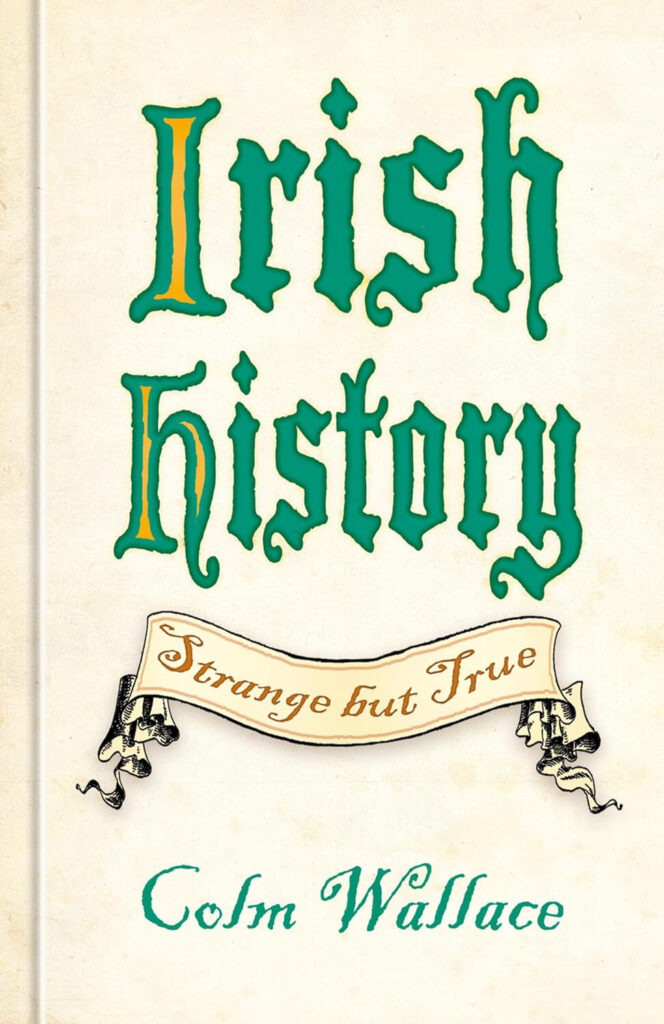
Irish history: strange but true is concerned with all that is unusual and weird in Irish history, like St Patrick’s triumph over Caoránach, an oilliphéist condemned to the bottom of Lough Derg. These water-snakes appear regularly in Irish folklore and could cause significant flooding and other natural disasters. These were not simply tales for the fireside, however. In 1871 in Kilkee, Co. Clare, several locals claimed to have seen a sea monster sunning itself by the shore. In May 1960 three priests fishing in Lough Ree also reported seeing a 6ft-long sea serpent.
One of the more miraculous episodes of Irish history is covered in Captain Francisco de Cuéllar: the Armada, Ireland, and the wars of the Spanish monarchy, 1578–1606. De Cuéllar was part of the 1588 Spanish Armada and was shipwrecked near Sligo that September. He survived the rough seas and the rougher welcome that many Spaniards received upon reaching Irish shores, and he lived amongst the native Irish across the north-west for seven months, writing a remarkable account of his experiences. De Cuéllar had an eventful swashbuckling career in the pay of the Spanish monarchy before and after his arrival in Ireland, which is related in detail for the first time in this book.
Wicklow was also the landing-point of many famous visitors to our shores. According to Chris Lalor’s The little history of Wicklow, there is evidence of settlement in the region over five millennia before Christ, whose message was first brought to Ireland not by St Patrick but by his predecessor, Palladius. Sent by Pope Celestine to be Ireland’s first bishop, Palladius apparently landed in Wicklow in 431 and founded the church known as Teach na Romain at a site in the Vale of Avoca. Patrick himself is believed to have landed in Ireland somewhere in the Garden County, with Bray, Arklow and Wicklow town all claiming that distinction. Skipping forward, Wicklow gave Ireland stalwarts like Michael Dwyer, Charles Stewart Parnell, Robert Barton and Erskine Childers.
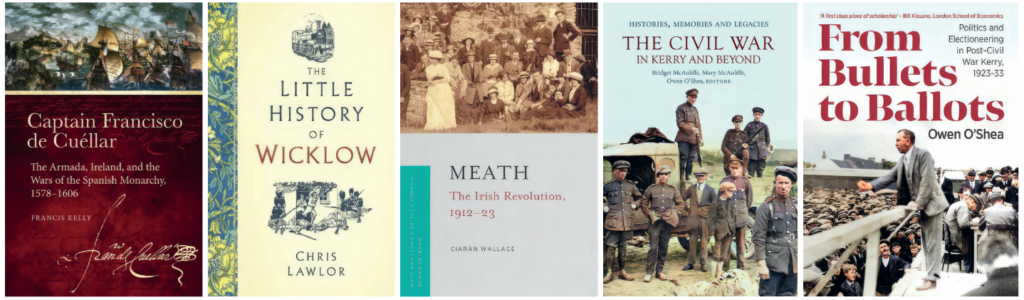
Ciarán Wallace’s Meath: the Irish revolution, 1912–23, the eighteenth such county study published on the revolutionary period, documents how the Royal County experienced the fluctuations of the day. The mooted partition of Ireland would have rendered Meath a border county if Northern Ireland had included all nine counties of Ulster. Thirteen Meath men signed the Ulster Solemn League and Covenant, while the county had its own detachment of the Ulster Volunteer Force. However, many prominent unionists who might have been expected to sign the pledge, including the Marquess of Headfort, did not, perhaps indicative of southern unionists’ concerns regarding a potential partition. The Irish Volunteers had much more success in the county, with 58 Volunteer companies spread across Meath by the summer of 1914. Following the Volunteer split, most Meath men remained loyal to Redmond but did not answer his call to enlist in the British Army, a pattern common across Volunteer companies nationally. Nevertheless, over 500 men from Meath were killed in the war, some as young as sixteen, the eldest being 65. Indeed, during Easter Week more Meath natives died on the Western Front than in Dublin or in Ashbourne. The county lost three men during the Rising, ironically enough all killed in Dublin, while the two Volunteers who were killed in the battle of Ashbourne were themselves Dubliners.
The Civil War in Kerry and beyond: histories, memories and legacies is a collection of essays reflecting on the most bitter and controversial phase of the Irish Civil War. Contributors include Liz Gillis, Richard McElligot, Fionnula Walsh and Mary McAuliffe, who co-edited the collection with Bridget McAuliffe and Owen O’Shea. Fresh from the Irish Civil War Fatalities Project, John Dorney’s chapter details the patterns of violence in the Kingdom. Between the ‘official’ start and end dates of the Civil War 185 individuals were killed in Kerry, a figure that rises to 200 if those who died from wounds or imprisonment after these dates are included. These figures place Kerry third on the county ‘league table’ behind Dublin and Cork, but Kerry is first by some distance per head of population. It was the site of the most savage reprisals during the Civil War, and the war was distinctive in Kerry as it was experienced as an invasion from outside. Ambitious amphibious landings by Free State forces brought the war to Kerry, and while the National Army battalions garrisoning the county contained substantial numbers of locals, the bulk of the troops originated from Dublin, Clare and Galway. Kerry natives were twice as likely to die in the uniform of the IRA than in that of the National Army. Over half of the Kerry anti-Treaty dead were killed while prisoners of the Free State, lending credence to the anti-Treaty perception that they were subject to a campaign of murder.
From bullets to ballots: politics and electioneering in post-Civil War Kerry, 1923–33 documents how politics in Kerry developed in the immediate aftermath of this horrific period. While ‘Civil War politics’ is often said to have dominated Irish politics since the conflict, the usefulness of this label is questioned by author Owen O’Shea, as it may obscure issues of concern for voters that were totally unrelated to the Civil War. The specifics of the conflict, like the atrocity at Ballyseedy, were not used for electoral gain by anti-Treaty candidates in this period, perhaps as it was too raw and would appear crass, while Cumann na nGaedheal activists similarly refrained from referencing IRA attacks in their own campaigning. In the August 1923 election a third of the electorate voted for Cumann na nGaedheal and about half for republicans, while Labour and the Farmers Party both received significant support, illustrating that the Treaty and the subsequent Civil War were not the most pressing issues for many in the county. Fianna Fáil later consolidated the republican, labour and disgruntled small farmer vote and achieved close to 70% of the vote in 1933. (For more on this topic see the author’s article on pp 42–4 of this issue.) What is most significant about all this is that democracy endured in Kerry and the Free State despite acrimonious fratricide and polarisation, while it fell by the wayside across much of Europe.
Next year will be a good one: life with Sean O’Casey, my family and theatre is the memoir of Shivaun O’Casey, Seán’s daughter, who was a respected actress and stage manager in her own right. It was far from Dublin tenements that Shivaun was raised, her earliest memories being her experience of the Blitz in Devon. She had the honour of being the first ‘blackout baby’ born at Torbay Hospital in September 1939 and remembered crouching under the kitchen table with Seán poking his head under, playing ‘peekaboo’. While this is a quaint image, one’s mind turns to the thousands of children living under the horrors of aerial bombardment today.
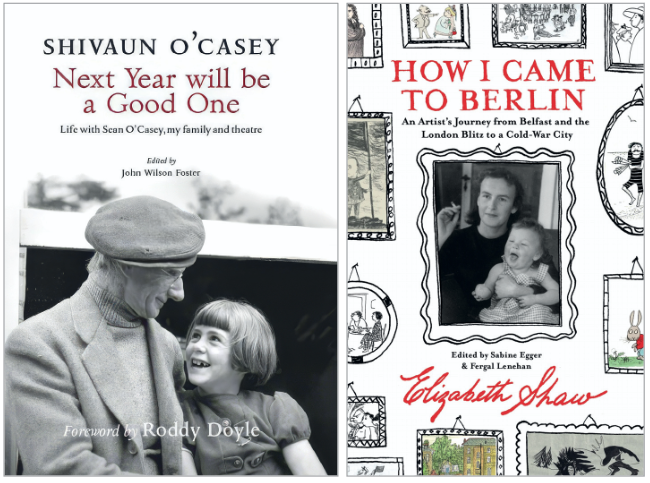
How I came to Berlin: an artist’s journey from Belfast and the London Blitz to a Cold-War city is another memoir by an Irish artist, Elizabeth Shaw, who was a prominent illustrator in the GDR. (See ‘Belfast woman Elizabeth Shaw’s Stasi file’ in HI 32.6, Nov./Dec. 2024, pp 36–8.) In travelling to Berlin, Shaw exchanged one divided city for another as she left her native Belfast, where she was born during the pogrom of 1922. Shaw’s family received a note in their letterbox demanding that they sack their Catholic maid, Bridget, or ‘she would not be the only one to suffer’. One of Elizabeth’s first memories was of being told to wave goodbye to Bridget as she left, only later realising that this public farewell was for the benefit of unseen hostile observers.
Colm Wallace, Irish history: strange but true (History Press, €20 hb, 189pp, ISBN 9781837051359).
Francis Kelly, Captain Francisco de Cuéllar: the Armada, Ireland, and the wars of the Spanish monarchy, 1578–1606 (Four Courts Press, €22.45 pb, 312pp, ISBN 9781801512084).
Chris Lawlor, The little history of Wicklow (History Press, €20 hb, 224pp, ISBN 9781837050970).
Ciarán Wallace, Meath: the Irish revolution, 1912–23 (Four Courts Press, €22.45 pb, 216pp, ISBN 9781801510790).
Bridget McAuliffe, Mary McAuliffe and Owen O’Shea (eds), The Civil War in Kerry and beyond: histories, memories and legacies (Four Courts Press, €22.45 pb, 288pp, ISBN 9781801511803).
Owen O’Shea, From bullets to ballots: politics and electioneering in post-Civil War Kerry, 1923–33 (UCD Press, €30 pb, 175pp, ISBN 9781068502354).
Shivaun O’Casey, Next year will be a good one: life with Sean O’Casey, my family and theatre (Belcouver Press, €23 pb, 428pp, ISBN 9780993560774).
Elizabeth Shaw, How I came to Berlin: an artist’s journey from Belfast and the London Blitz to a Cold-War city (Lilliput Press, €18.95 pb, 226pp, ISBN 9781843519522).